COMPETITIVE GOVERNANCE

  • Haley2024
    • Home
    • FaceBook Pages 1-10 >
      • Competitive School Boards
      • End Welfare: Transition to Competitive Charity
      • Competitive Governance
      • Competitive Representative Agencies
      • 70% Democracy
      • Competitive Police
      • Competitive Military
      • Competitive Social Security
      • From Government to Societal Oversight
      • Competitive Roads
    • Facebook Pages 11-20 >
      • Competitive Currencies
      • Pockets of Freedom
      • Competitive Rating System
      • Competitive Prisons
      • Competitive HealthCare Systems
      • Competitive Family Law
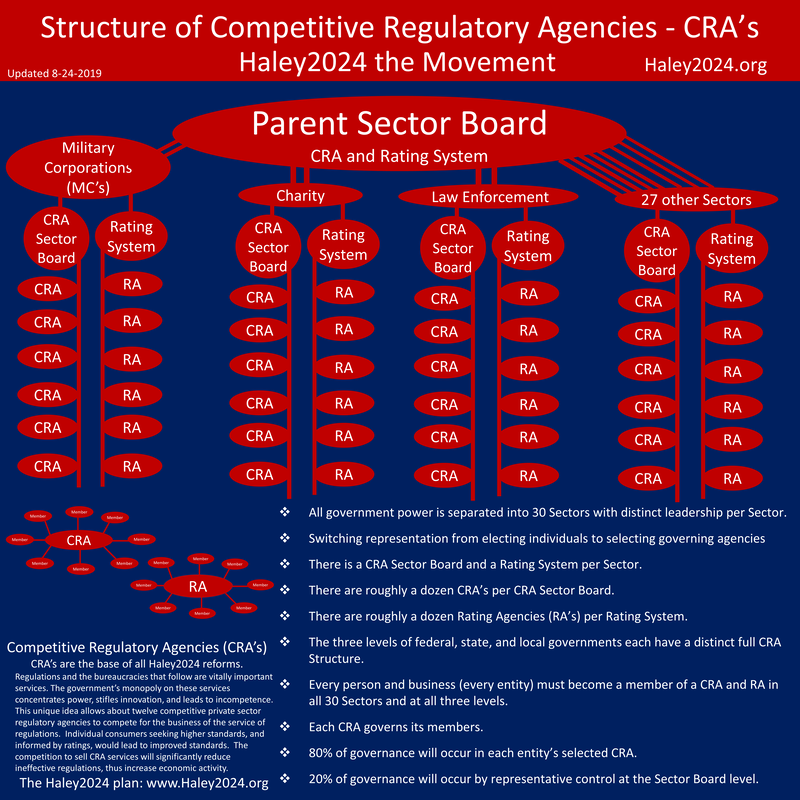
      • Separate Government Authority into 30 Sectors
  • THE CORE
    • All Reforms In Constitutional Form >
      • Constitutional Amendment Creating the CRA Structure
    • Competitive Regulatory Agencies >
      • CRA Structure
      • The 30 Sectors >
        • The Food Sector
        • The Manufacturing Sector
        • The Human Resources and Sales Sector
        • The Identity Sector: Personal and Business
        • The Environmental Sector
        • The Work Safety and Disability Sector
        • The Media and Communications Sector
        • The Land and Water Sector
      • CRA Bullet Points
      • CRA: The Need for a New System
      • Media for CRAs
    • The Rating System >
      • Rating Structure
    • Welfare to Charity >
      • The Charity System
      • The Charity Structure
      • The Charty Sector
      • The Charitable Distribution Association - CDA Sector
      • The Charity Assessor Organization - AO Sector
      • The Family Law Sector
      • The Religious Sector
      • Media for Charity
    • Education >
      • Education Structure
      • Colleges
      • The Public School System Is Unconstitutional
      • Education articles and Videos
    • Structure of the Foreign Policy and Private Military >
      • The Diplomatic Foreign Policy - DFP Sector
      • The Commander in Chief - CIC Sector
      • The Military Corporations Sector
      • The Military Capabilities System MCS Sector
      • The Military Authorization Agency - MAA Sector
    • Social Security and Medicare >
      • The Insurance Sector
    • Roads / Transportation >
      • Media on Road
  • Others
    • Monetary Policy >
      • Financial Sectors 18 and 19
      • Monetary Policy Structure
      • Monetary Policy Media
    • Health Care >
      • Heath Care Media
    • Fighting Federal Control >
      • Governor's Repeal
      • The Supreme Court
      • A New Court System
      • Changing the Head of the Inspectors General
    • Haleynomics >
      • Educational Media and Books
      • Laffer Curve
    • Statism organizations
    • A Citizens Responsibility
  • More
    • Violent Crime Mitigation System >
      • The Violent Crime (VC) Sector
      • Police >
        • Police Structure
      • Law Enforcement Authorization (LEA)
      • The Judicial Authorities Sector
      • Prison and Corrections
    • Corporate Proxy Groups
    • Haley2024 taxes >
      • Taxes
    • Debt
    • Foreign Policy: Pockets of Freedom
  • Blogs
    • Blog on Welfare to Charity
    • Blog on Haleynomics
    • Blog on Monetary Policy
    • Blog on Haley2024 the Movement
    • Blog on issues of the day
    • Blog on Education
    • Blog on Competitive Regulatory Agencies
    • Blog on Health Care
    • Blog on Ratings
    • Blog on EPA
    • Blog on Roads
    • Blog on Pockets of Freedom
    • Blog on Social Security
    • Blog on Military
    • Blog Statism Organizations
    • Blog on Social Issues
  • About the Movement
    • About Bill
    • MY STUDY
    • Social Media
  • Donate
    • Volunteer!

Creating Great Educational Content

11/16/2023


​Creating Great Educational Content.  

By Bill Haley 11-16-2023
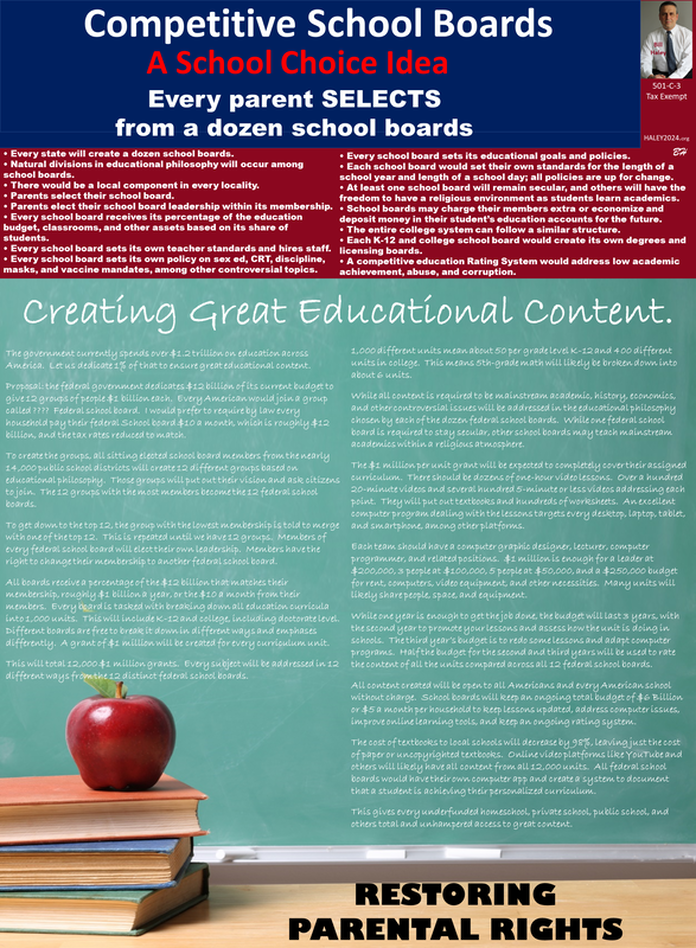
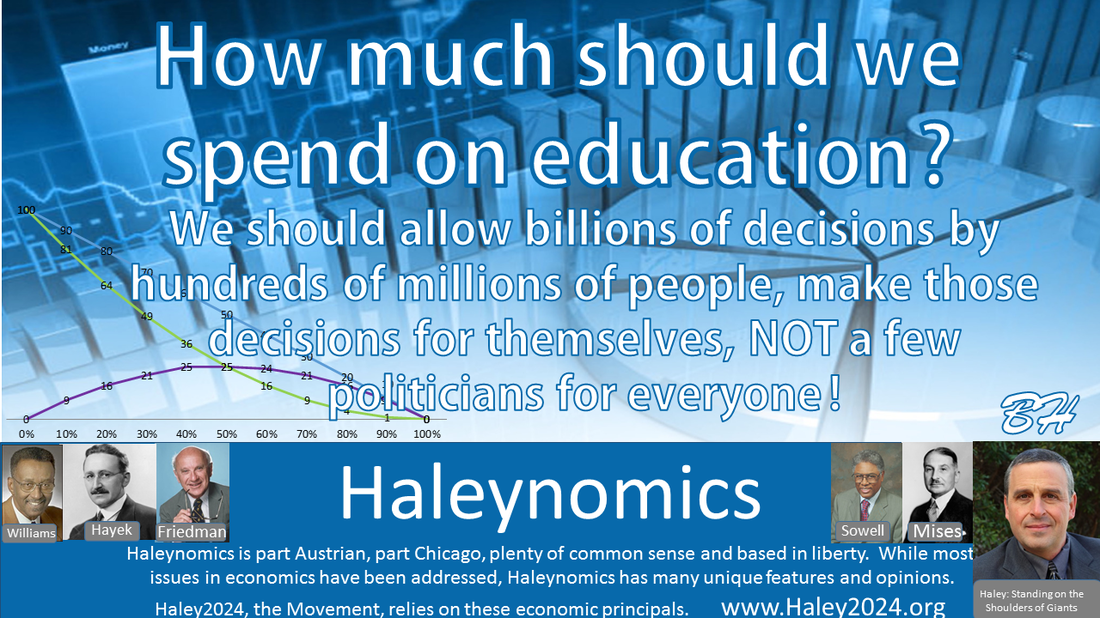
​The government currently spends over $1.2 trillion on education across America.  Let us dedicate 1% of that to ensure great educational content.
​Proposal: the federal government dedicates $12 billion of its current budget to give 12 groups of people $1 billion each.  Every American would join a group called ???? Federal school board.  I would prefer to require by law every household pay their federal School board $10 a month, which is roughly $12 billion, and the tax rates reduced to match.  
Picture
Picture
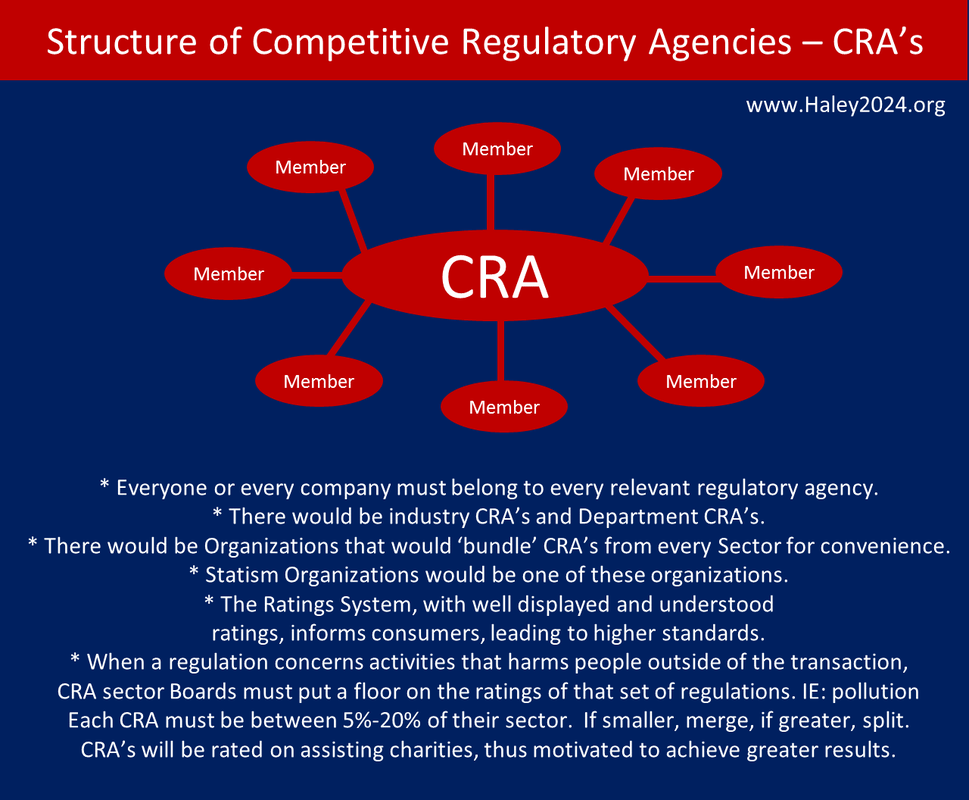
​To create the groups, all sitting elected school board members from the nearly 14,000 public school districts will create 12 different groups based on educational philosophy.  Those groups will put out their vision and ask citizens to join.  The 12 groups with the most members become the 12 federal school boards.  
​To get down to the top 12, the group with the lowest membership is told to merge with one of the top 12.  This is repeated until we have 12 groups.  Members of every federal school board will elect their own leadership.  Members have the right to change their membership to another federal school board.     
​All boards receive a percentage of the $12 billion that matches their membership, roughly $1 billion a year, or the $10 a month from their members.  Every board is tasked with breaking down all education curricula into 1,000 units.  This will include K-12 and college, including doctorate level.  Different boards are free to break it down in different ways and emphases differently.  A grant of $1 million will be created for every curriculum unit.   
This will total 12,000 $1 million grants.  Every subject will be addressed in 12 different ways from the 12 distinct federal school boards. 
​1,000 different units mean about 50 per grade level K-12 and 400 different units in college.  This means 5th-grade math will likely be broken down into about 6 units.  
Picture
Picture
​While all content is required to be mainstream academic, history, economics, and other controversial issues will be addressed in the educational philosophy chosen by each of the dozen federal school boards.  While one federal school board is required to stay secular, other school boards may teach mainstream academics within a religious atmosphere.   
​The $1 million per unit grant will be expected to completely cover their assigned curriculum.  There should be dozens of one-hour video lessons.  Over a hundred 20-minute videos and several hundred 5-minute or less videos addressing each point.  They will put out textbooks and hundreds of worksheets.  An excellent computer program dealing with the lessons targets every desktop, laptop, tablet, and smartphone, among other platforms.   
​Each team should have a computer graphic designer, lecturer, computer programmer, and related positions.  $1 million is enough for a leader at $200,000, 3 people at $100,000, 5 people at $50,000, and a $250,000 budget for rent, computers, video equipment, and other necessities.  Many units will likely share people, space, and equipment.
​While one year is enough to get the job done, the budget will last 3 years, with the second year to promote your lessons and assess how the unit is doing in schools.  The third year’s budget is to redo some lessons and adapt computer programs.  Half the budget for the second and third years will be used to rate the content of all the units compared across all 12 federal school boards.  
Picture
Picture
All content created will be open to all Americans and every American school without charge.  School boards will keep an ongoing total budget of $6 Billion or $5 a month per household to keep lessons updated, address computer issues, improve online learning tools, and keep an ongoing rating system.    
​The cost of textbooks to local schools will decrease by 98%, leaving just the cost of paper or uncopyrighted textbooks.  Online video platforms like YouTube and others will likely have all content from all 12,000 units.  All federal school boards would have their own computer app and create a system to document that a student is achieving their personalized curriculum.  
​
​This gives every underfunded homeschool, private school, public school, and others total and unhampered access to great content. 
Picture

Teaching Creation or Evolution

10/25/2019

 
​Bill Haley, created in 2013.
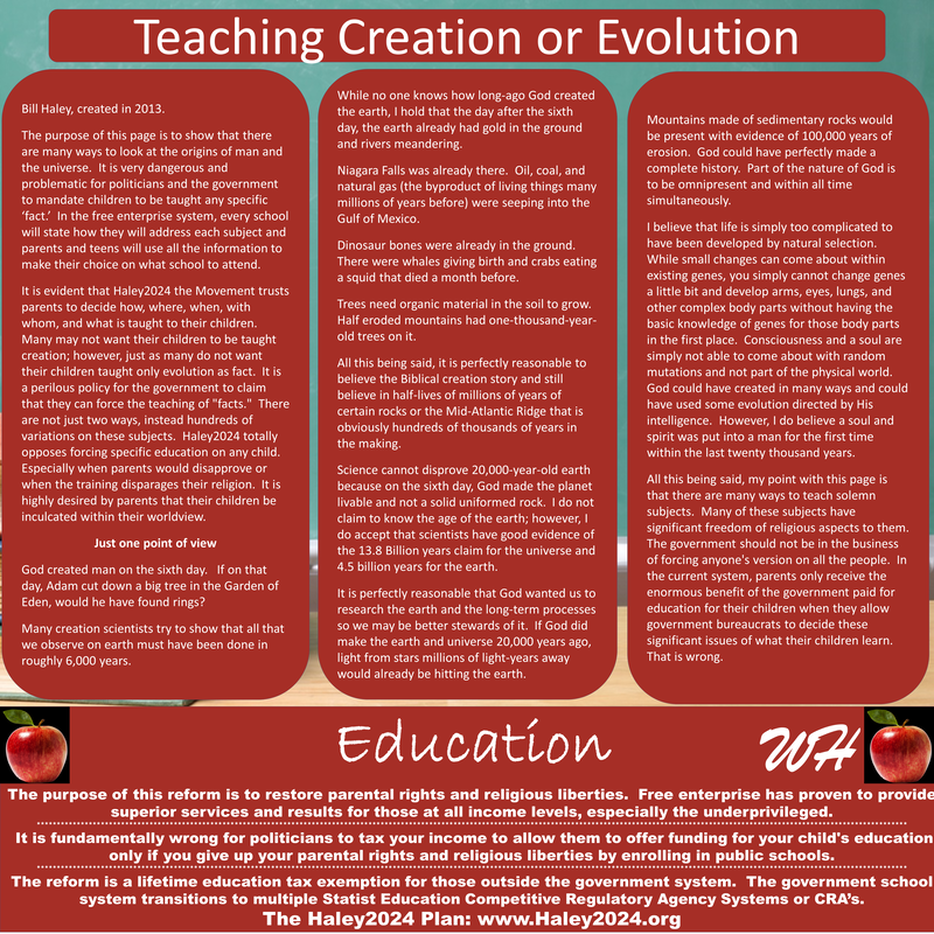
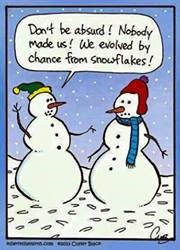
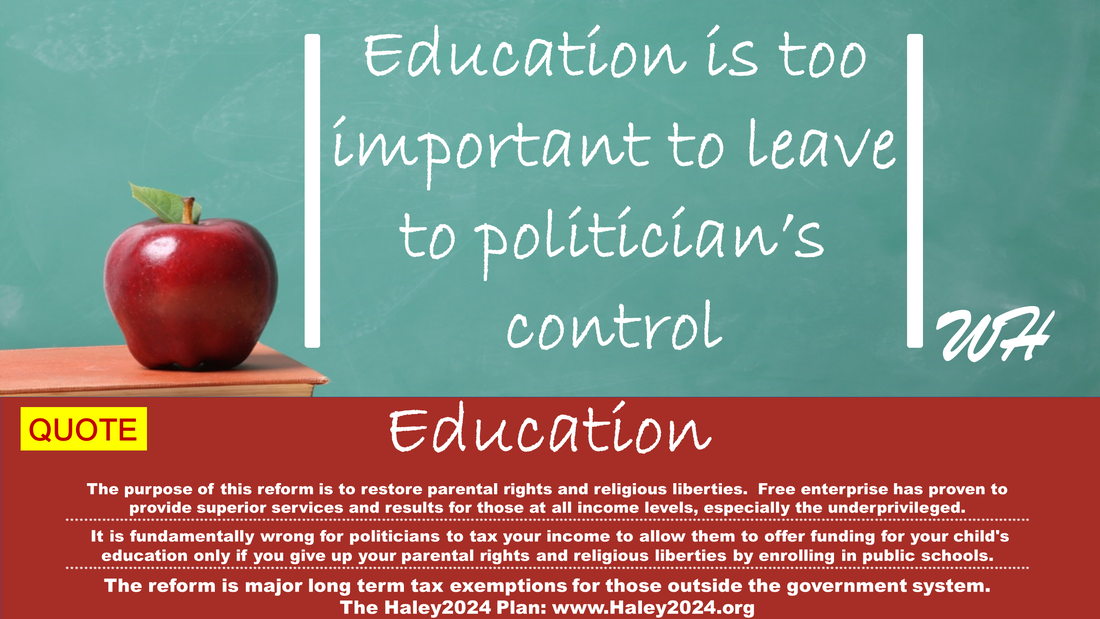
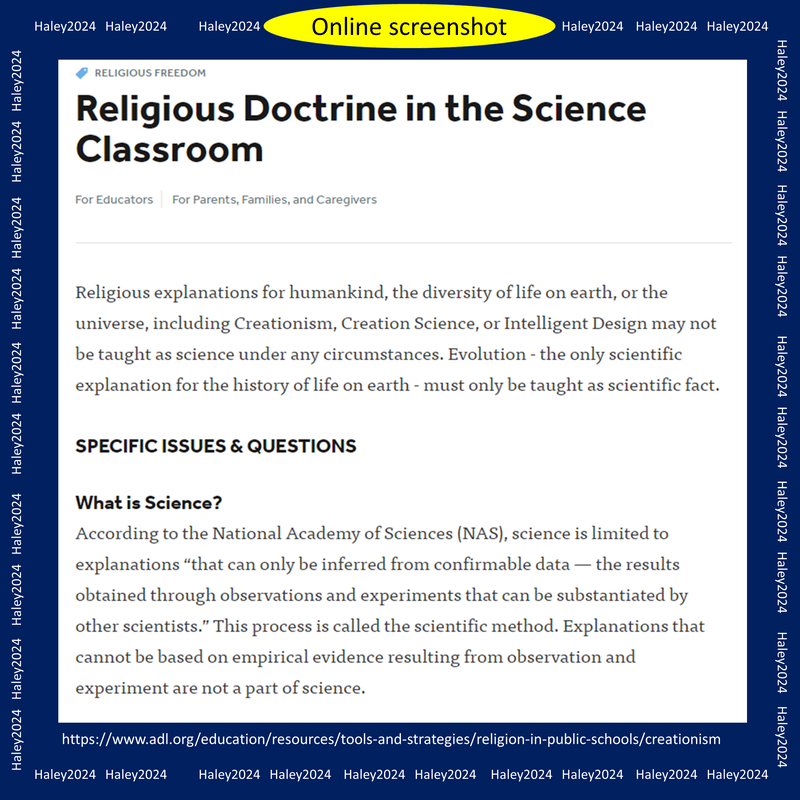
The purpose of this page is to show that there are many ways to look at the origins of man and the universe.  It is very dangerous and problematic for politicians and the government to mandate children to be taught any specific ‘fact.’  In the free enterprise system, every school will state how they will address each subject and parents and teens will use all the information to make their choice on what school to attend.
Picture
Picture
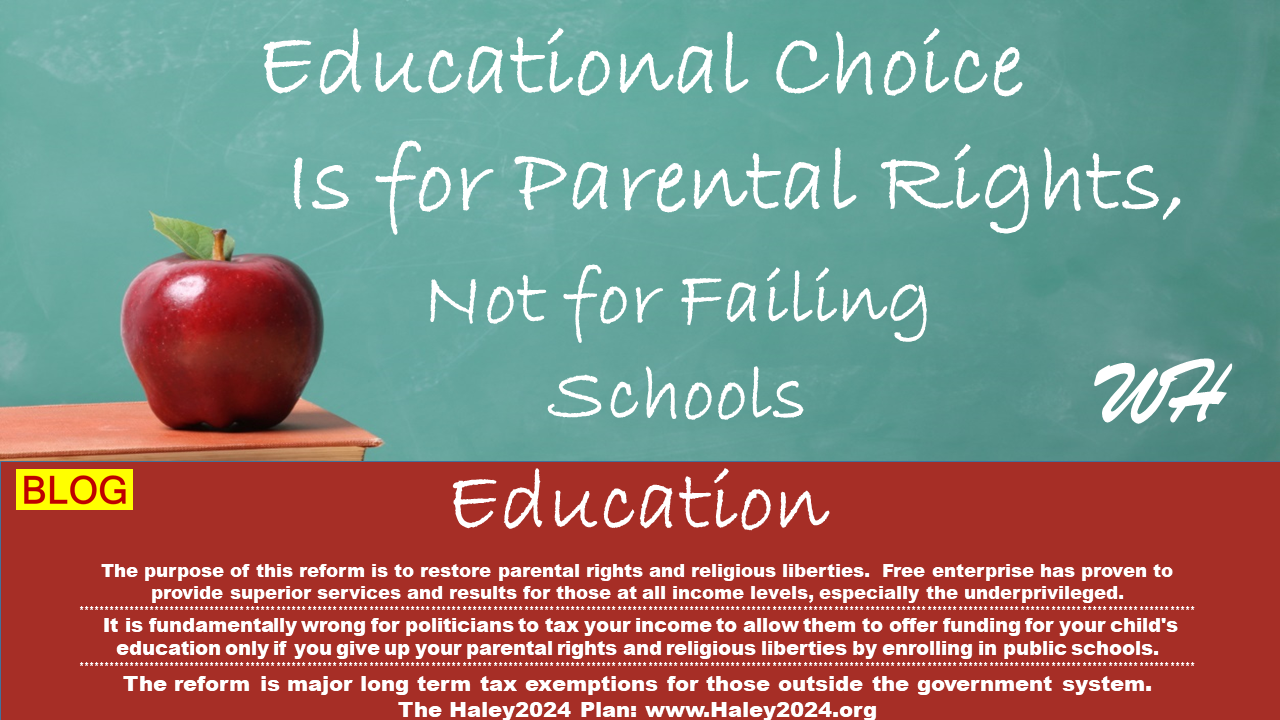
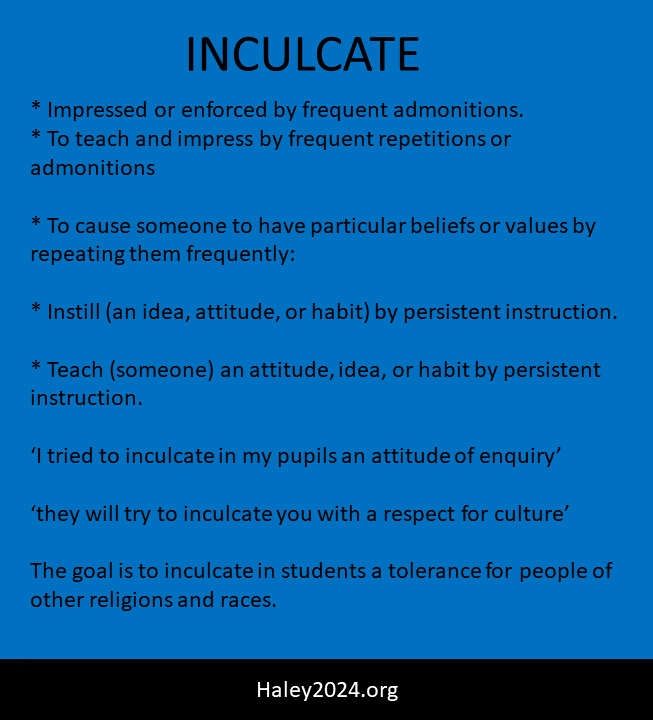
​It is evident that Haley2024 the Movement trusts parents to decide how, where, when, with whom, and what is taught to their children.  Many may not want their children to be taught creation; however, just as many do not want their children taught only evolution as fact.  It is a perilous policy for the government to claim that they can force the teaching of "facts."  There are not just two ways, instead hundreds of variations on these subjects.  Haley2024 totally opposes forcing specific education on any child.  Especially when parents would disapprove or when the training disparages their religion.  It is highly desired by parents that their children be inculcated within their worldview.  

Just one point of view

God created man on the sixth day.   If on that day, Adam cut down a big tree in the Garden of Eden, would he have found rings?   ​

Many creation scientists try to show that all that we observe on earth must have been done in roughly 6,000 years.
​
While no one knows how long ago God created the earth, I hold that the day after the sixth day, the earth already had gold in the ground and rivers meandering. ​
Picture
Picture
Niagara Falls was already there.  Oil, coal, and natural gas (the byproduct of living things many millions of years before) were seeping into the Gulf of Mexico.  ​

Dinosaur bones were already in the ground.  There were whales giving birth and crabs eating a squid that died a month before. ​
​
Trees need organic material in the soil to grow.   Half eroded mountains had one-thousand-year-old trees on it. ​
All this being said, it is perfectly reasonable to believe the Biblical creation story and still believe in half-lives of millions of years of certain rocks or the Mid-Atlantic Ridge that is obviously hundreds of thousands of years in the making. ​
​
Science cannot disprove 20,000-year-old earth because on the sixth day, God made the planet livable and not a solid uniformed rock.  I do not claim to know the age of the earth; however, I do accept that scientists have good evidence of the 13.8 Billion years claim for the universe and 4.5 billion years for the earth. ​
Picture
Picture
​It is perfectly reasonable that God wanted us to research the earth and the long-term processes so we may be better stewards of it. ​ If God did make the earth and universe 20,000 years ago, light from stars millions of light-years away would already be hitting the earth. 
Mountains made of sedimentary rocks would be present with evidence of 100,000 years of erosion.  God could have perfectly made a complete history.  Part of the nature of God is to be omnipresent and within all time simultaneously.    
​I believe that life is simply too complicated to have been developed by natural selection.  While small changes can come about within existing genes, you simply cannot change genes a little bit and develop arms, eyes, lungs, and other complex body parts without having the basic knowledge of genes for those body parts in the first place.  Consciousness and a soul are simply not able to come about with random mutations and not part of the physical world.  God could have created in many ways and could have used some evolution directed by His intelligence.  However, I do believe a soul and spirit was put into a man for the first time within the last twenty thousand years. ​
Picture
Picture
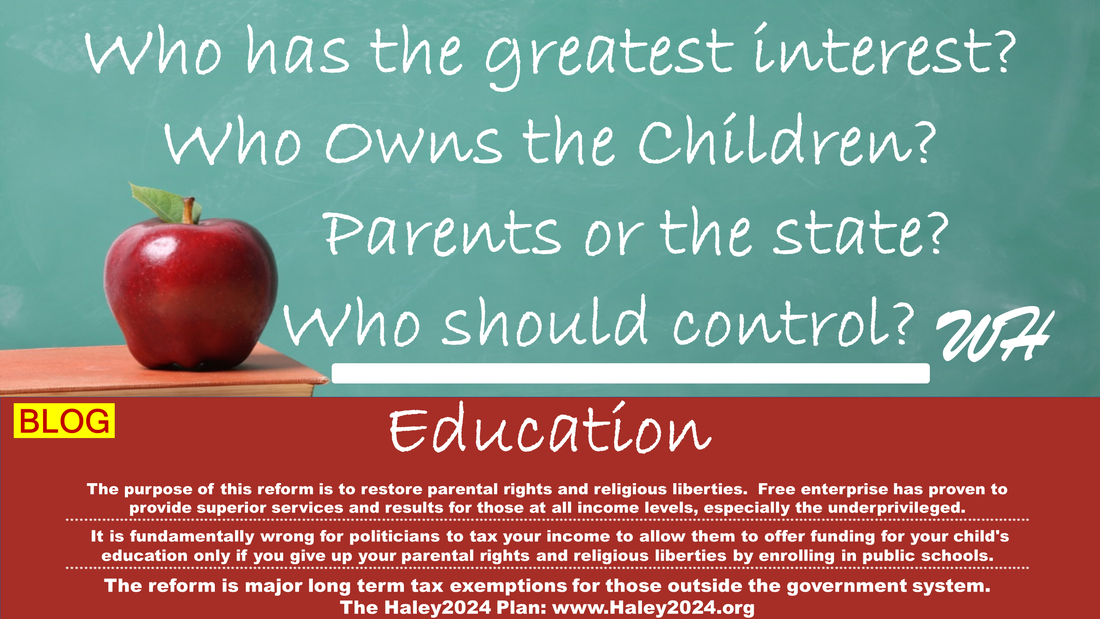
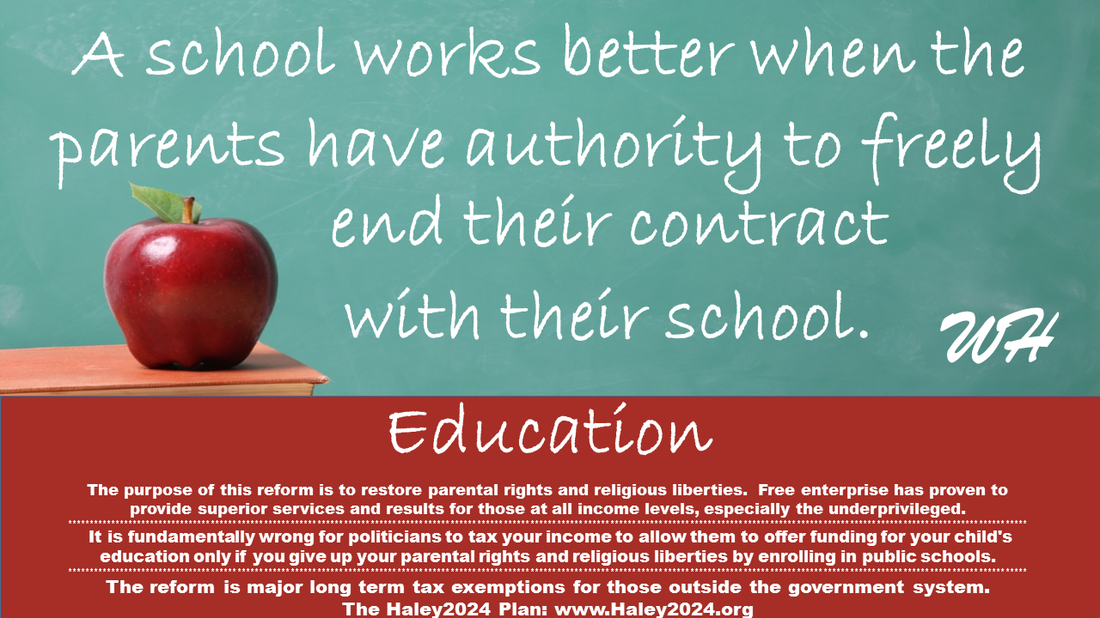
All this being said, my point with this page is that there are many ways to teach solemn subjects.  Many of these subjects have significant freedom of religious aspects to them.  The government should not be in the business of forcing anyone's version on all the people.  In the current system, parents only receive the enormous benefit of the government paid for education for their children when they allow government bureaucrats to decide these significant issues of what their children learn.  That is wrong.  
Picture
Picture
Picture
Picture
Picture
Picture
Picture
Picture
Picture
Picture
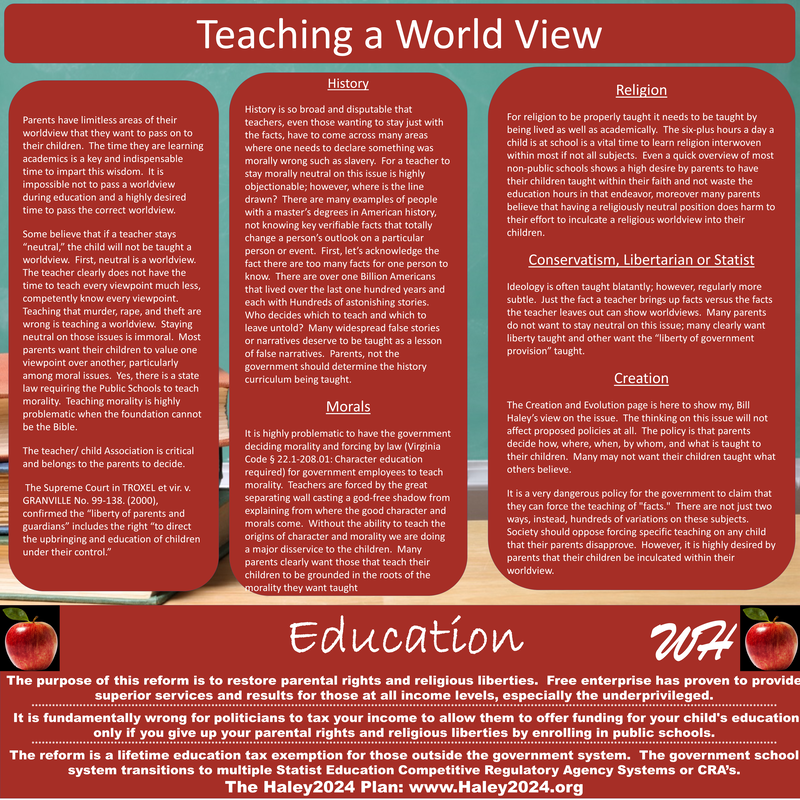
Picture
Picture

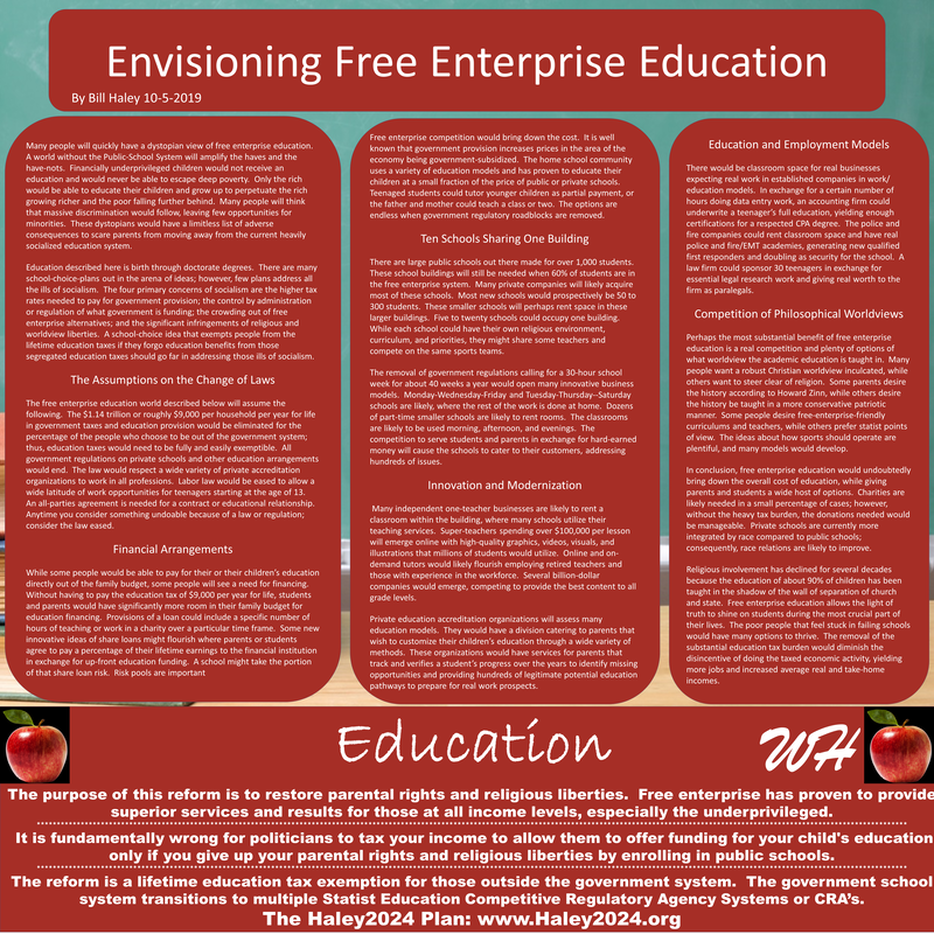
Envisioning Free Enterprise Education

10/5/2019

 
By Bill Haley
​Many people will quickly have a dystopian view of free enterprise education.  A world without the Public-School System will amplify the haves and the have-nots.  Financially underprivileged children would not receive an education and would never be able to escape deep poverty.  Only the rich would be able to educate their children and grow up to perpetuate the rich growing richer and the poor falling further behind.  Many people will think that massive discrimination would follow, leaving few opportunities for minorities.  These dystopians would have a limitless list of adverse consequences to scare parents from moving away from the current heavily socialized education system. 
Picture
Picture
​Education described here is birth through doctorate degrees.  There are many school-choice-plans out in the arena of ideas; however, few plans address all the ills of socialism.  The four primary concerns of socialism are the higher tax rates needed to pay for government provision; the control by administration or regulation of what government is funding; the crowding out of free enterprise alternatives; and the significant infringements of religious and worldview liberties.  A school-choice idea that exempts people from the lifetime education taxes if they forgo education benefits from those segregated education taxes should go far in addressing those ills of socialism.

The Assumptions on the Change of Laws

The free enterprise education world described below will assume the following.  The $1.14 trillion or roughly $9,000 per household per year for life in government taxes and education provision would be eliminated for the percentage of the people who choose to be out of the government system; thus, education taxes would need to be fully and easily exemptible.  All government regulations on private schools and other education arrangements would end.  The law would respect a wide variety of private accreditation organizations to work in all professions.  Labor law would be eased to allow a wide latitude of work opportunities for teenagers starting at the age of 13.  An all-parties agreement is needed for a contract or educational relationship.  Anytime you consider something undoable because of a law or regulation; consider the law eased.         
Picture
Picture

Financial Arrangements

​While some people would be able to pay for their or their children’s education directly out of the family budget, some people will see a need for financing.  Without having to pay the education tax of $9,000 per year for life, students and parents would have significantly more room in their family budget for education financing.  Provisions of a loan could include a specific number of hours of teaching or work in a charity over a particular time frame.  Some new innovative ideas of share loans might flourish where parents or students agree to pay a percentage of their lifetime earnings to the financial institution in exchange for up-front education funding.  A school might take the portion of that share loan risk.  Risk pools are important
Free enterprise competition would bring down the cost.  It is well known that government provision increases prices in the area of the economy being government-subsidized.  The home school community uses a variety of education models and has proven to educate their children at a small fraction of the price of public or private schools.  Teenaged students could tutor younger children as partial payment, or the father and mother could teach a class or two.  The options are endless when government regulatory roadblocks are removed.    
Picture
Picture

Ten Schools Sharing One Building

​There are large public schools out there made for over 1,000 students.  These school buildings will still be needed when 60% of students are in the free enterprise system.  Many private companies will likely acquire most of these schools.  Most new schools would prospectively be 50 to 300 students.  These smaller schools will perhaps rent space in these larger buildings.  Five to twenty schools could occupy one building.  While each school could have their own religious environment, curriculum, and priorities, they might share some teachers and compete on the same sports teams.  
​The removal of government regulations calling for a 30-hour school week for about 40 weeks a year would open many innovative business models.  Monday-Wednesday-Friday and Tuesday-Thursday--Saturday schools are likely, where the rest of the work is done at home.  Dozens of part-time smaller schools are likely to rent rooms.  The classrooms are likely to be used morning, afternoon, and evenings.  The competition to serve students and parents in exchange for hard-earned money will cause the schools to cater to their customers, addressing hundreds of issues. 
Picture
Picture

​Innovation and Modernization

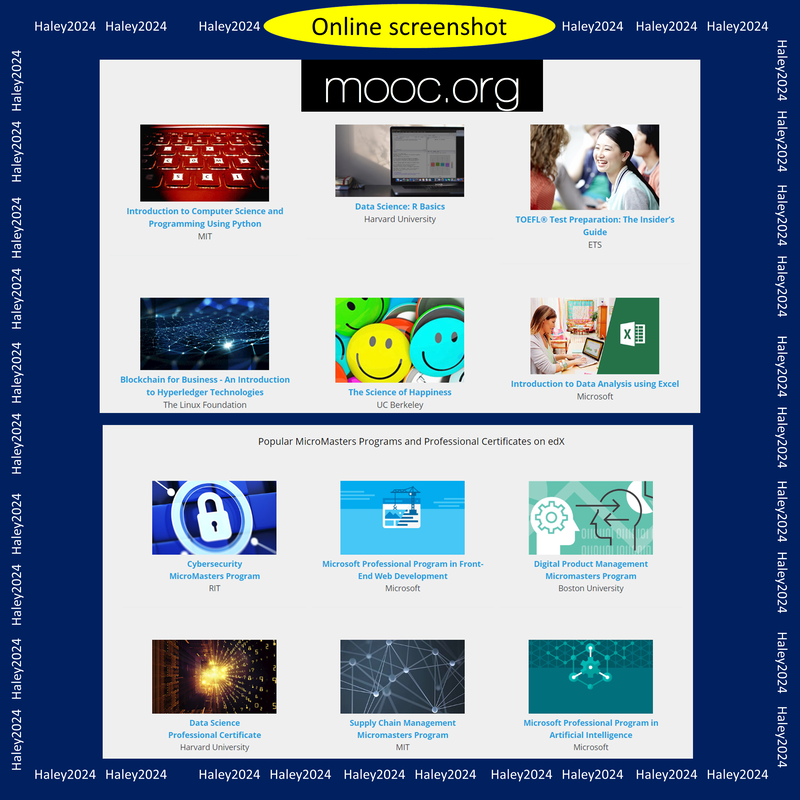
​ Many independent one-teacher businesses are likely to rent a classroom within the building, where many schools utilize their teaching services.  Super-teachers spending over $100,000 per lesson will emerge online with high-quality graphics, videos, visuals, and illustrations that millions of students would utilize.  Online and on-demand tutors would likely flourish employing retired teachers and those with experience in the workforce.  Several billion-dollar companies would emerge, competing to provide the best content to all grade levels.
​Private education accreditation organizations will assess many education models.  They would have a division catering to parents that wish to customize their children’s education through a wide variety of methods.  These organizations would have services for parents that track and verifies a student’s progress over the years to identify missing opportunities and providing hundreds of legitimate potential education pathways to prepare for real work prospects.
Picture
Picture

Education and Employment Models

​There would be classroom space for real businesses expecting real work in established companies in work/ education models.  In exchange for a certain number of hours doing data entry work, an accounting firm could underwrite a teenager’s full education, yielding enough certifications for a respected CPA degree.  The police and fire companies could rent classroom space and have real police and fire/EMT academies, generating new qualified first responders and doubling as security for the school.  A law firm could sponsor 30 teenagers in exchange for essential legal research work and giving real worth to the firm as paralegals.  

Competition of Philosophical Worldviews

​Perhaps the most substantial benefit of free enterprise education is a real competition and plenty of options of what worldview the academic education is taught in.  Many people want a robust Christian worldview inculcated, while others want to steer clear of religion.  Some parents desire the history according to Howard Zinn, while others desire the history be taught in a more conservative patriotic manner.  Some people desire free-enterprise-friendly curriculums and teachers, while others prefer statist points of view.  The ideas about how sports should operate are plentiful, and many models would develop. 
Picture
Picture
​In conclusion, free enterprise education would undoubtedly bring down the overall cost of education, while giving parents and students a wide host of options.  Charities are likely needed in a small percentage of cases; however, without the heavy tax burden, the donations needed would be manageable.  Private schools are currently more integrated by race compared to public schools; consequently, race relations are likely to improve. 
​Religious involvement has declined for several decades because the education of about 90% of children has been taught in the shadow of the wall of separation of church and state.  Free enterprise education allows the light of truth to shine on students during the most crucial part of their lives.  The poor people that feel stuck in failing schools would have many options to thrive.  The removal of the substantial education tax burden would diminish the disincentive of doing the taxed economic activity, yielding more jobs and increased average real and take-home incomes.
Picture
Picture

How the Public-School System Reduces Citizens Religious Participation

4/27/2019

 
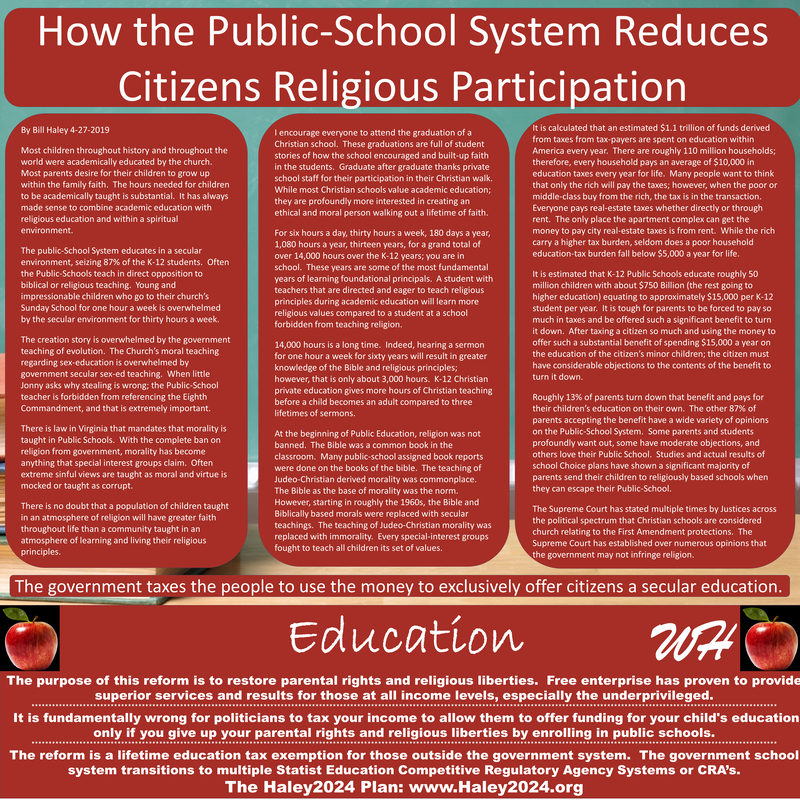
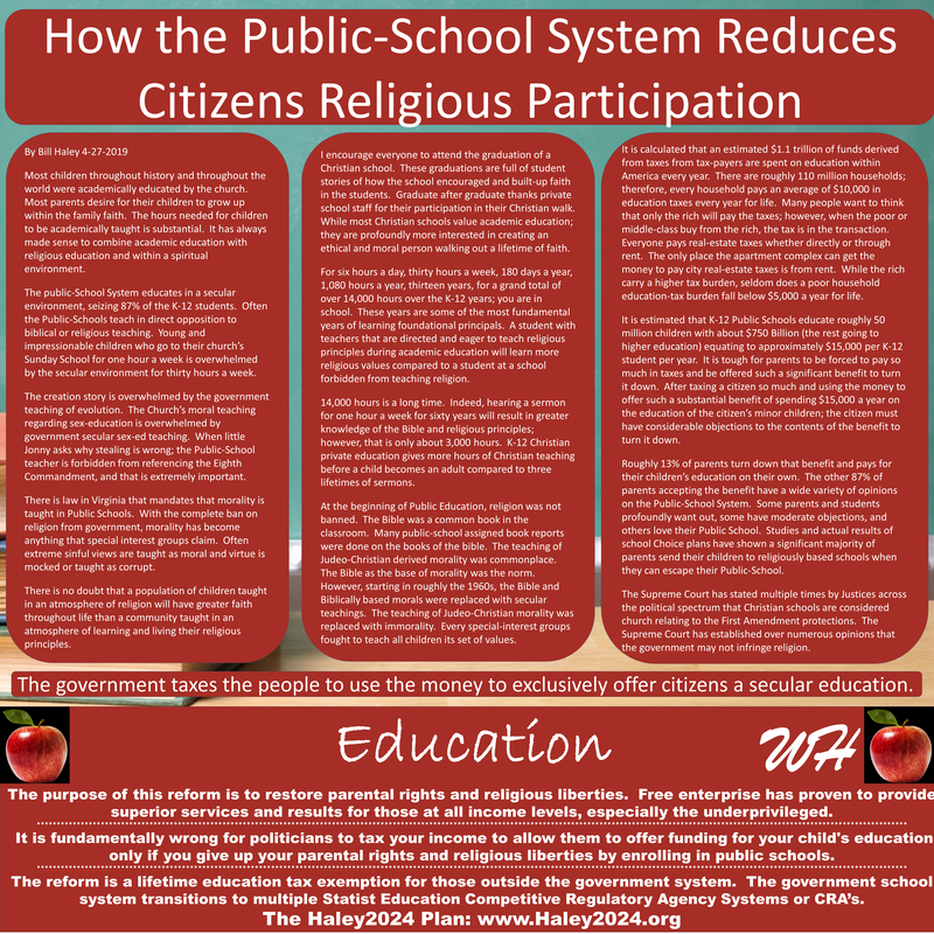
Most children throughout history and throughout the world were academically educated by the church.  Most parents desire for their children to grow up within the family faith.  The hours needed for children to be academically taught is substantial.  It has always made sense to combine academic education with religious education and within a spiritual environment.   
Picture
Picture
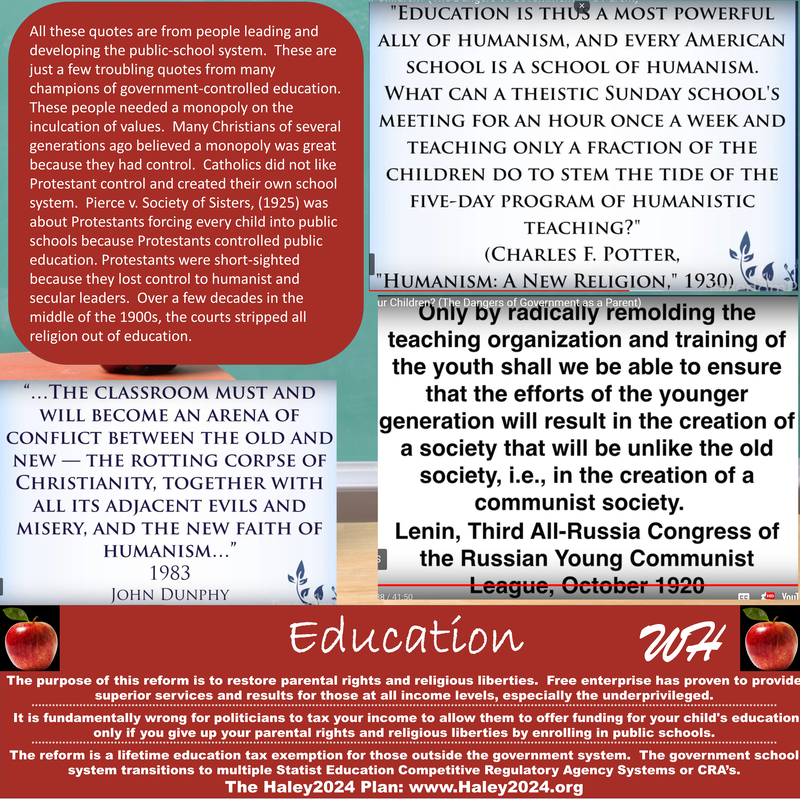
The public-School System educates in a secular environment, seizing 87% of the K-12 students.  Often the Public-Schools teach in direct opposition to biblical or religious teaching.  Young and impressionable children who go to their church’s Sunday School for one hour a week is overwhelmed by the secular environment for thirty hours a week. 
The creation story is overwhelmed by the government teaching of evolution.  The Church’s moral teaching regarding sex-education is overwhelmed by government secular sex-ed teaching.  When little Jonny asks why stealing is wrong; the Public-School teacher is forbidden from referencing the Eighth Commandment, and that is extremely important. 
Picture
Picture
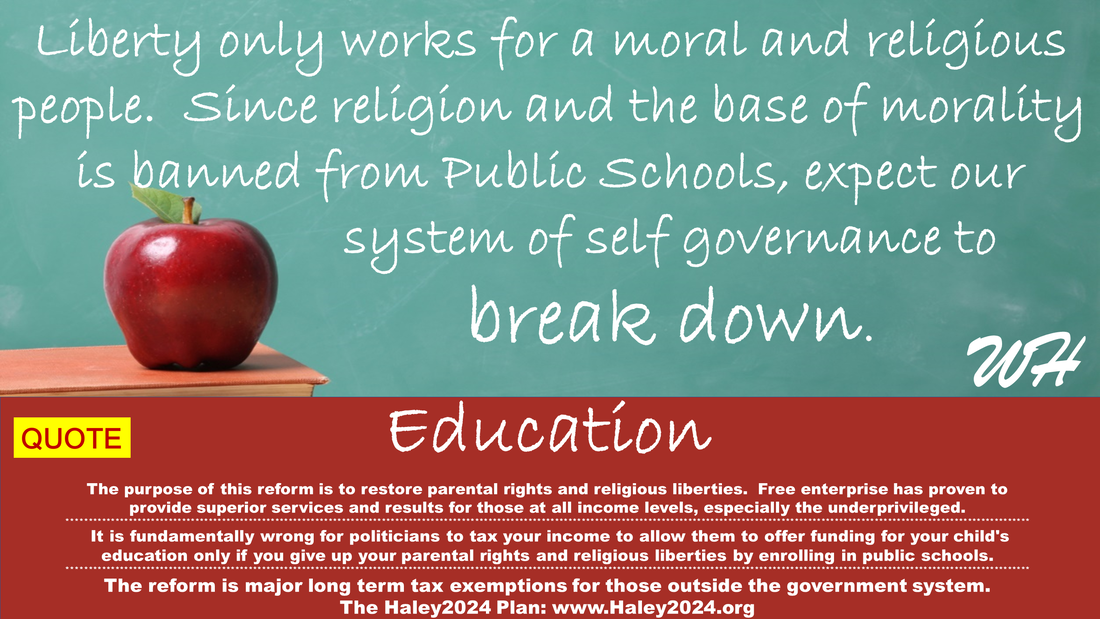
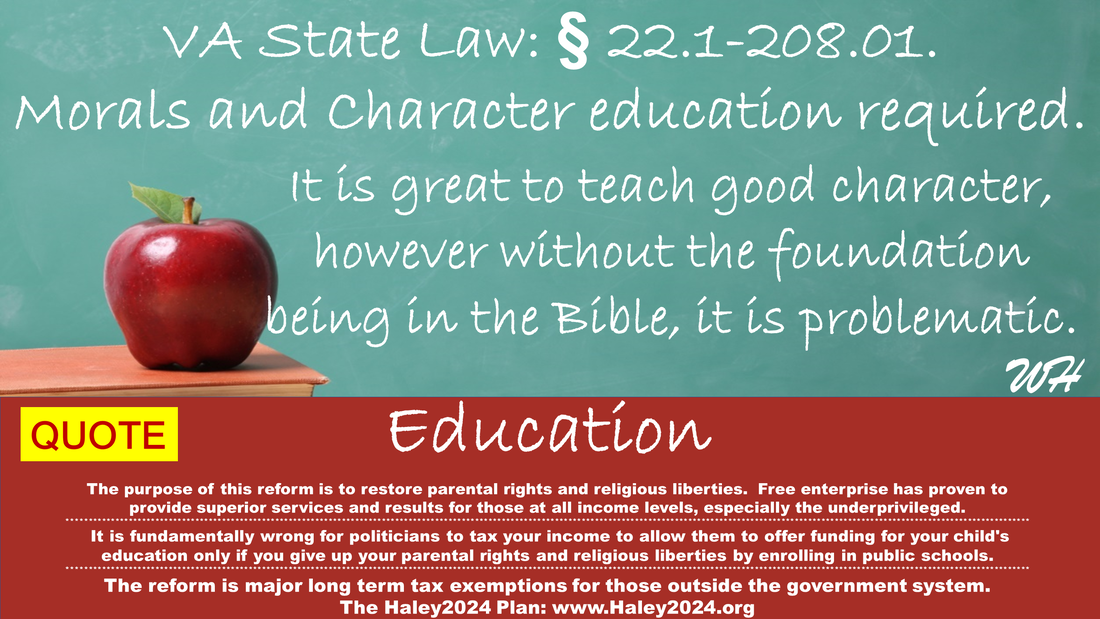
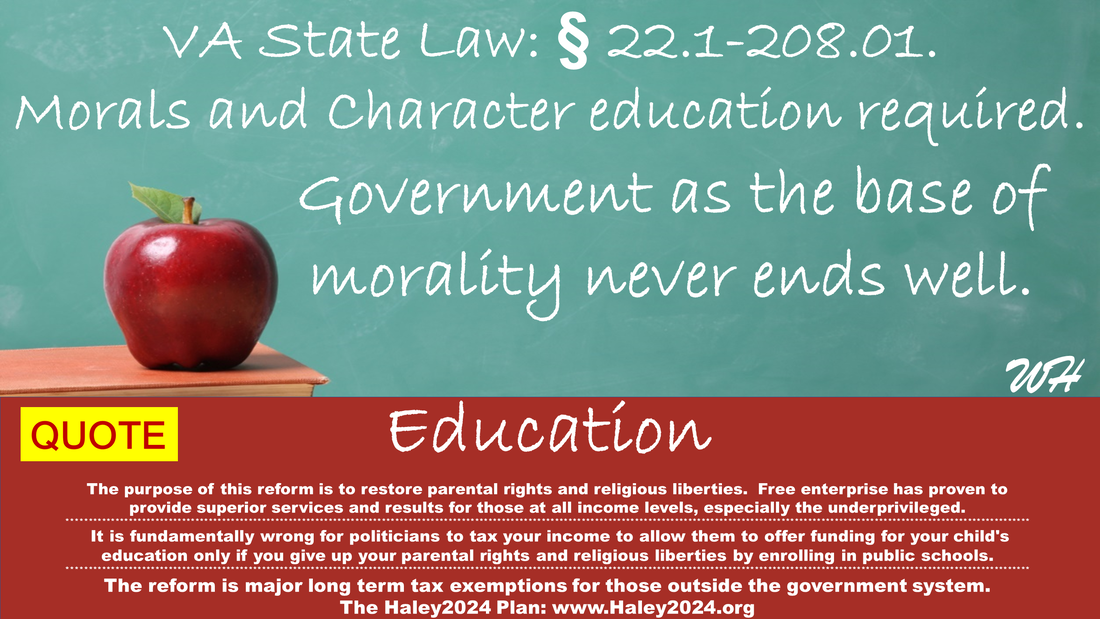
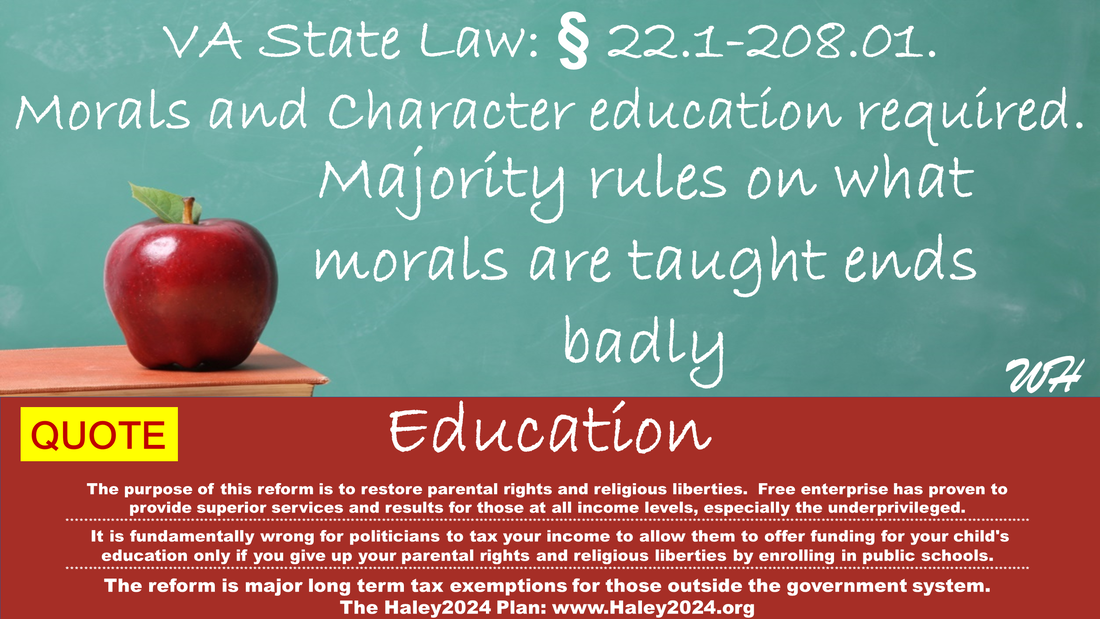
There is law in Virginia that mandates that morality is taught in Public Schools.  With the complete ban on religion from government, morality has become anything that special interest groups claim.  Often extreme sinful views are taught as moral and virtue is mocked or taught as corrupt. 
There is no doubt that a population of children taught in an atmosphere of religion will have greater faith throughout life than a community taught in an atmosphere of learning and living their religious principles.
Picture
Picture
I encourage everyone to attend the graduation of a Christian school.  These graduations are full of student stories of how the school encouraged and built-up faith in the students.  Graduate after graduate thanks private school staff for their participation in their Christian walk.  While most Christian schools value academic education; they are profoundly more interested in creating an ethical and moral person walking out a lifetime of faith.        
For six hours a day, thirty hours a week, 180 days a year, 1,080 hours a year, thirteen years, for a grand total of over 14,000 hours over the K-12 years; you are in school. These years are some of the most fundamental years of learning foundational principals.  A student with teachers that are directed and eager to teach religious principles during academic education will learn more religious values compared to a student at a school forbidden from teaching religion. 
Picture
Picture
14,000 hours is a long time.  Indeed, hearing a sermon for one hour a week for sixty years will result in greater knowledge of the Bible and religious principles; however, that is only about 3,000 hours.  K-12 Christian private education gives more hours of Christian teaching before a child becomes an adult compared to three lifetimes of sermons.     
At the beginning of Public Education, religion was not banned.  The Bible was a common book in the classroom.  Many public-school assigned book reports were done on the books of the bible.  The teaching of Judeo-Christian derived morality was commonplace.  The Bible as the base of morality was the norm.  However, starting in roughly the 1960s, the Bible and Biblically based morals were replaced with secular teachings.  The teaching of Judeo-Christian morality was replaced with immorality.  Every special-interest groups fought to teach all children its set of values. 
Picture
Picture
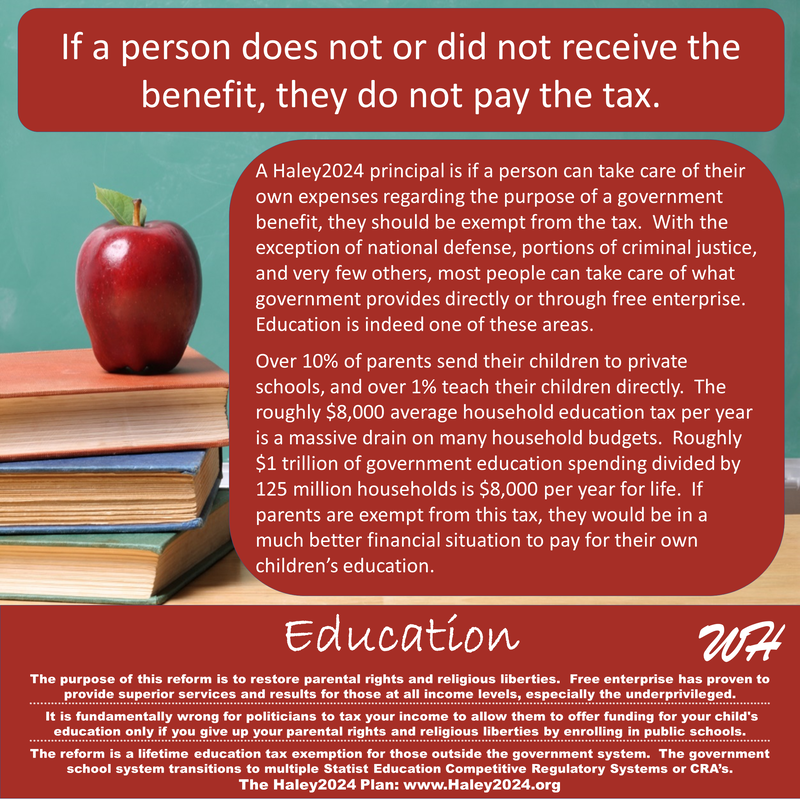
It is calculated that an estimated $1.1 trillion of funds derived from taxes from tax-payers are spent on education within America every year.  There are roughly 110 million households; therefore, every household pays an average of $10,000 in education taxes every year for life.  Many people want to think that only the rich will pay the taxes; however, when the poor or middle-class buy from the rich, the tax is in the transaction.  Everyone pays real-estate taxes whether directly or through rent.  The only place the apartment complex can get the money to pay city real-estate taxes is from rent.  While the rich carry a higher tax burden, seldom does a poor household education-tax burden fall below $5,000 a year for life. 
​
It is estimated that K-12 Public Schools educate roughly 50 million children with about $750 Billion (the rest going to higher education) equating to approximately $15,000 per K-12 student per year.  It is tough for parents to be forced to pay so much in taxes and be offered such a significant benefit to turn it down.  After taxing a citizen so much and using the money to offer such a substantial benefit of spending $15,000 a year on the education of the citizen’s minor children; the citizen must have considerable objections to the contents of the benefit to turn it down. 
Picture
Picture
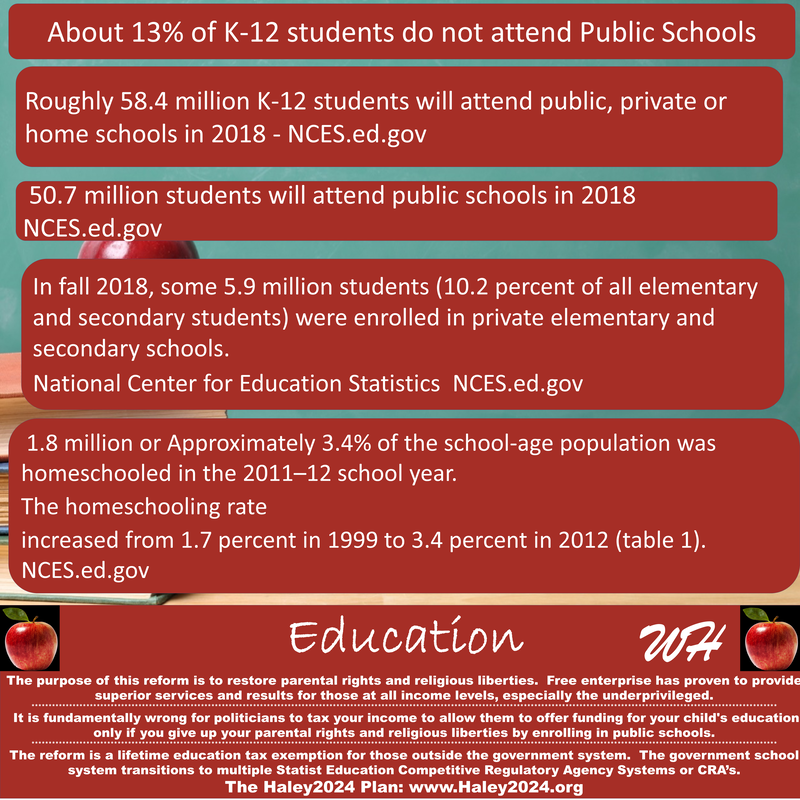
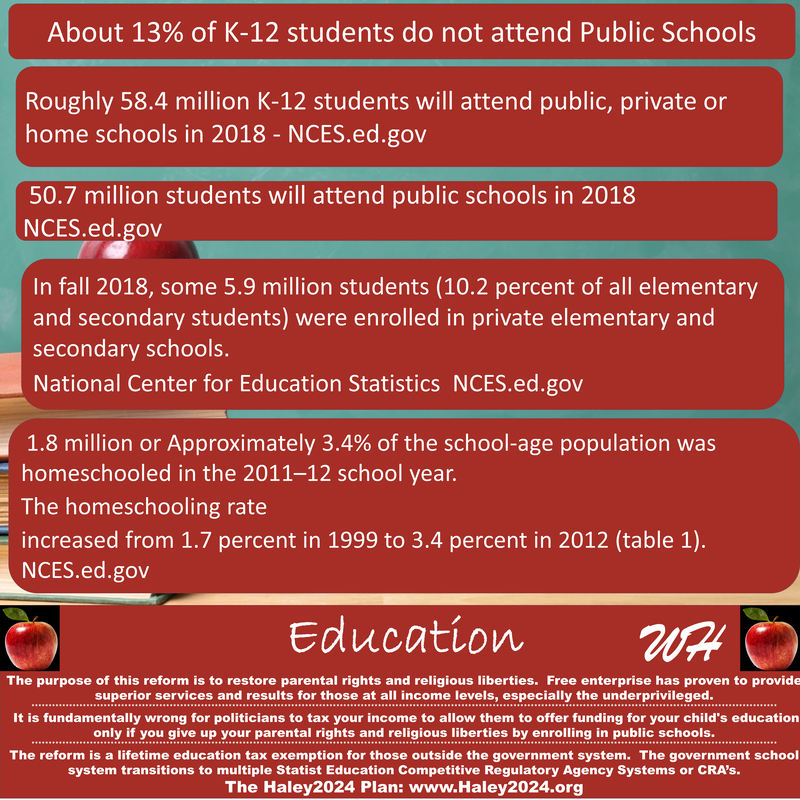
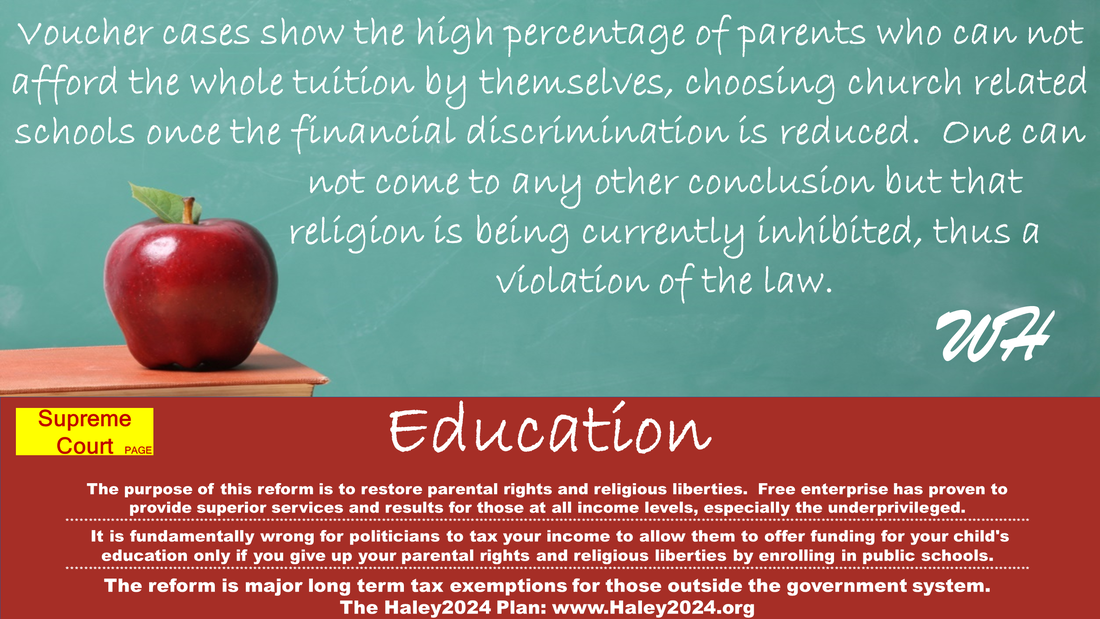
Roughly 13% of parents turn down that benefit and pays for their children’s education on their own.  The other 87% of parents accepting the benefit have a wide variety of opinions on the Public-School System.  Some parents and students profoundly want out, some have moderate objections, and others love their Public School.  Studies and actual results of school Choice plans have shown a significant majority of parents send their children to religiously based schools when they can escape their Public-School.        
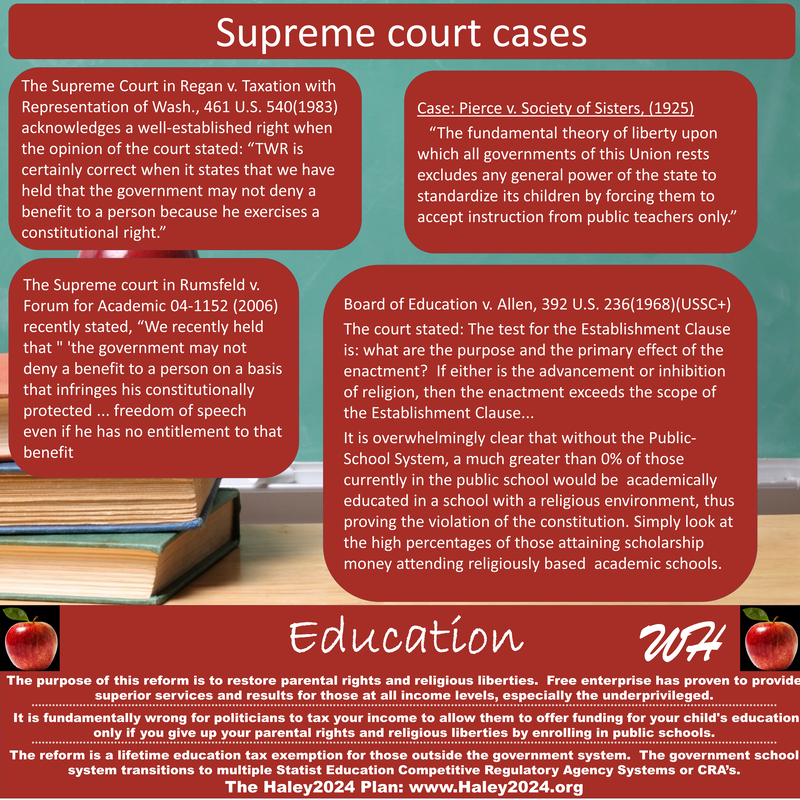
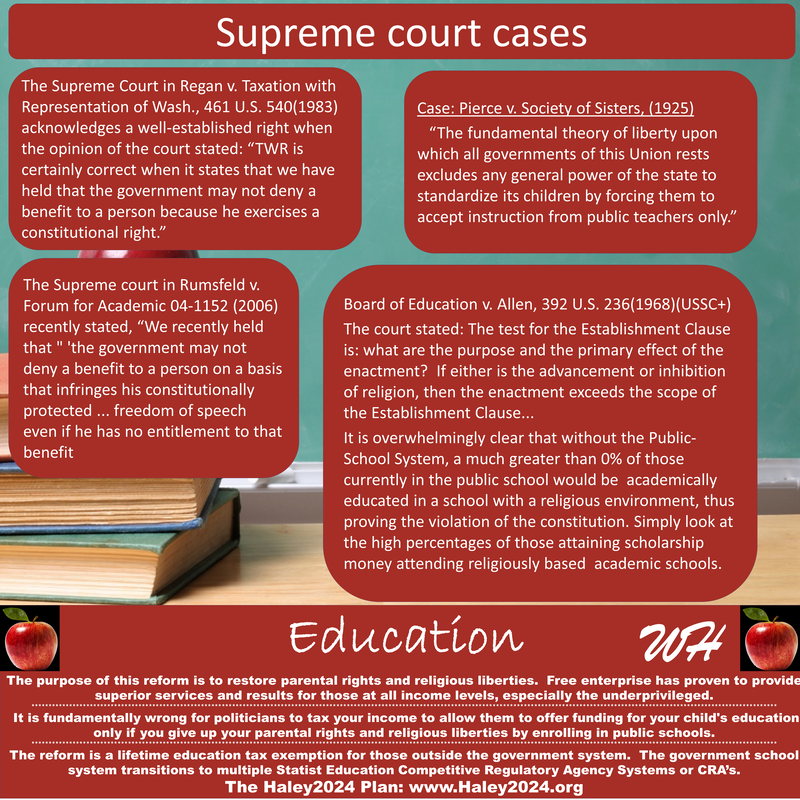
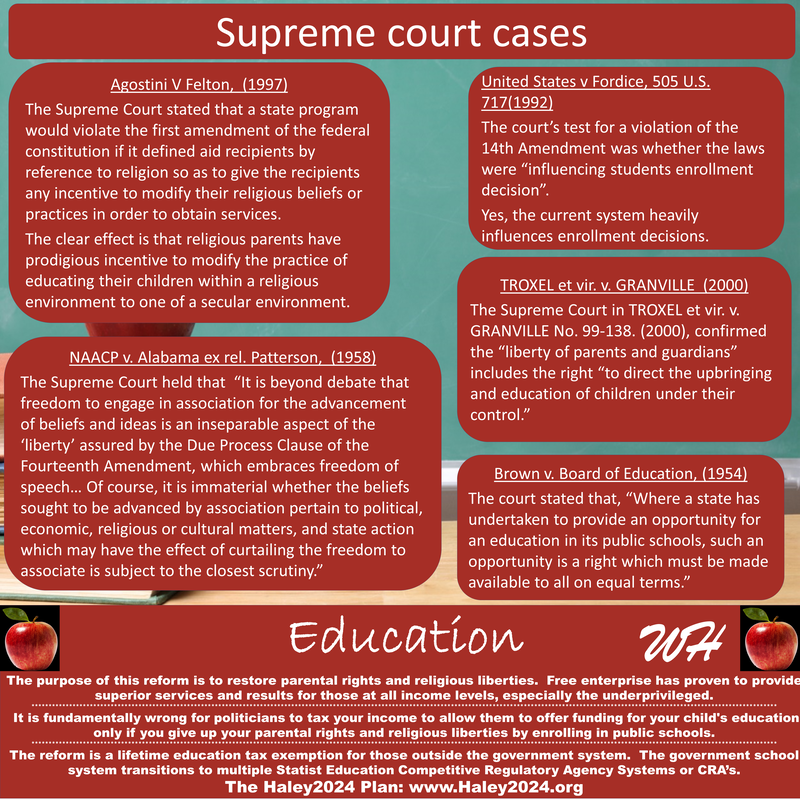
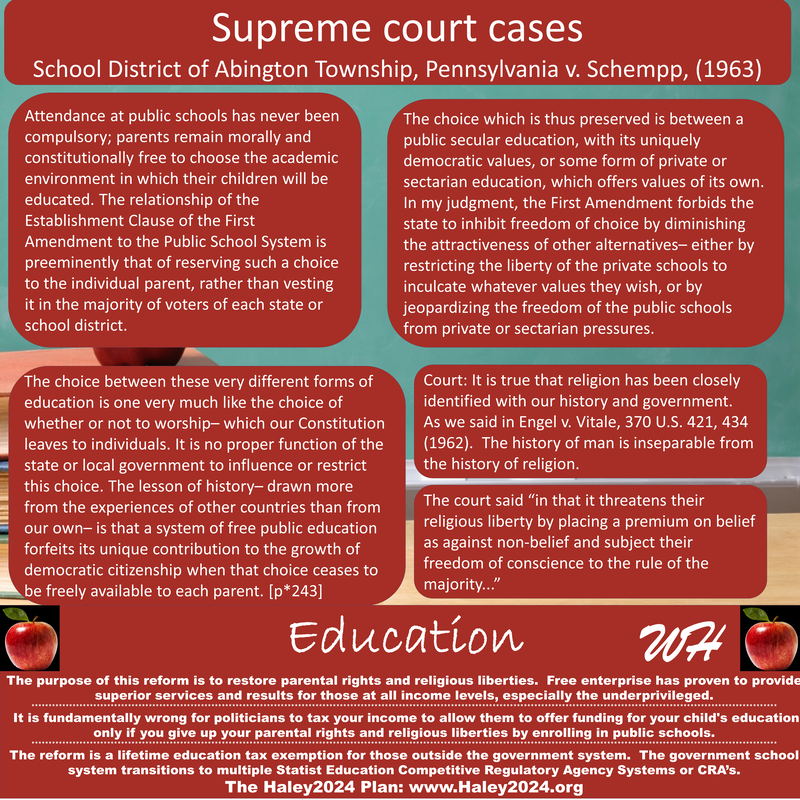
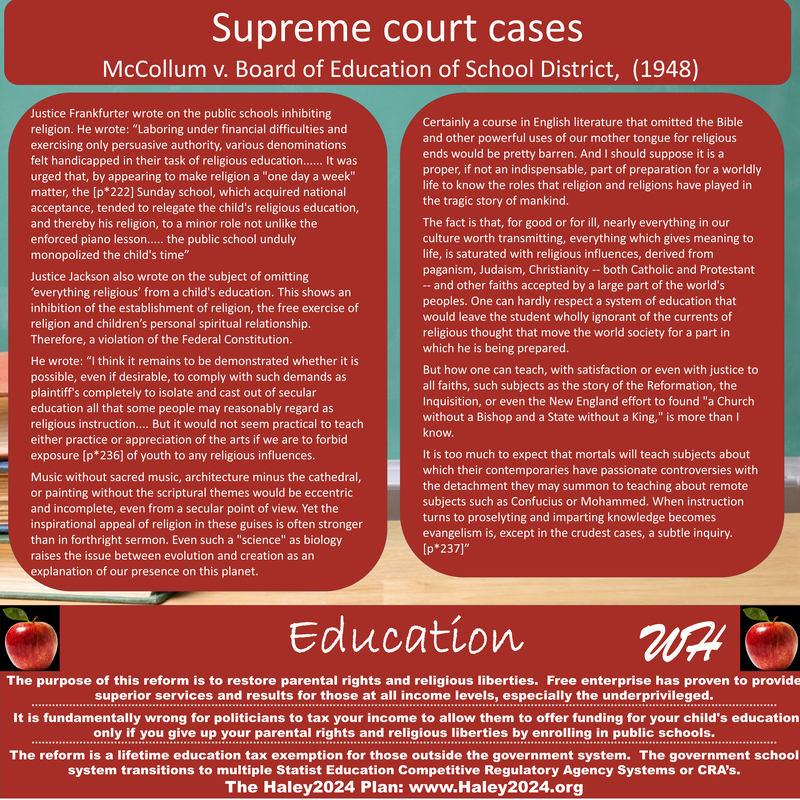
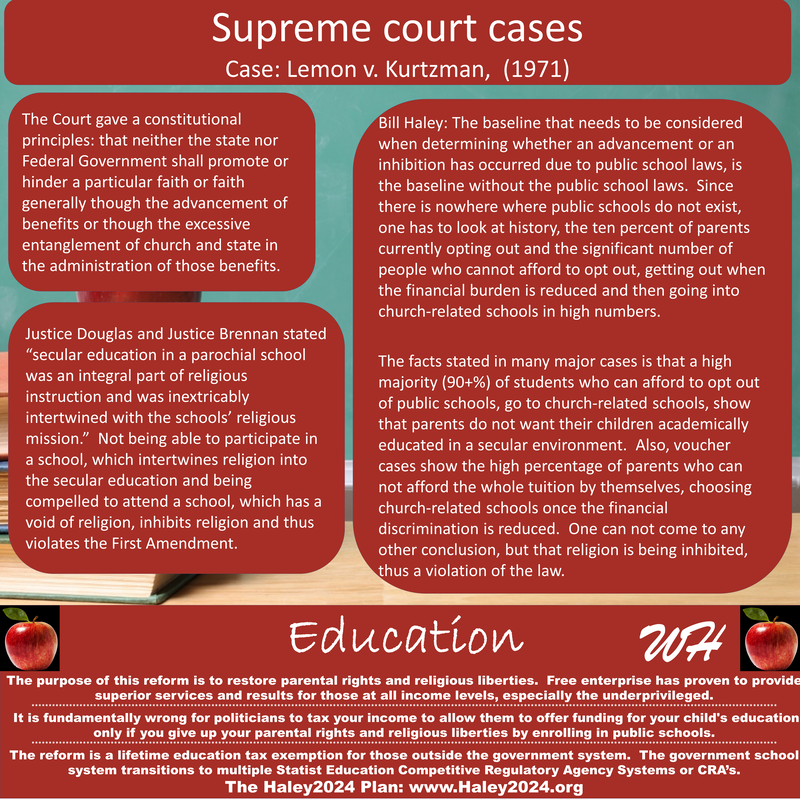
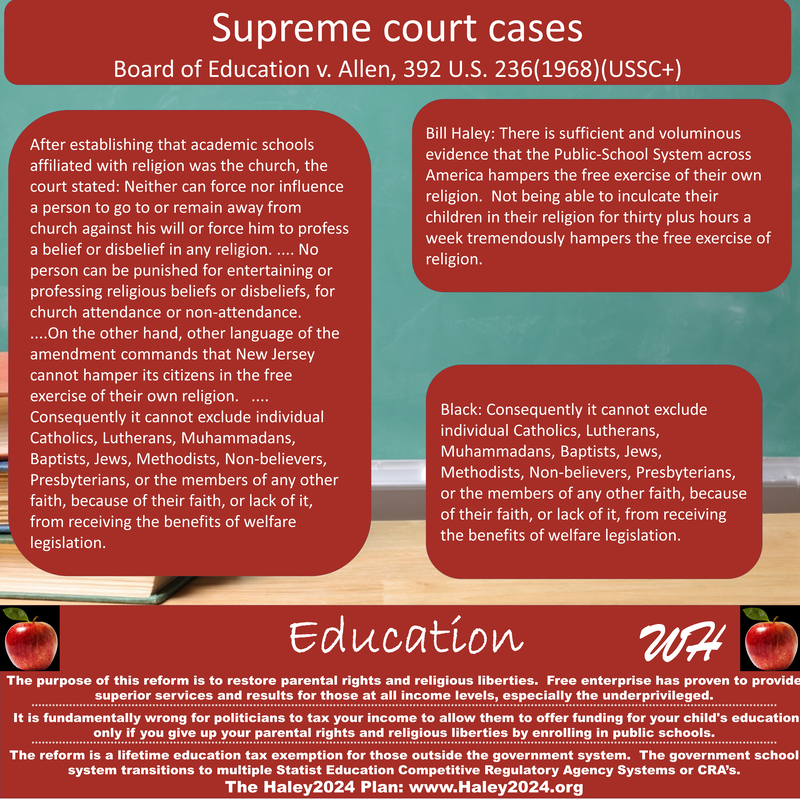
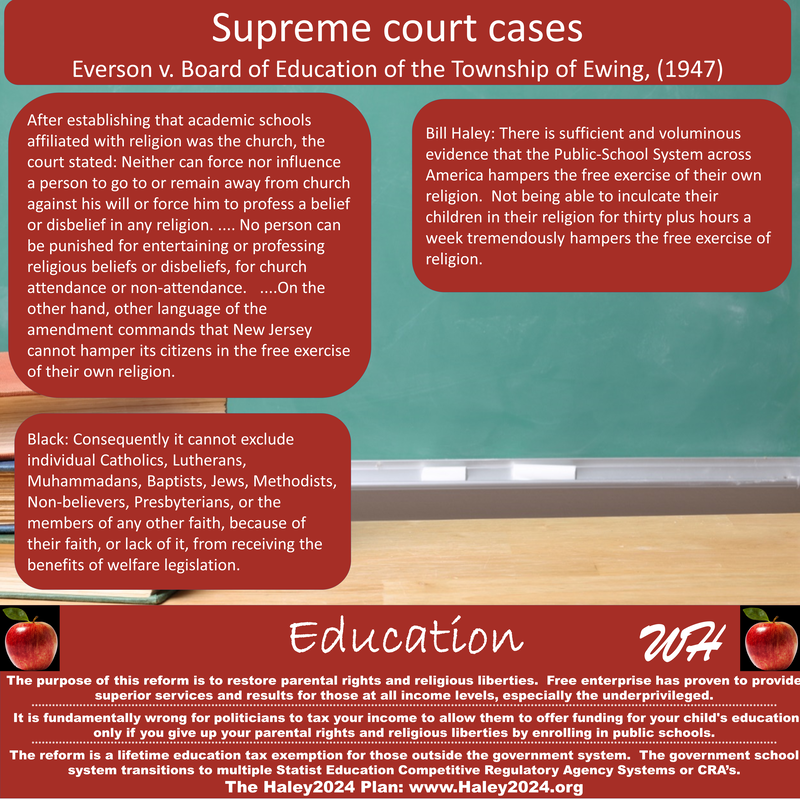
The Supreme Court has stated multiple times by Justices across the political spectrum that Christian schools are considered church relating to the First Amendment protections.  The Supreme Court has established over numerous opinions that the government may not infringe religion. 
Picture
Picture

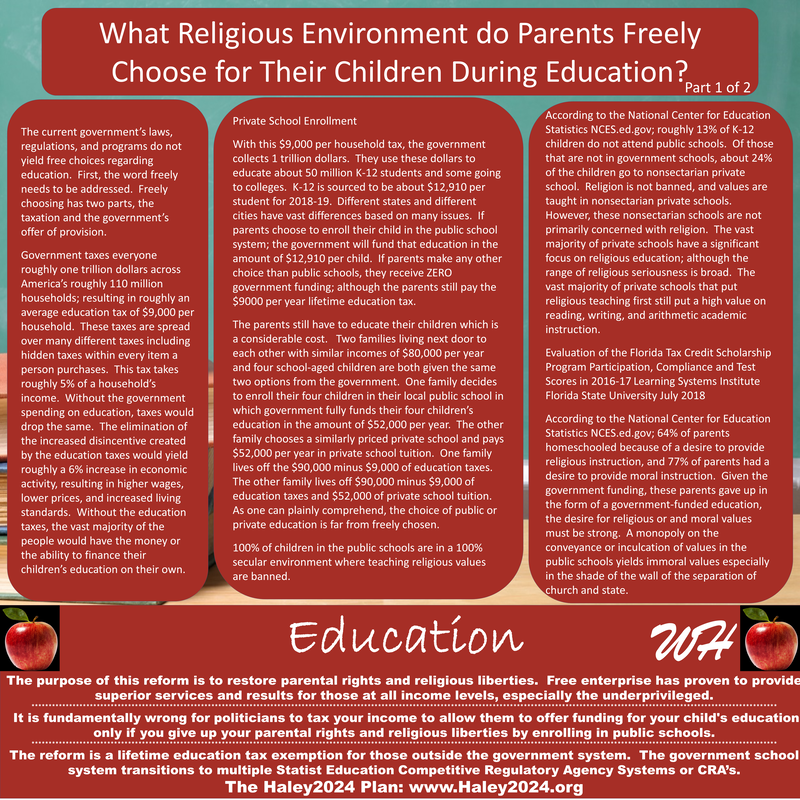
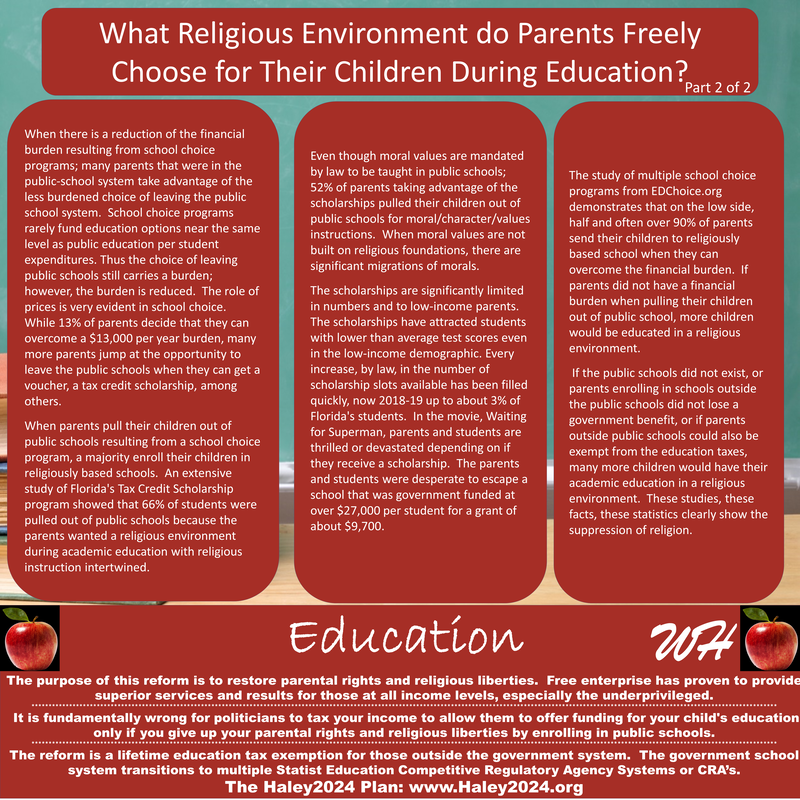
What Religious Environment do Parents Freely Choose for Their Children During Education?

12/1/2018

 
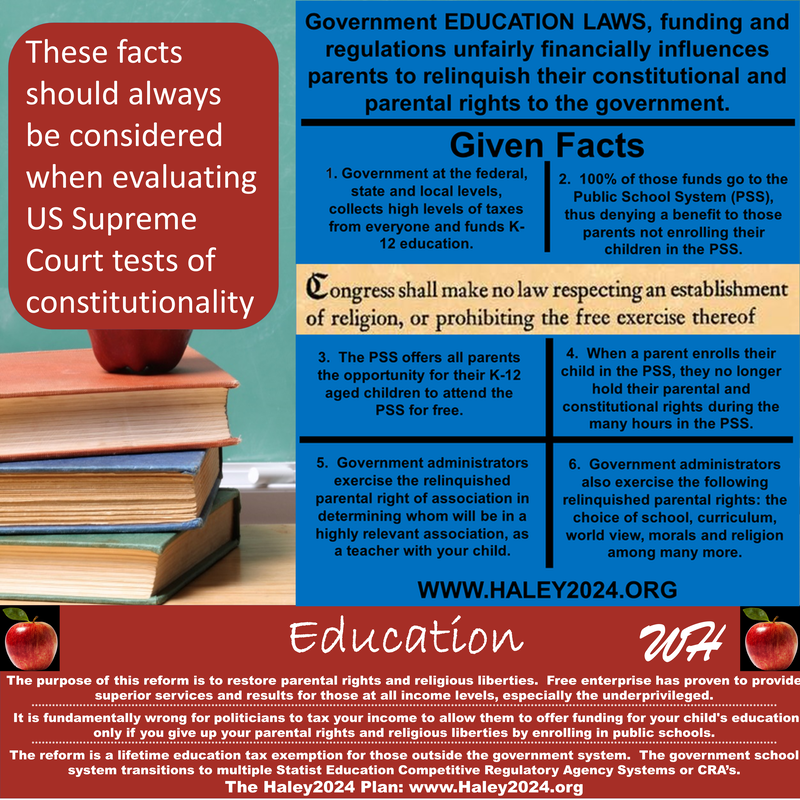
The current government’s laws, regulations, and programs do not yield free choices regarding education.  First, the word freely needs to be addressed.  Freely choosing has two parts, the taxation and the government’s offer of provision.  
Picture
Picture
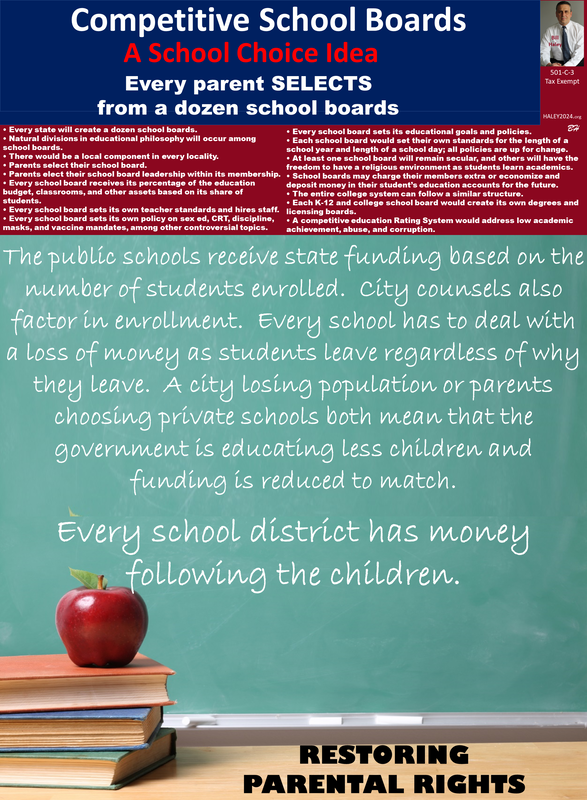
 Government taxes everyone roughly one trillion dollars across America’s roughly 110 million households; resulting in roughly an average education tax of $9,000 per household.  These taxes are spread over many different taxes including hidden taxes within every item a person purchases.  This tax takes roughly 5% of a household’s income.  Without the government spending on education, taxes would drop the same.  The elimination of the increased disincentive created by the education taxes would yield roughly a 6% increase in economic activity, resulting in higher wages, lower prices, and increased living standards.  Without the education taxes, the vast majority of the people would have the money or the ability to finance their children’s education on their own. 
Private School Enrollment 
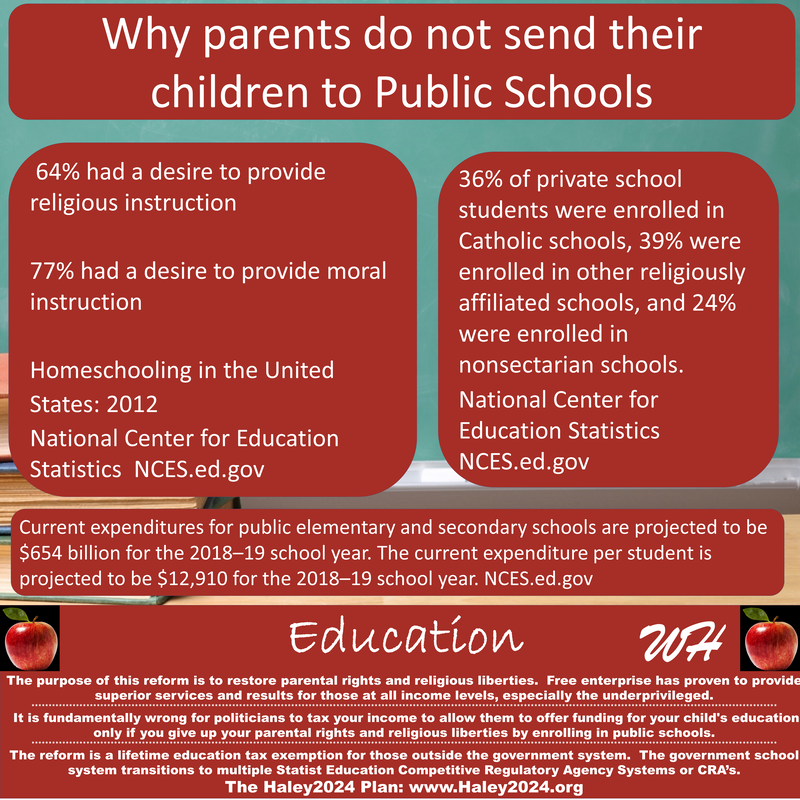
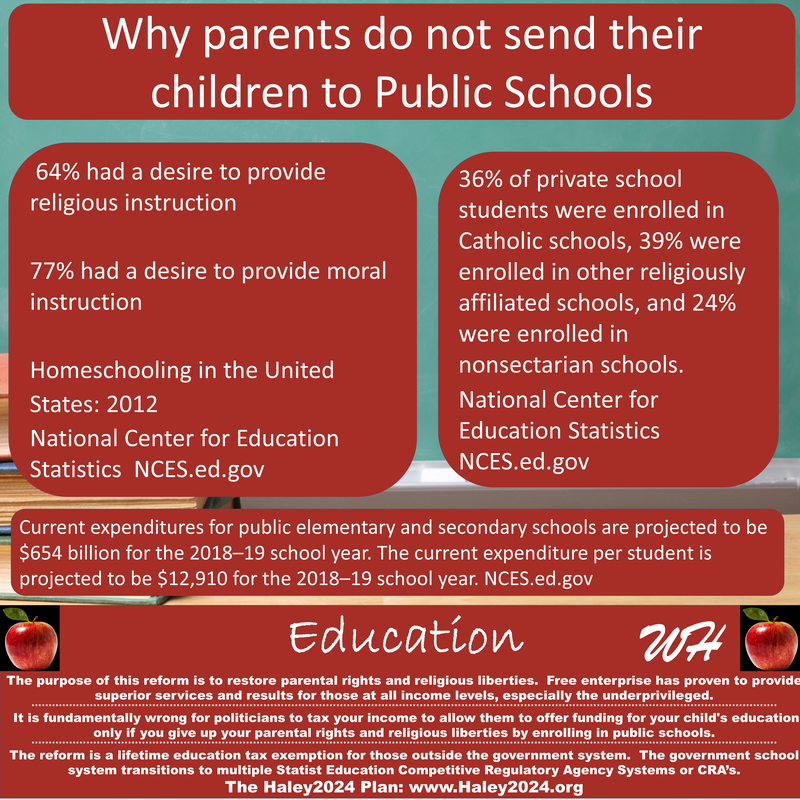
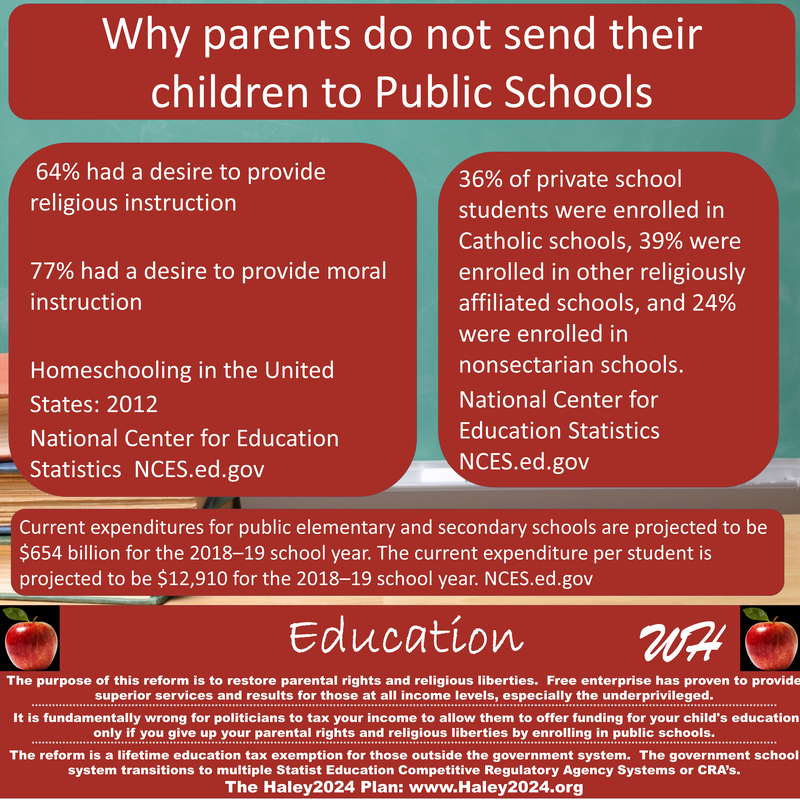
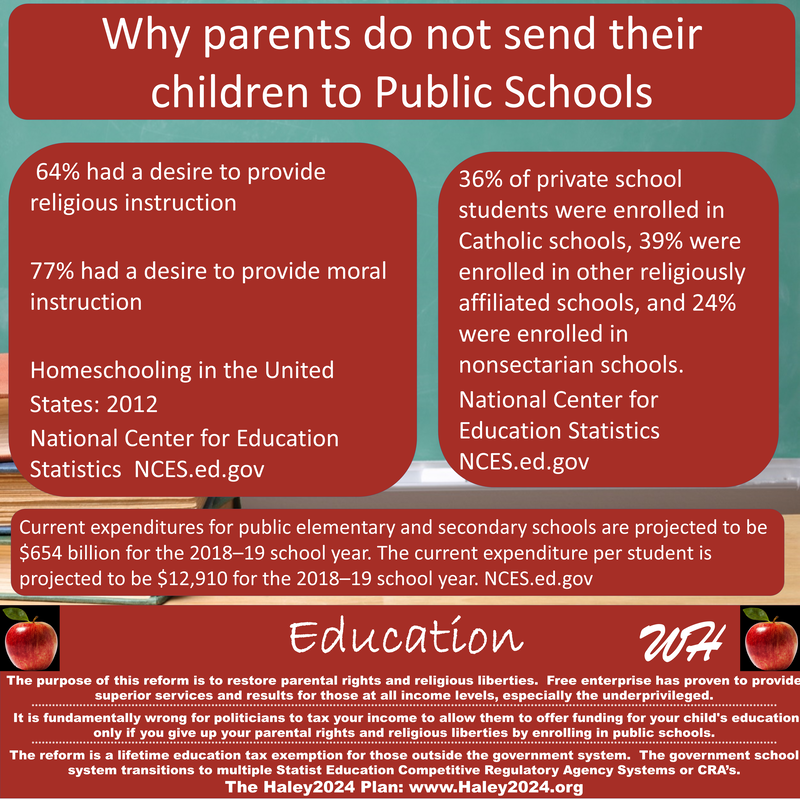
With this $9,000 per household tax, the government collects 1 trillion dollars.  They use these dollars to educate about 50 million K-12 students and some going to colleges.  K-12 is sourced to be about $12,910 per student for 2018-19.  Different states and different cities have vast differences based on many issues.  If parents choose to enroll their child in the public school system; the government will fund that education in the amount of $12,910 per child.  If parents make any other choice than public schools, they receive ZERO government funding; although the parents still pay the $9000 per year lifetime education tax. 
Picture
Picture
The parents still have to educate their children which is a considerable cost.   Two families living next door to each other with similar incomes of $80,000 per year and four school-aged children are both given the same two options from the government.  One family decides to enroll their four children in their local public school in which government fully funds their four children’s education in the amount of $52,000 per year.  The other family chooses a similarly priced private school and pays $52,000 per year in private school tuition.  One family lives off the $90,000 minus $9,000 of education taxes.  The other family lives off $90,000 minus $9,000 of education taxes and $52,000 of private school tuition.  As one can plainly comprehend, the choice of public or private education is far from freely chosen. 

100% of children in the public schools are in a 100% secular environment where teaching religious values are banned.  

Picture
Picture
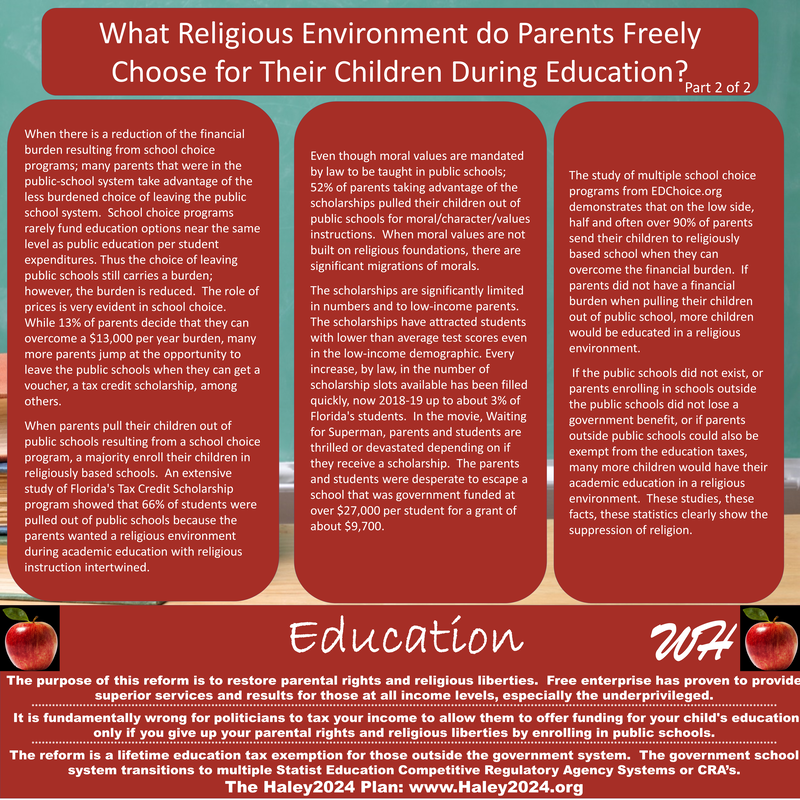
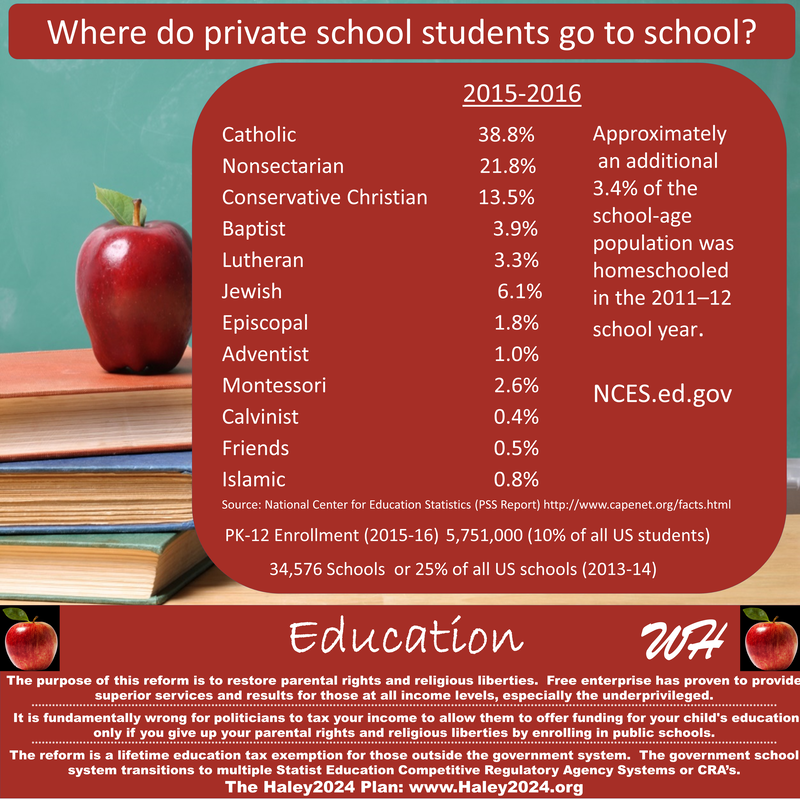
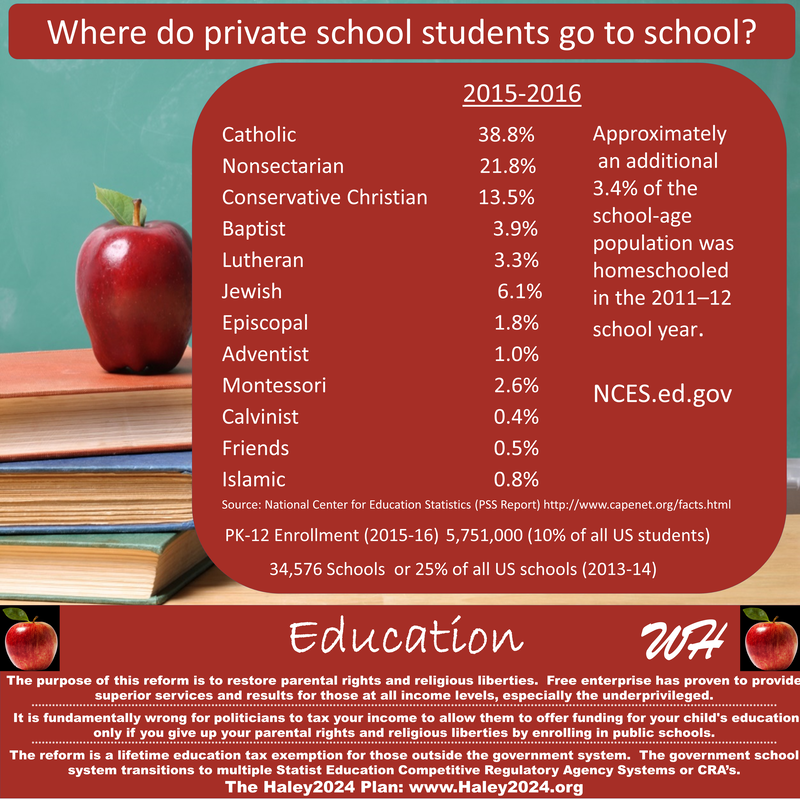
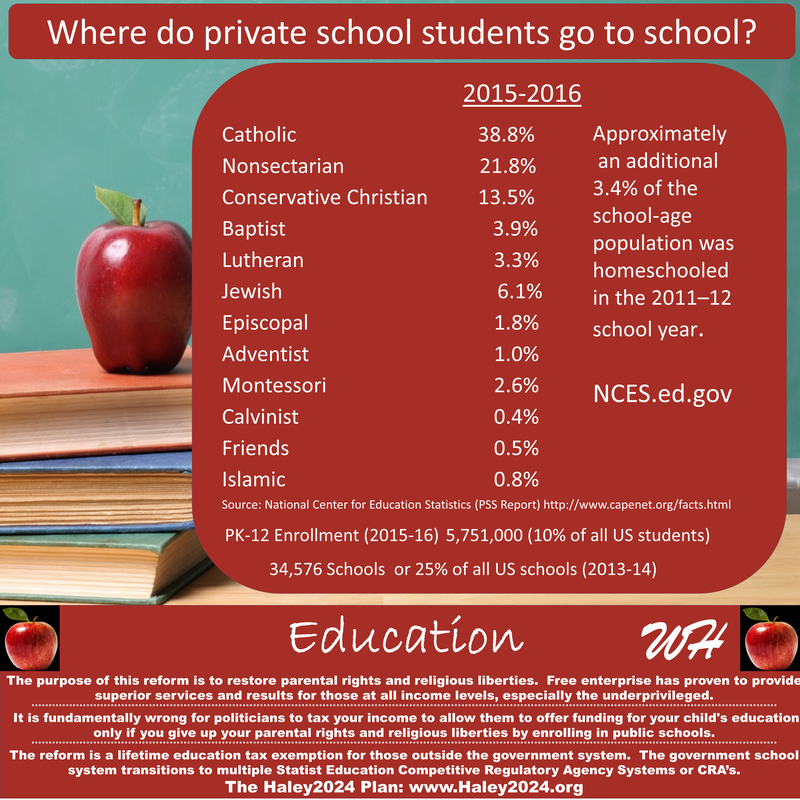
According to the National Center for Education Statistics NCES.ed.gov; roughly 13% of K-12 children do not attend public schools.  Of those that are not in government schools, about 24% of the children go to nonsectarian private school.  Religion is not banned, and values are taught in nonsectarian private schools.  However, these nonsectarian schools are not primarily concerned with religion.  The vast majority of private schools have a significant focus on religious education; although the range of religious seriousness is broad.  The vast majority of private schools that put religious teaching first still put a high value on reading, writing, and arithmetic academic instruction.  
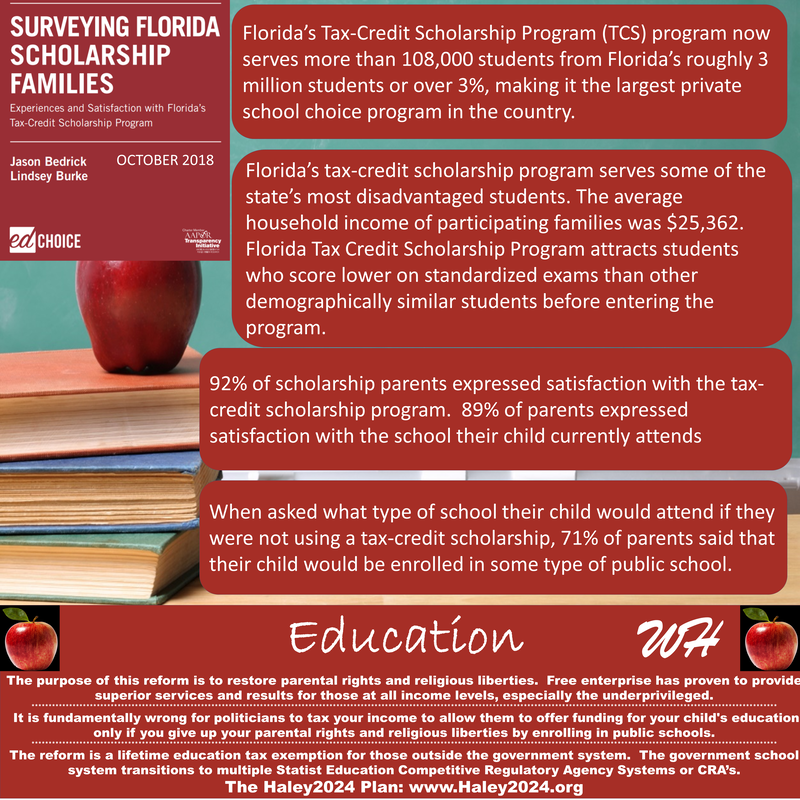
Evaluation of the Florida Tax Credit Scholarship Program Participation, Compliance and Test Scores in 2016-17 Learning Systems Institute Florida State University July 2018​
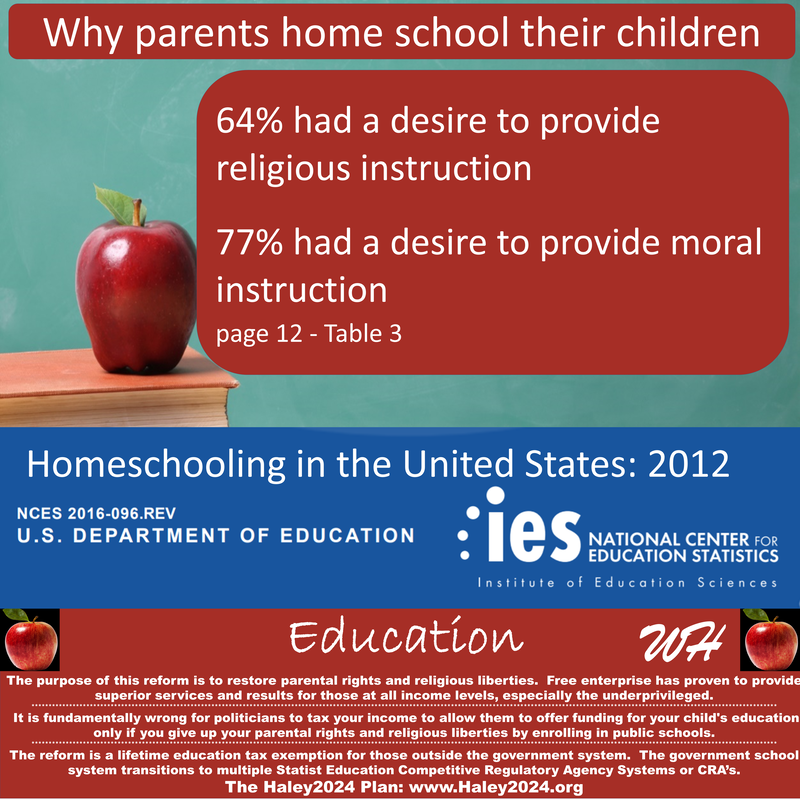
According to the National Center for Education Statistics NCES.ed.gov; 64% of parents homeschooled because of a desire to provide religious instruction, and 77% of parents had a desire to provide moral instruction.  Given the government funding, these parents gave up in the form of a government-funded education, the desire for religious or and moral values must be strong.  A monopoly on the conveyance or inculcation of values in the public schools yields immoral values especially in the shade of the wall of the separation of church and state.  
Picture
Picture
When there is a reduction of the financial burden resulting from school choice programs; many parents that were in the public school system take advantage of the less burdened choice of leaving the public school system.  School choice programs rarely fund education options near the same level as public education per student expenditures. 
Thus the choice of leaving public schools still carries a burden; however, the burden is reduced.  The role of prices is very evident in school choice.  While 13% of parents decide that they can overcome a $13,000 per year burden, many more parents jump at the opportunity to leave the public schools when they can get a voucher, a tax credit scholarship, among others.  
Picture
Picture
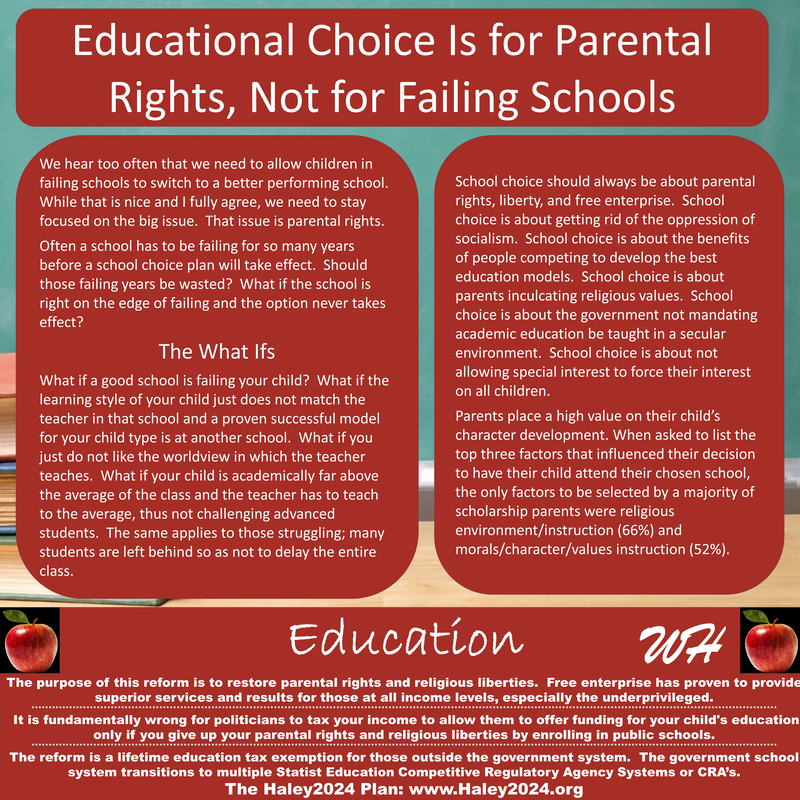
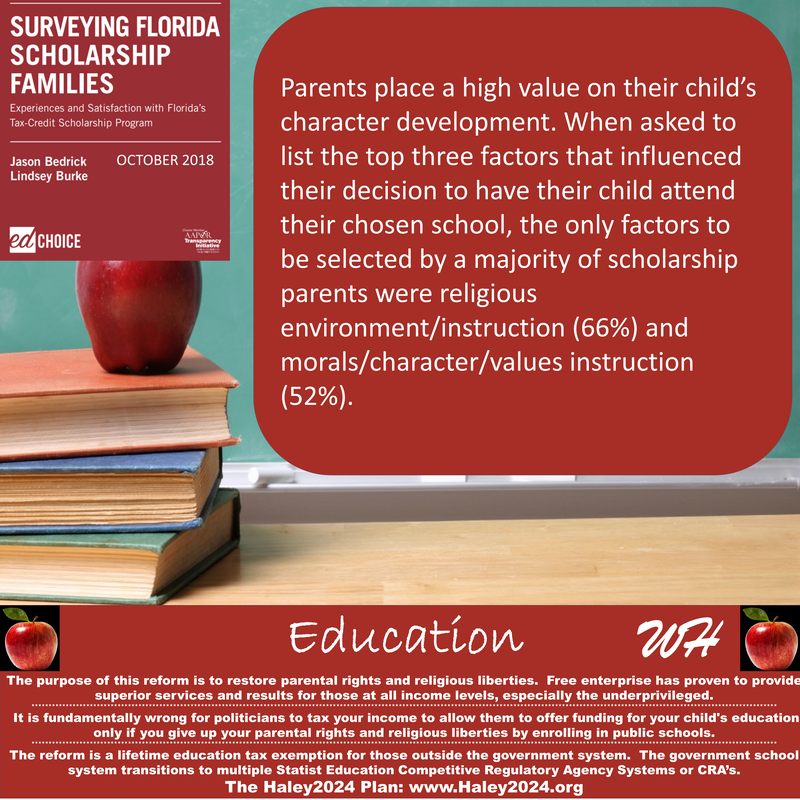
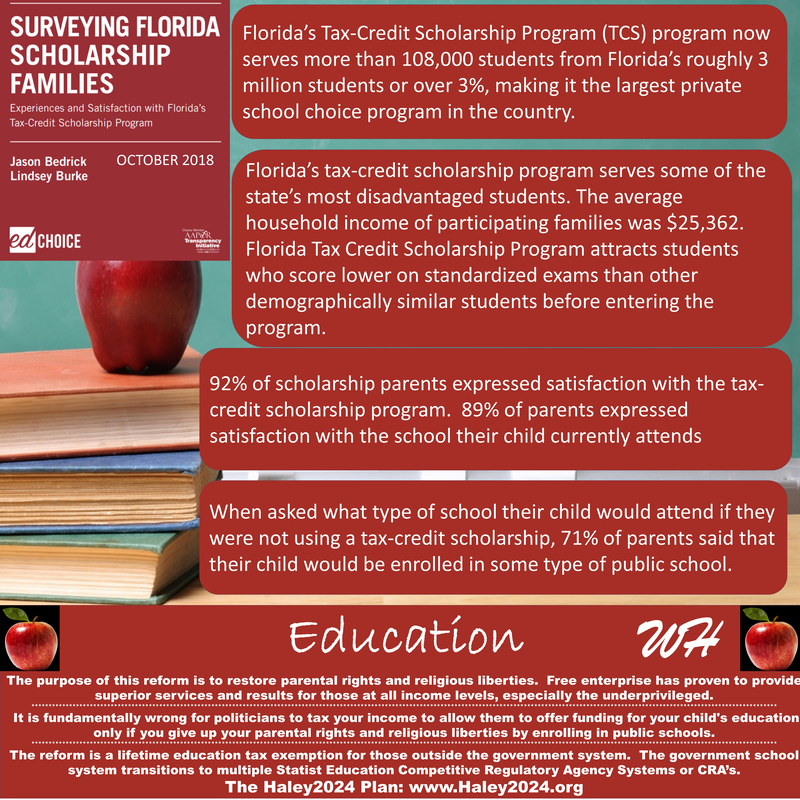
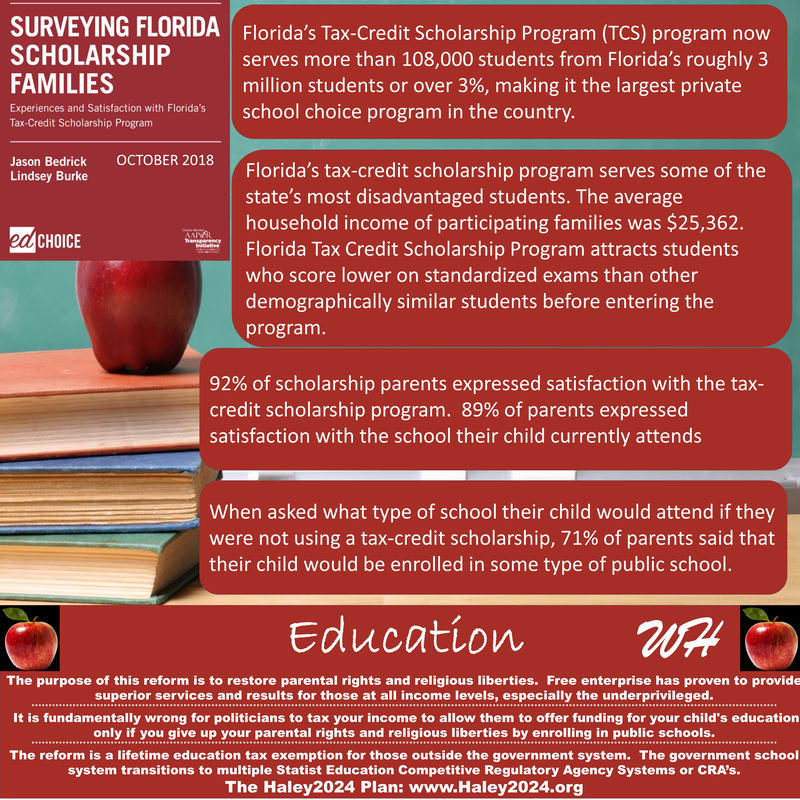
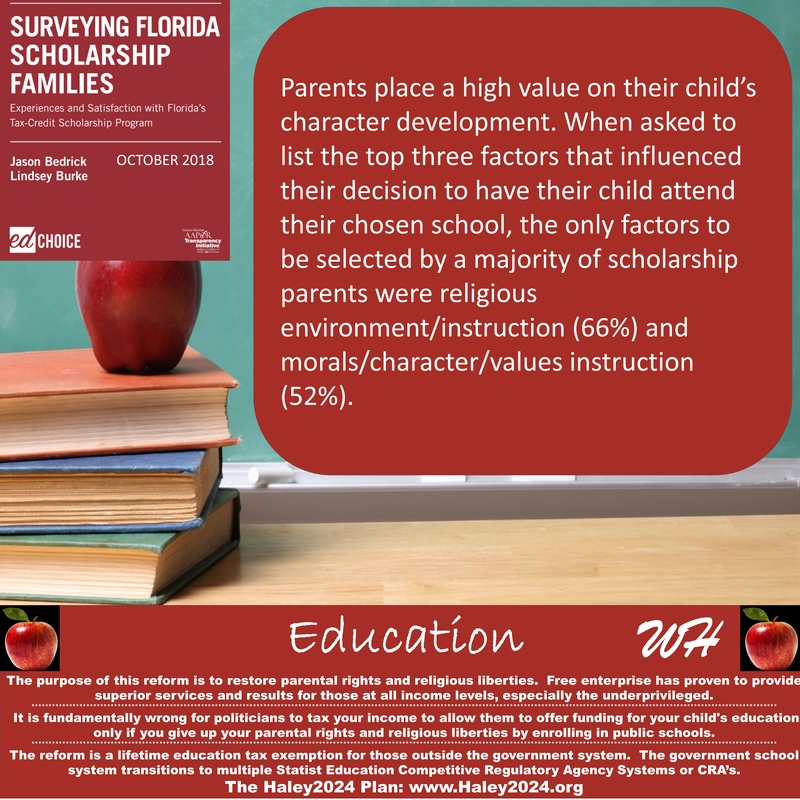
When parents pull their children out of public schools resulting from a school choice program, a majority enroll their children in religiously based schools.  An extensive study of Florida's Tax Credit Scholarship program showed that 66% of students were pulled out of public schools because the parents wanted a religious environment during academic education with religious instruction intertwined.  Even though moral values are mandated by law to be taught in public schools; 52% of parents taking advantage of the scholarships pulled their children out of public schools for moral/character/values instructions.  When moral values are not built on religious foundations, there are significant migrations of morals.
The scholarships are significantly limited in numbers and to low-income parents.  The scholarships have attracted students with lower than average test scores even in the low-income demographic.  Every increase, by law, in the number of scholarship slots available has been filled quickly, now 2018-19 up to about 3% of Florida's students.   In the movie, Waiting for Superman, parents and students are thrilled or devastated depending on if they receive a scholarship.  The parents and students were desperate to escape a school that was government funded at over $27,000 per student for a grant of about $9,700. 
Picture
Picture
The study of multiple school choice programs from EDChoice.org demonstrates that on the low side, half and often over 90% of parents send their children to religiously based school when they can overcome the financial burden.  If parents did not have a financial burden when pulling their children out of public school, more children would be educated in a religious environment.  ​
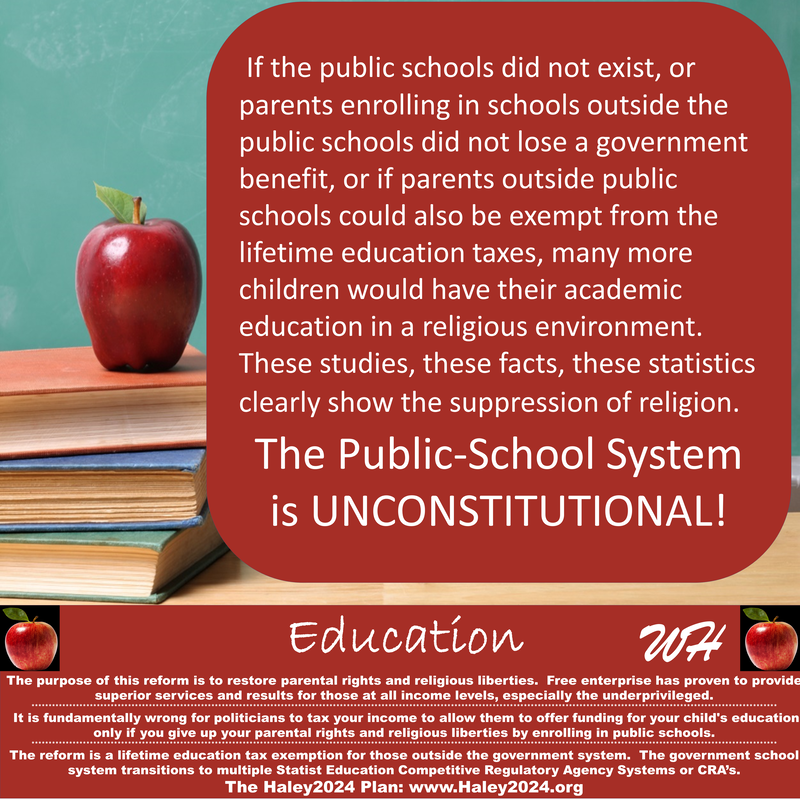
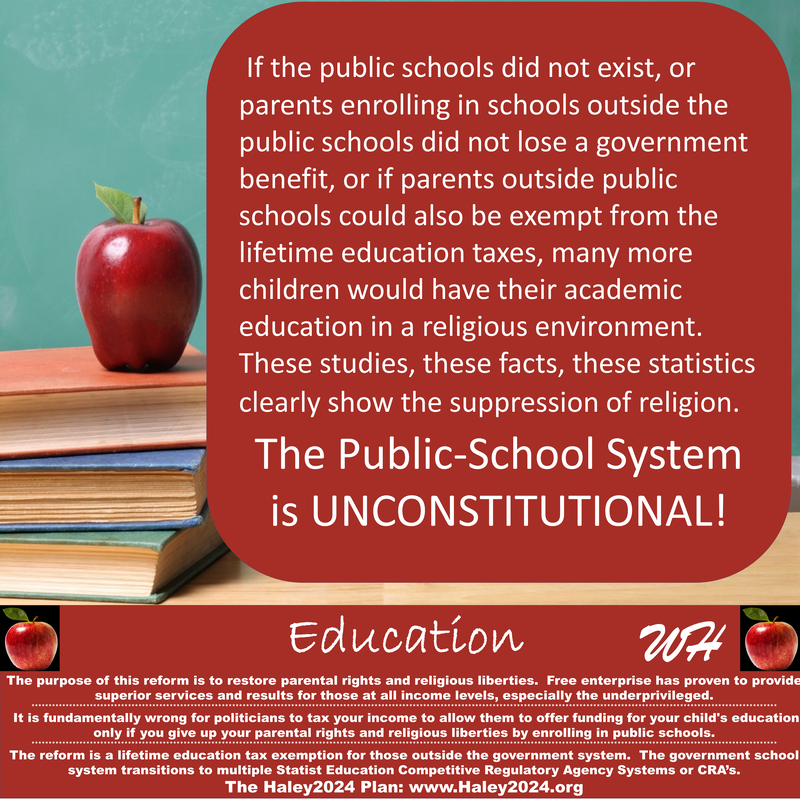
 If the public schools did not exist, or parents enrolling in schools outside the public schools did not lose a government benefit, or if parents outside public schools could also be exempt from the education taxes, many more children would have their academic education in a religious environment.  These studies, these facts, these statistics clearly show the suppression of religion.   
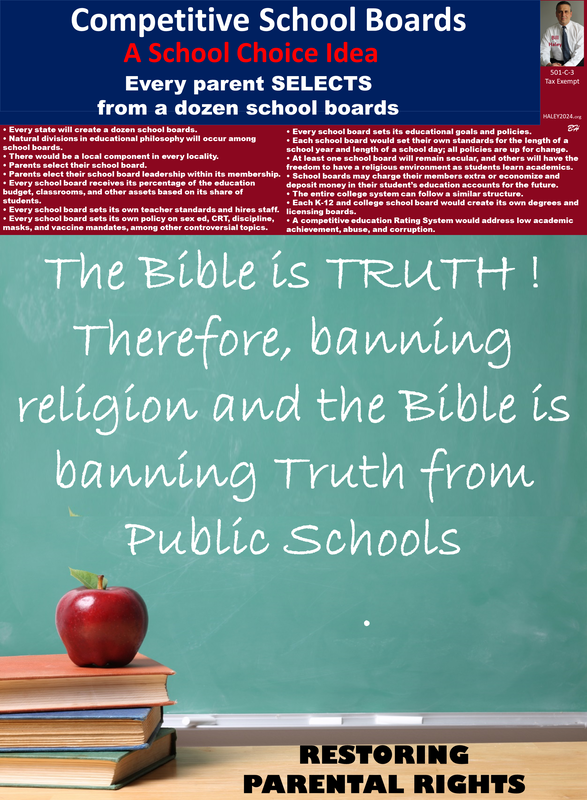
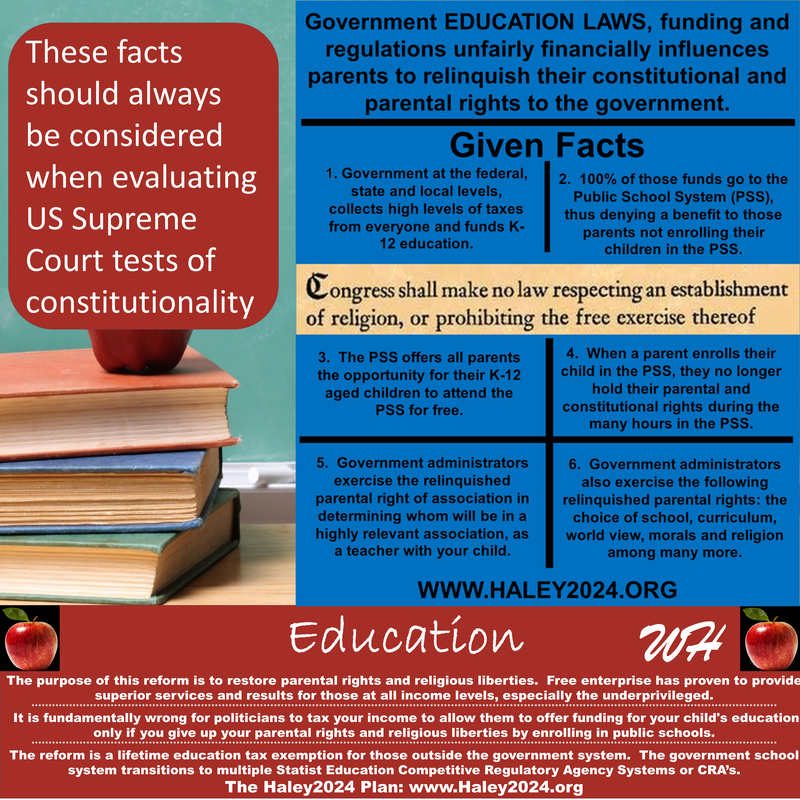
The Public School System is UNCONSTITUTIONAL!       
Picture
Picture
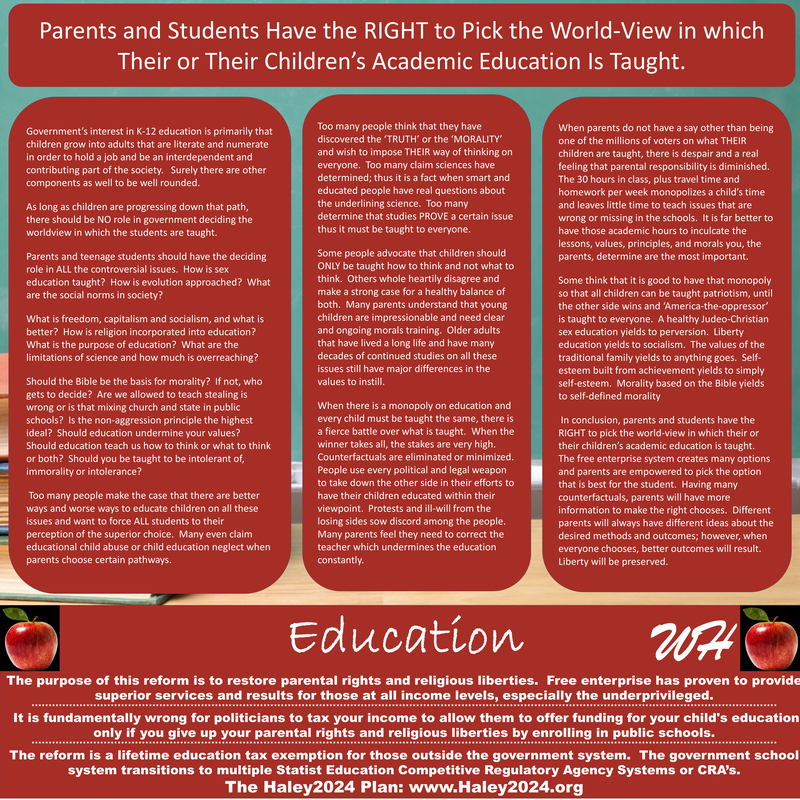
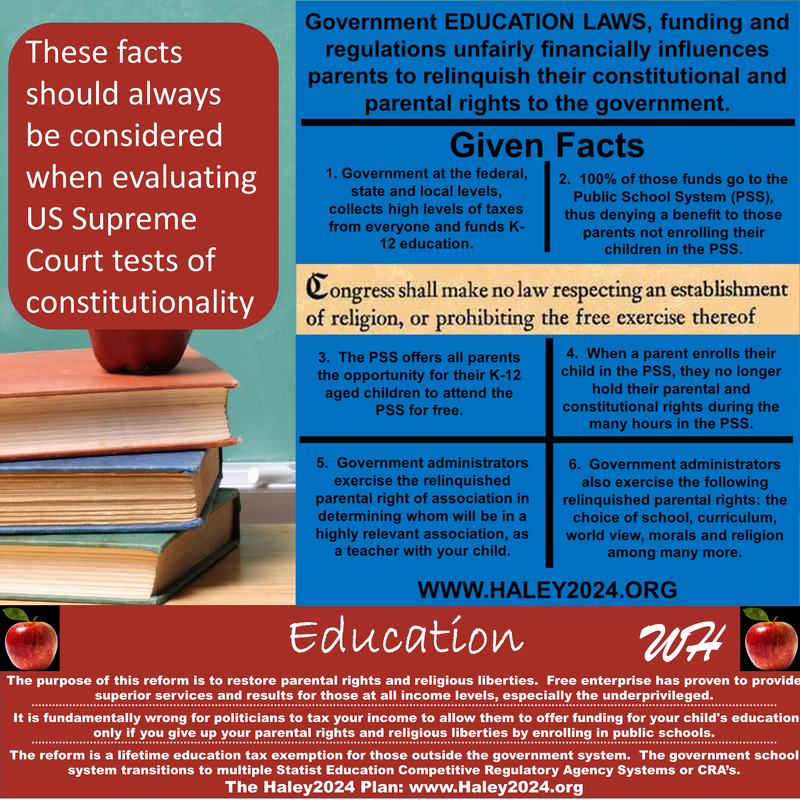
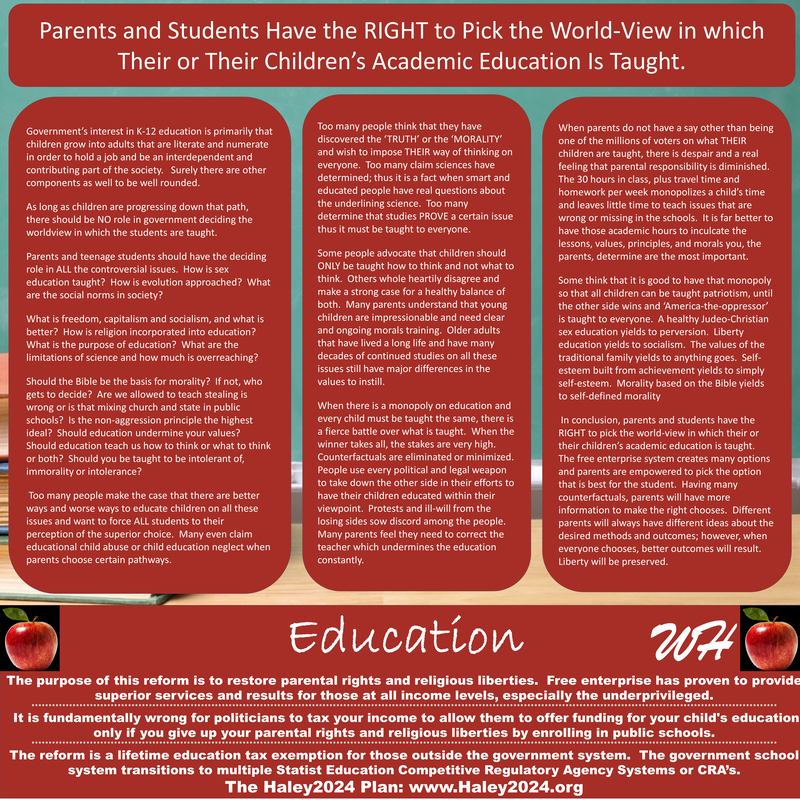
Parents and Students Have the RIGHT to Pick the World-View in which Their or Their Children’s Academic Education Is Taught.

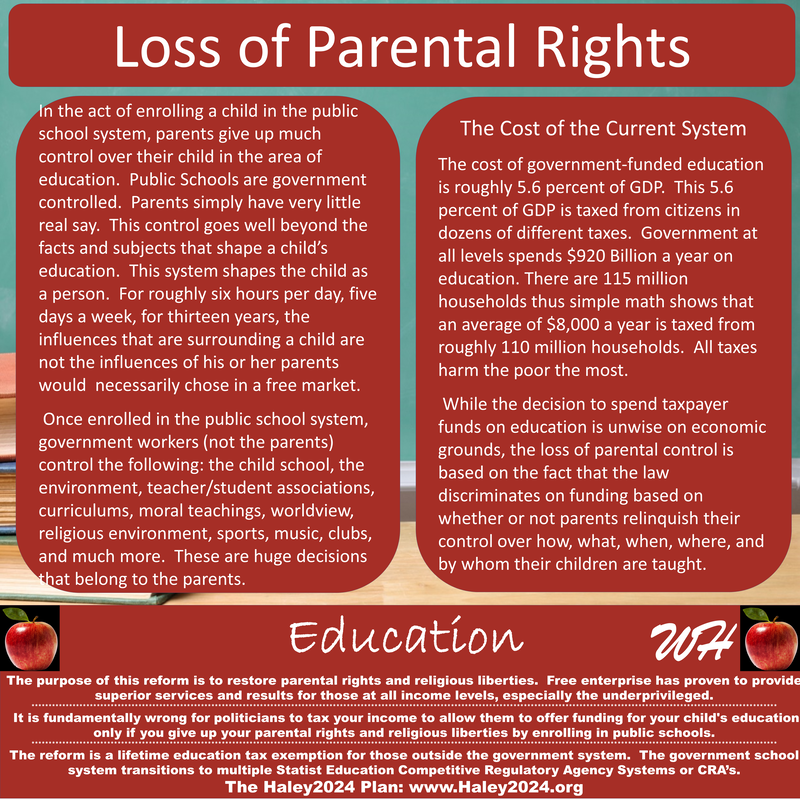
Loss of Parental Rights
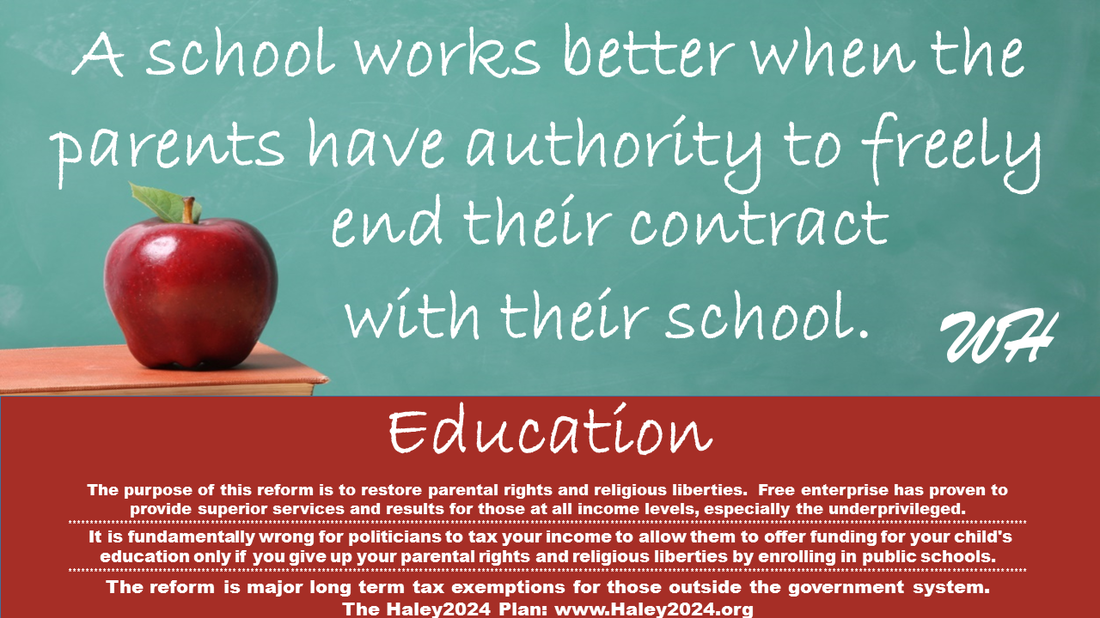
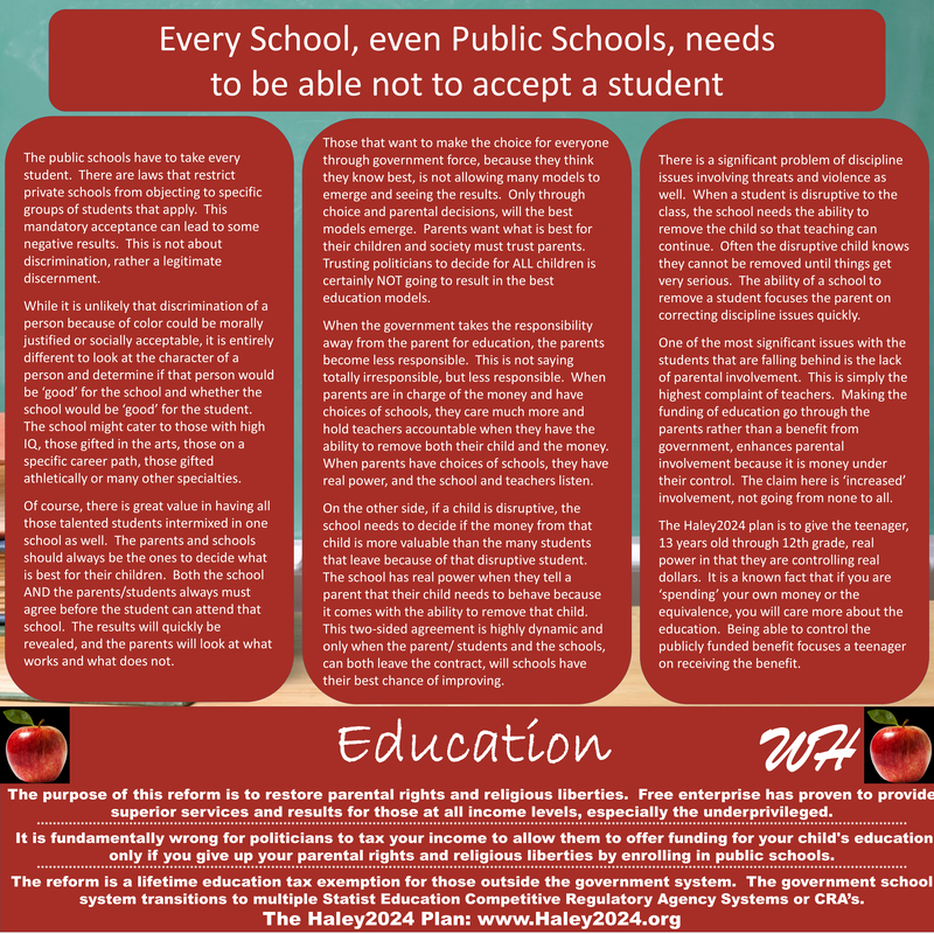
Every School, even Public Schools, needs to be able to not accept a student

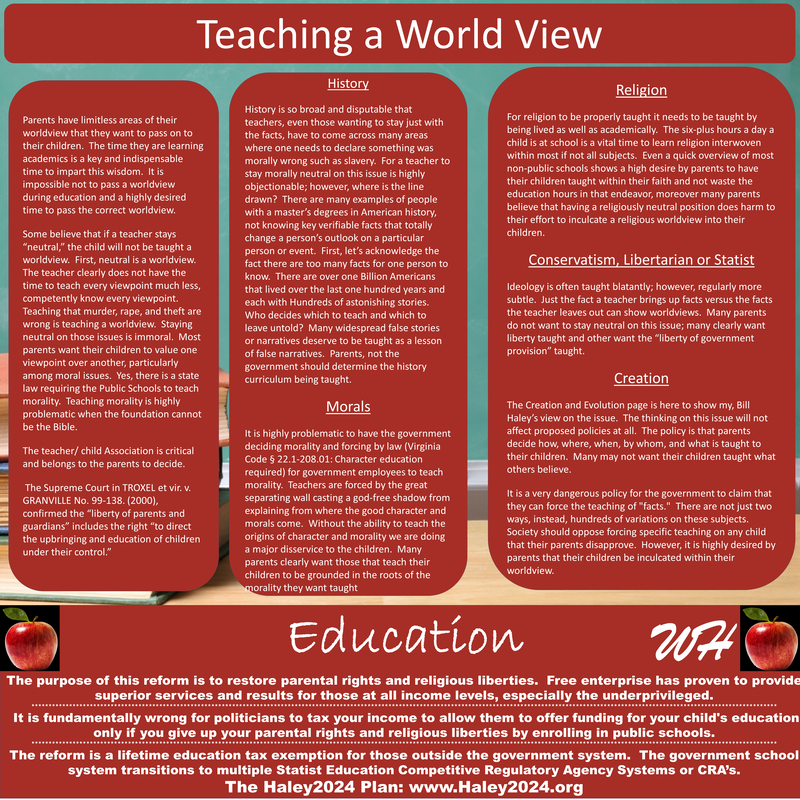
Teaching a World View

​It is overwhelming Clear, However if you had Doubts whether Parents have to give up Rights
Picture
Picture
The Public School System Inhibiting Religion 

​Birth Though College Governmental Control
Overwhelmingly obvious, however proof that parent are economically pressured by government taxing and spending, to give up their right to direct their children’s education and enroll their children in government schools.  
Picture
Education Spending Per Student by State

Picture
Picture
Picture

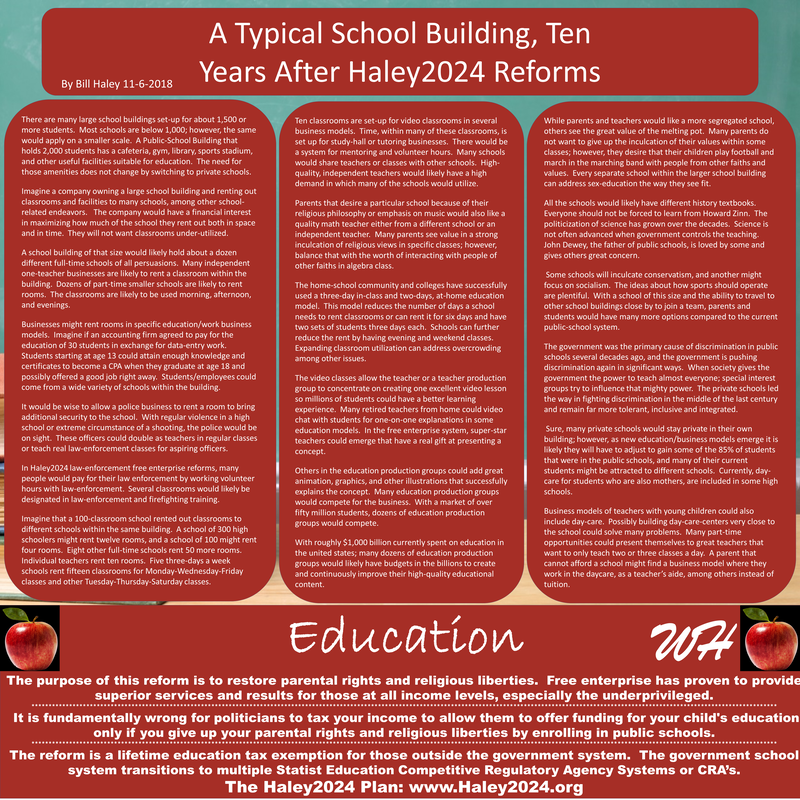
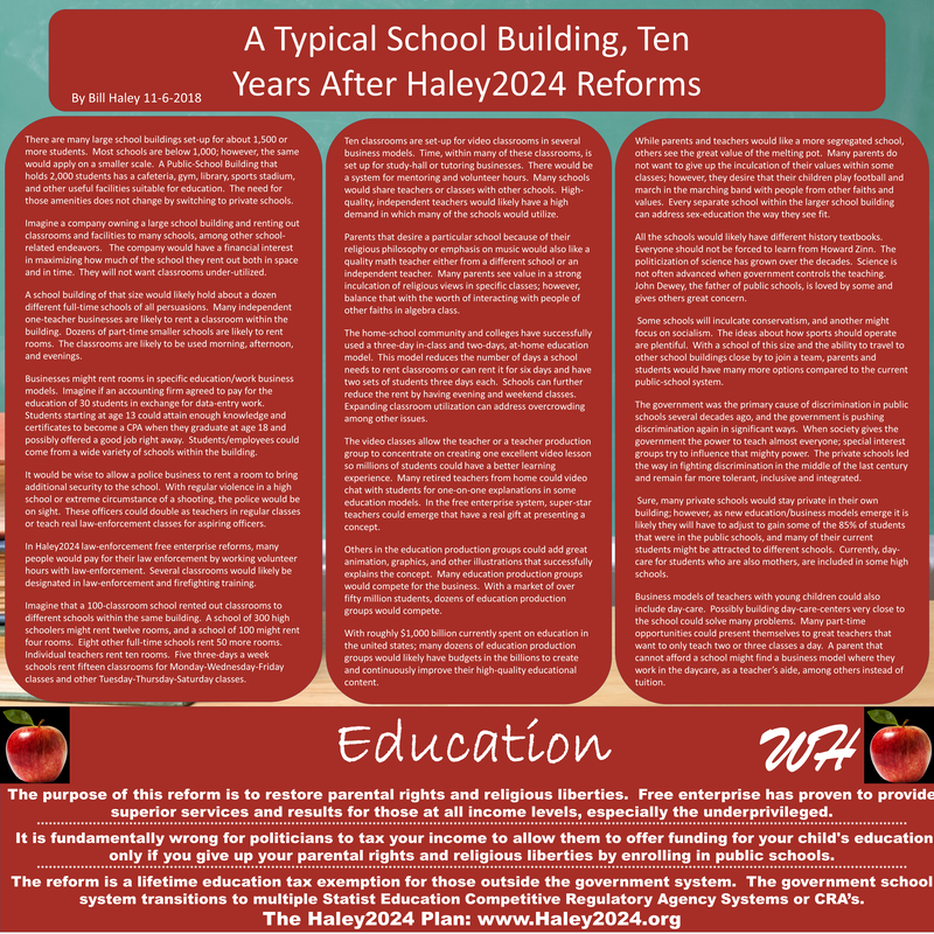
A Typical School Building, Ten Years After Haley2024 Reforms

11/6/2018

 
There are many large school buildings set-up for about 1,500 or more students.  Most schools are below 1,000; however, the same would apply on a smaller scale.  A Public-School Building that holds 2,000 students has a cafeteria, gym, library, sports stadium, and other useful facilities suitable for education.  The need for those amenities does not change by switching to private schools.
Picture
Picture
Imagine a company owning a large school building and renting out classrooms and facilities to many schools, among other school-related endeavors.   The company would have a financial interest in maximizing how much of the school they rent out both in space and in time.  They will not want classrooms under-utilized.  
A school building of that size would likely hold about a dozen different full-time schools of all persuasions.  Many independent one-teacher businesses are likely to rent a classroom within the building.  Dozens of part-time smaller schools are likely to rent rooms.  The classrooms are likely to be used morning, afternoon, and evenings.
Picture
Picture
Businesses might rent rooms in specific education/work business models.  Imagine if an accounting firm agreed to pay for the education of 30 students in exchange for data-entry work.  Students starting at age 13 could attain enough knowledge and certificates to become a CPA when they graduate at age 18 and possibly offered a good job right away.  Students/employees could come from a wide variety of schools within the building.    
It would be wise to allow a police business to rent a room to bring additional security to the school.  With regular violence in a high school or extreme circumstance of a shooting, the police would be on sight.  These officers could double as teachers in regular classes or teach real law-enforcement classes for aspiring officers.
Picture
Picture
In Haley2024 law-enforcement free enterprise reforms, many people would pay for their law enforcement by working volunteer hours with law-enforcement.  Several classrooms would likely be designated in law-enforcement and firefighting training. 
Imagine that a 100-classroom school rented out classrooms to different schools within the same building.  A school of 300 high schoolers might rent twelve rooms, and a school of 100 might rent four rooms.  Eight other full-time schools rent 50 more rooms.  Individual teachers rent ten rooms.  Five three-days a week schools rent fifteen classrooms for Monday-Wednesday-Friday classes and other Tuesday-Thursday-Saturday classes.
Picture
Picture
Ten classrooms are set-up for video classrooms in several business models.  Time, within many of these classrooms, is set up for study-hall or tutoring businesses.  There would be a system for mentoring and volunteer hours.  Many schools would share teachers or classes with other schools.  High-quality, independent teachers would likely have a high demand in which many of the schools would utilize.
Parents that desire a particular school because of their religious philosophy or emphasis on music would also like a quality math teacher either from a different school or an independent teacher.  Many parents see value in a strong inculcation of religious views in specific classes; however, balance that with the worth of interacting with people of other faiths in algebra class. 
Picture
Picture
The home-school community and colleges have successfully used a three-day in-class and two-days, at-home education model.  This model reduces the number of days a school needs to rent classrooms or can rent it for six days and have two sets of students three days each.  Schools can further reduce the rent by having evening and weekend classes.  Expanding classroom utilization can address overcrowding among other issues.
The video classes allow the teacher or a teacher production group to concentrate on creating one excellent video lesson so millions of students could have a better learning experience.  Many retired teachers from home could video chat with students for one-on-one explanations in some education models.  In the free enterprise system, super-star teachers could emerge that have a real gift at presenting a concept. 
Picture
Picture
Others in the education production groups could add great animation, graphics, and other illustrations that successfully explains the concept.  Many education production groups would compete for the business.  With a market of over fifty million students, dozens of education production groups would compete. 
With roughly $1,000 billion currently spent on education in the united states; many dozens of education production groups would likely have budgets in the billions to create and continuously improve their high-quality educational content.     
Picture
Picture
While parents and teachers would like a more segregated school, others see the great value of the melting pot.  Many parents do not want to give up the inculcation of their values within some classes; however, they desire that their children play football and march in the marching band with people from other faiths and values.  Every separate school within the larger school building can address sex-education the way they see fit. 
All the schools would likely have different history textbooks.  Everyone should not be forced to learn from Howard Zinn.  The politicization of science has grown over the decades.  Science is not often advanced when government controls the teaching.  John Dewey, the father of public schools, is loved by some and gives others great concern. 
Picture
Picture
Some schools will inculcate conservatism, and another might focus on socialism.  The ideas about how sports should operate are plentiful.  With a school of this size and the ability to travel to other school buildings close by to join a team, parents and students would have many more options compared to the current public-school system. 
The government was the primary cause of discrimination in public schools several decades ago, and the government is pushing discrimination again in significant ways.  When society gives the government the power to teach almost everyone; special interest groups try to influence that mighty power.  The private schools led the way in fighting discrimination in the middle of the last century and remain far more tolerant, inclusive and integrated.   
Picture
Picture
 Sure, many private schools would stay private in their own building; however, as new education/business models emerge it is likely they will have to adjust to gain some of the 85% of students that were in the public schools, and many of their current students might be attracted to different schools.  Currently, day-care for students who are also mothers, are included in some high schools. 
Business models of teachers with young children could also include day-care.  Possibly building day-care-centers very close to the school could solve many problems.  Many part-time opportunities could present themselves to great teachers that want to only teach two or three classes a day.  A parent that cannot afford a school might find a business model where they work in the daycare, as a teacher’s aide, among others instead of tuition.
Picture
Picture
Picture

Parents and Students Have the RIGHT to Pick the World-View in which Their or Their Children’s Academic Education Is Taught.

2/24/2018

0 Comments


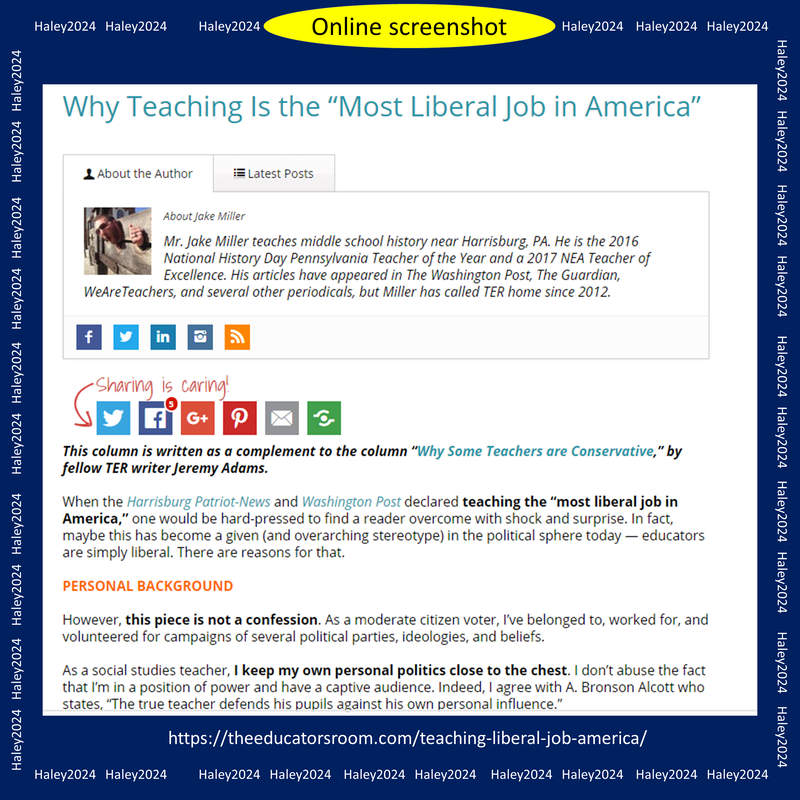
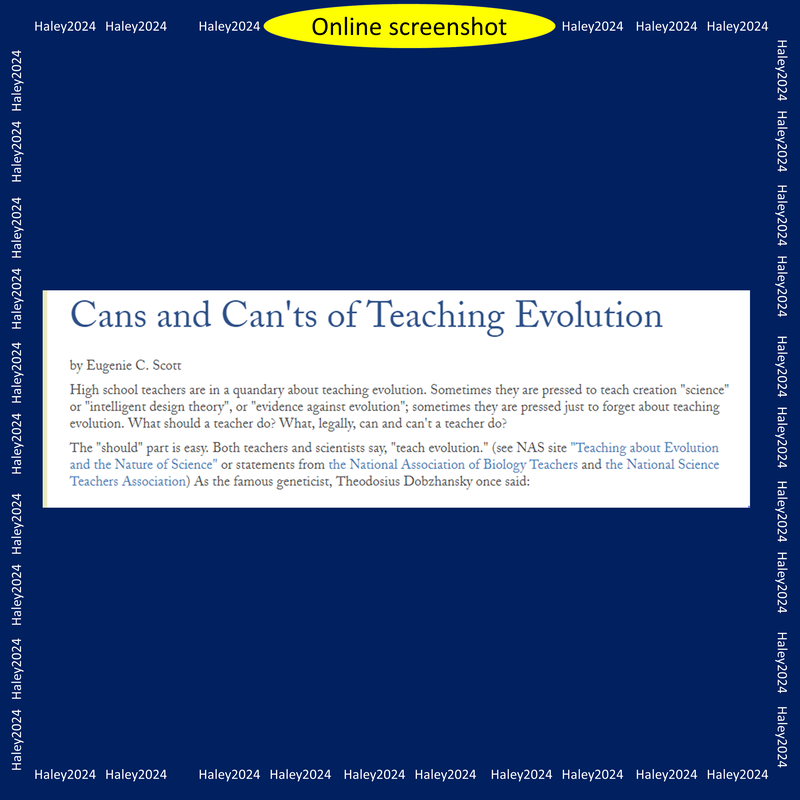
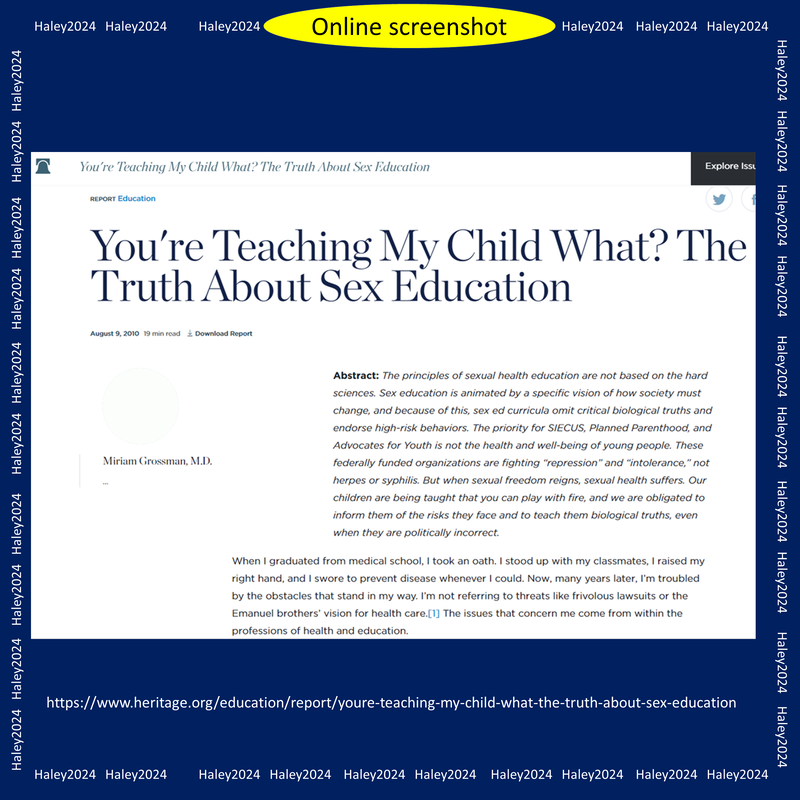
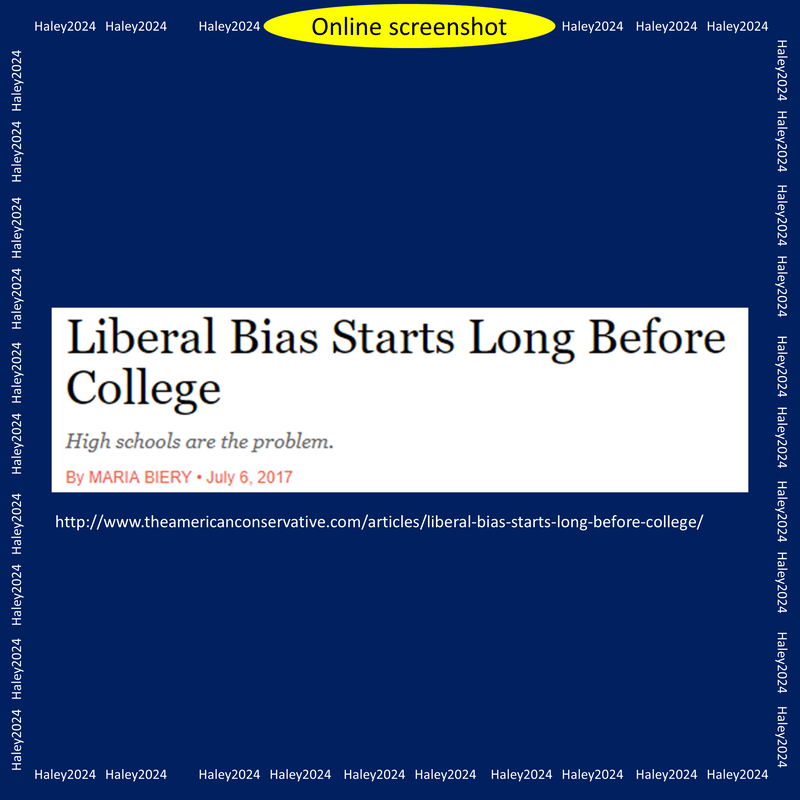
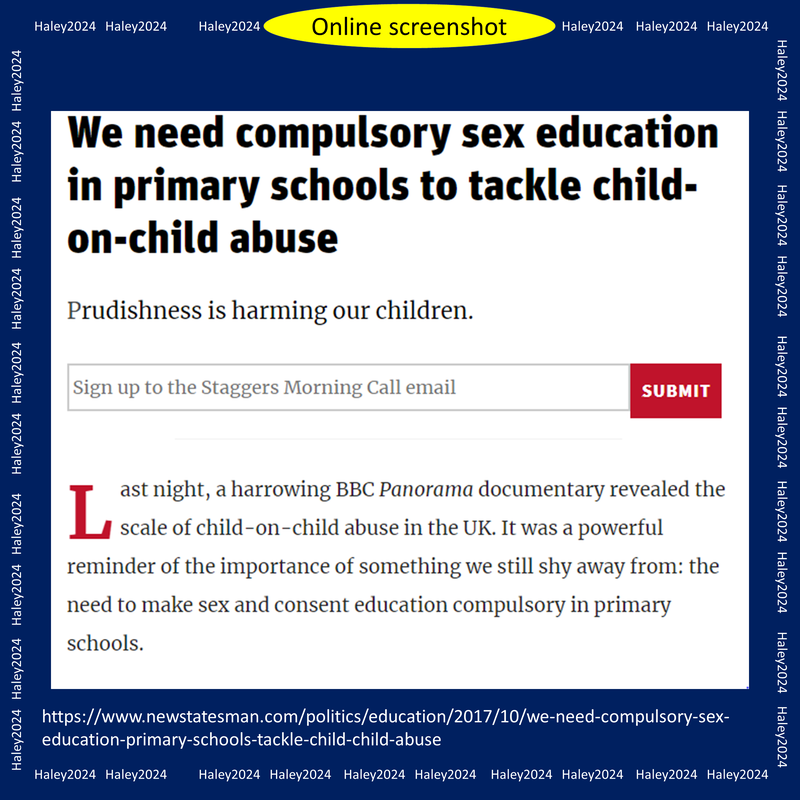
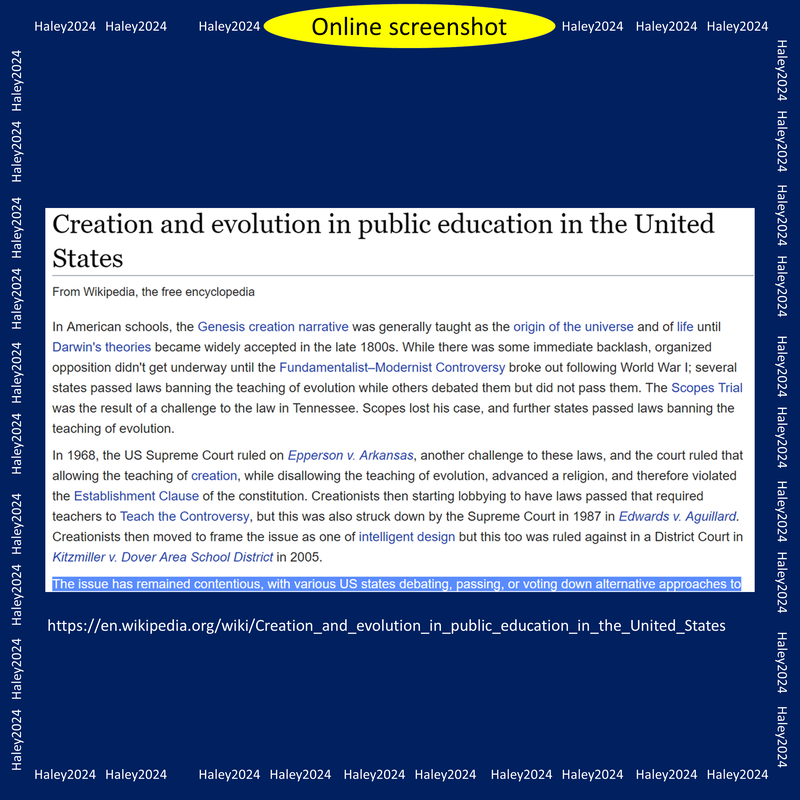
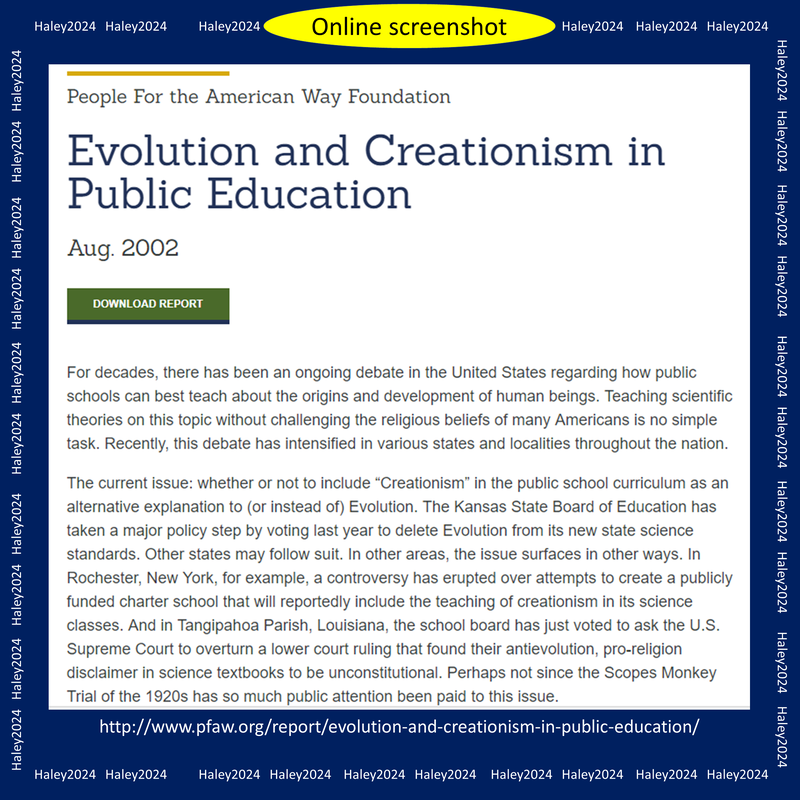
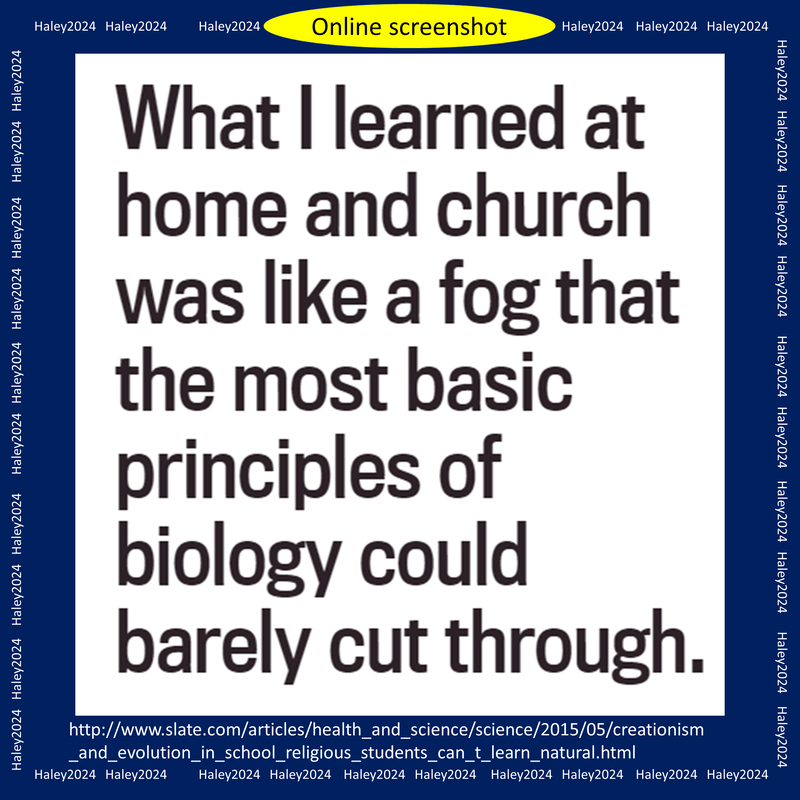
I have included many stories from the internet to give examples of the issues out there.  Many of those have links to the stories. 

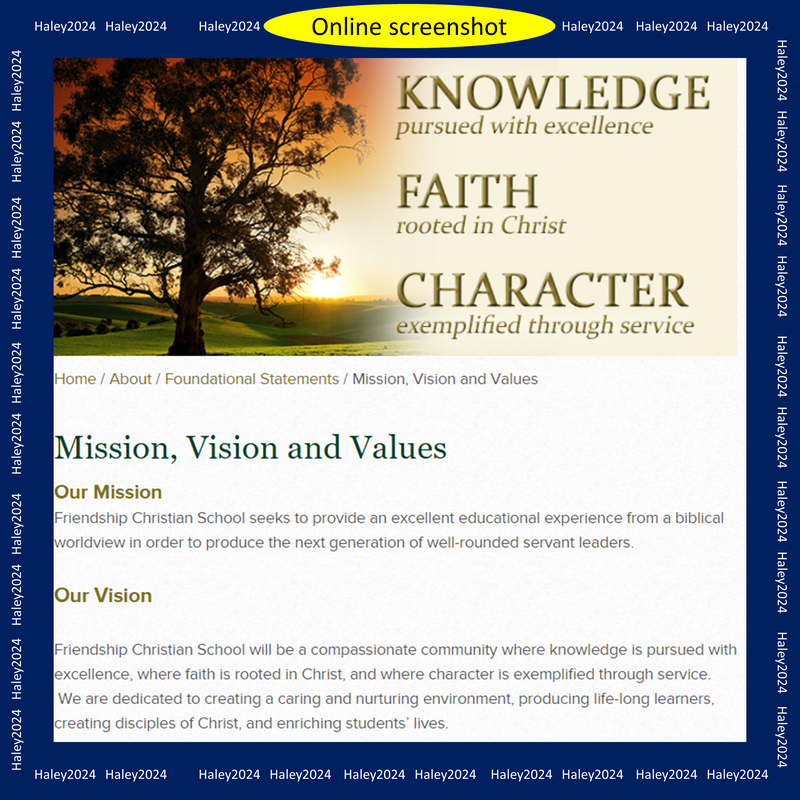
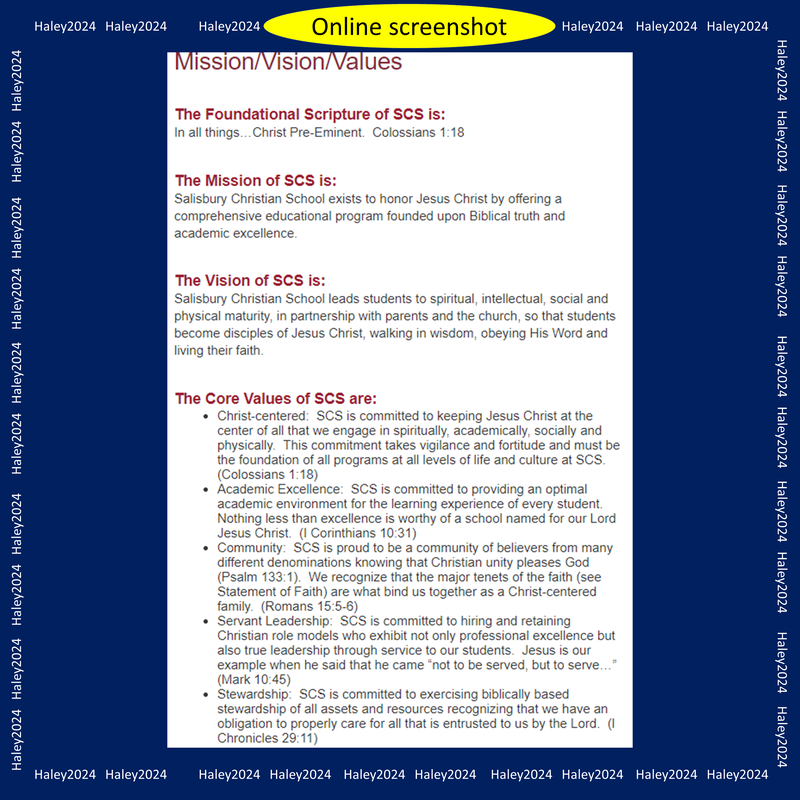
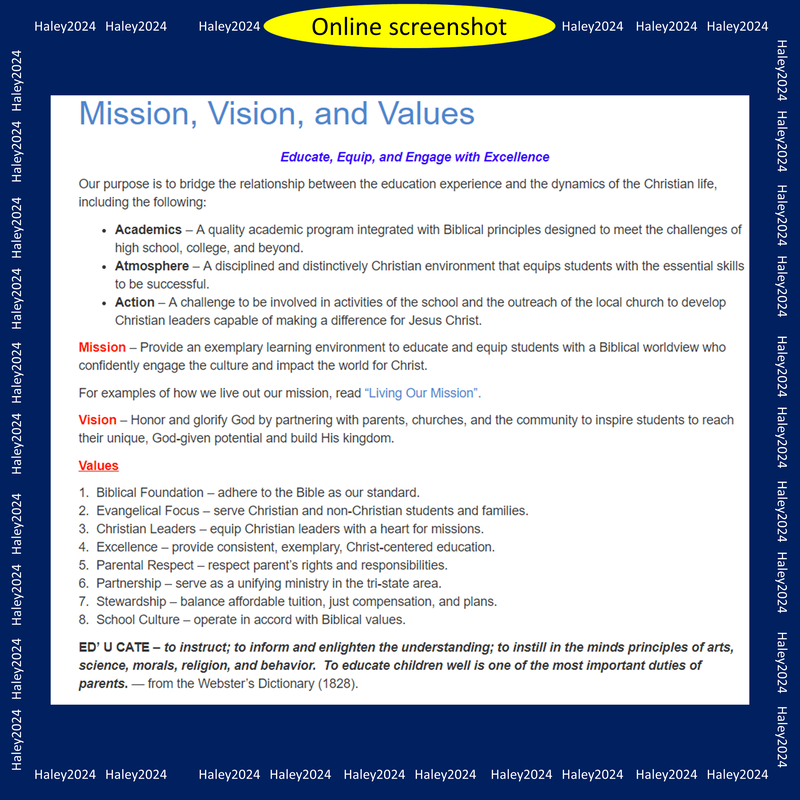
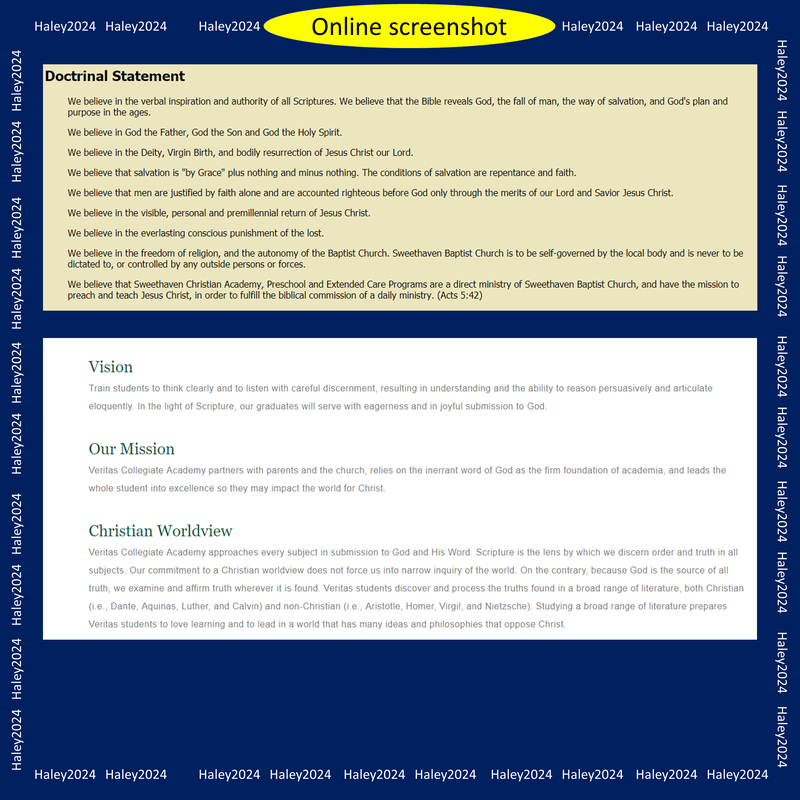
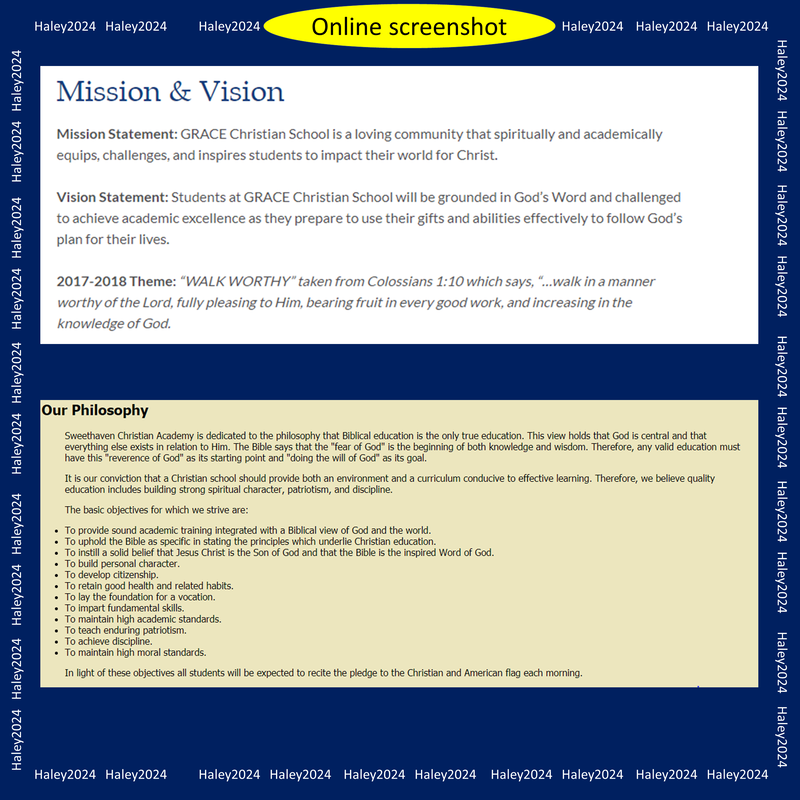
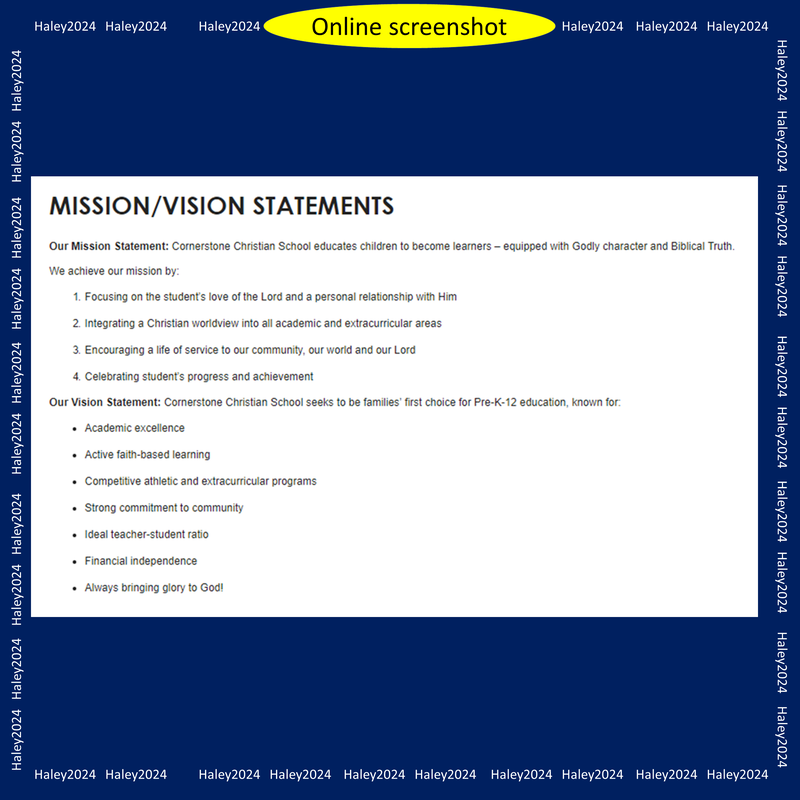
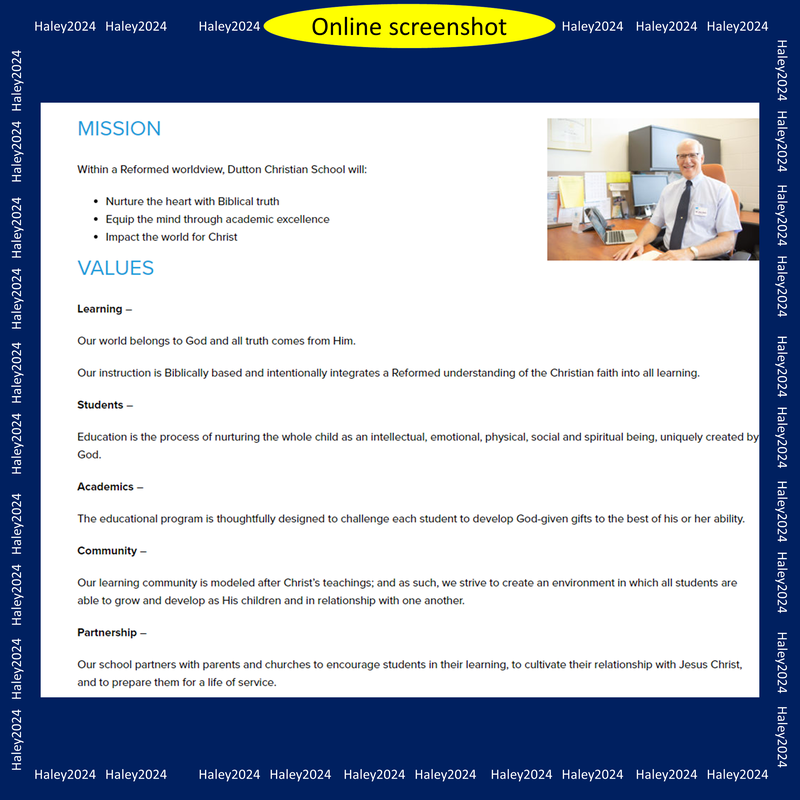
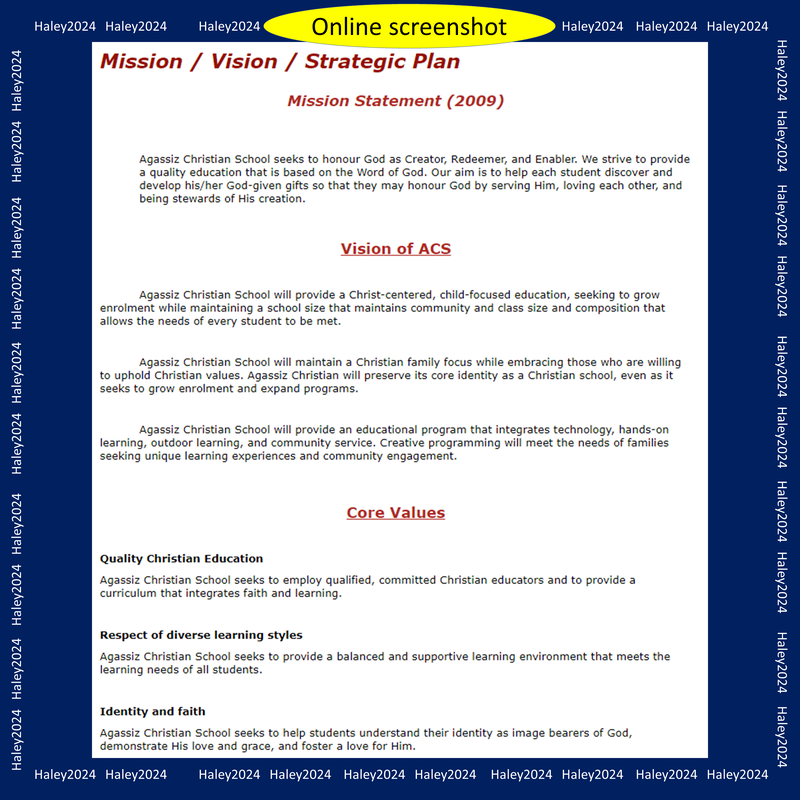
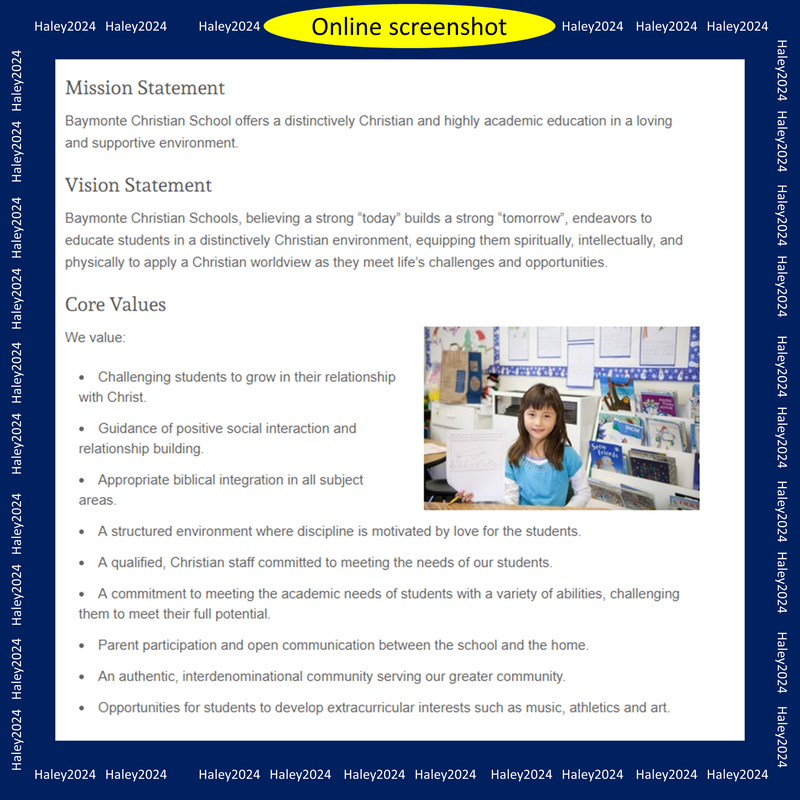
 I have included random Mission, Vision, and Values statements from many Christian schools (no links) to show how the private schools in the free enterprise system advertise their world-views.

​ To try to stop confusion, my words, are in this shade of green. 

Picture
Picture
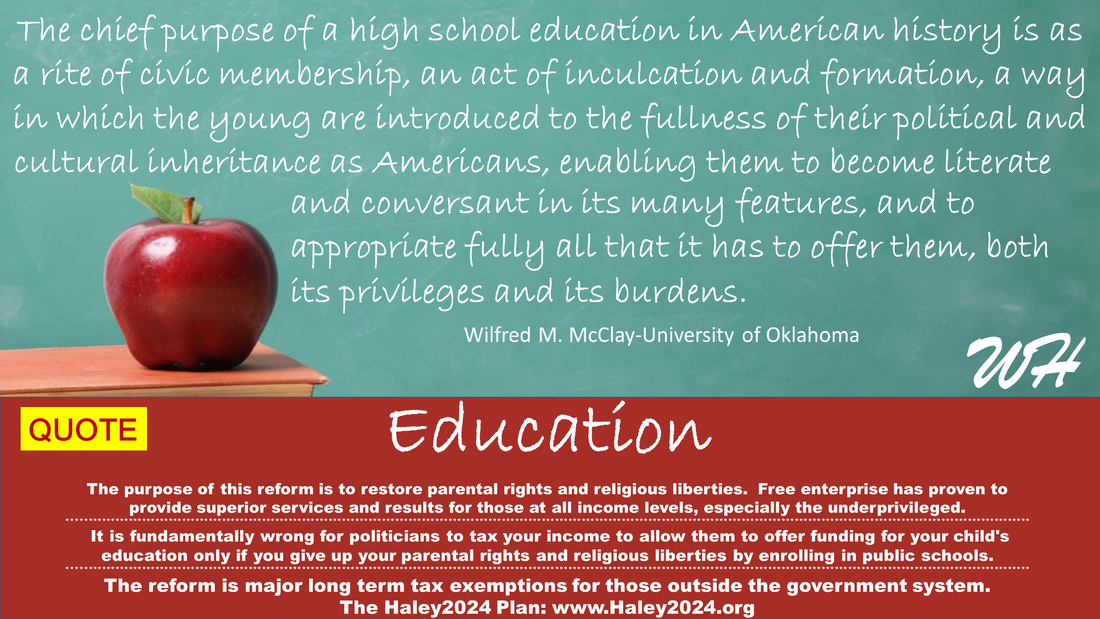
Government’s interest in K-12 education is primarily that children grow into adults that are literate and numerate in order to hold a job and be an interdependent and contributing part of the society.   Surely there are other components as well to be well rounded. 

As long as children are progressing down that path, there should be NO role in government deciding the worldview in which the students are taught.  
​
​Parents and teenage students should have the deciding role in ALL the controversial issues.  How is sex education taught?  How is evolution approached?  What are the social norms in society?  
Picture
Picture
​What is freedom, capitalism and socialism, and what is better?  How is religion incorporated into education?  What is the purpose of education?  What are the limitations of science and how much is overreaching?  
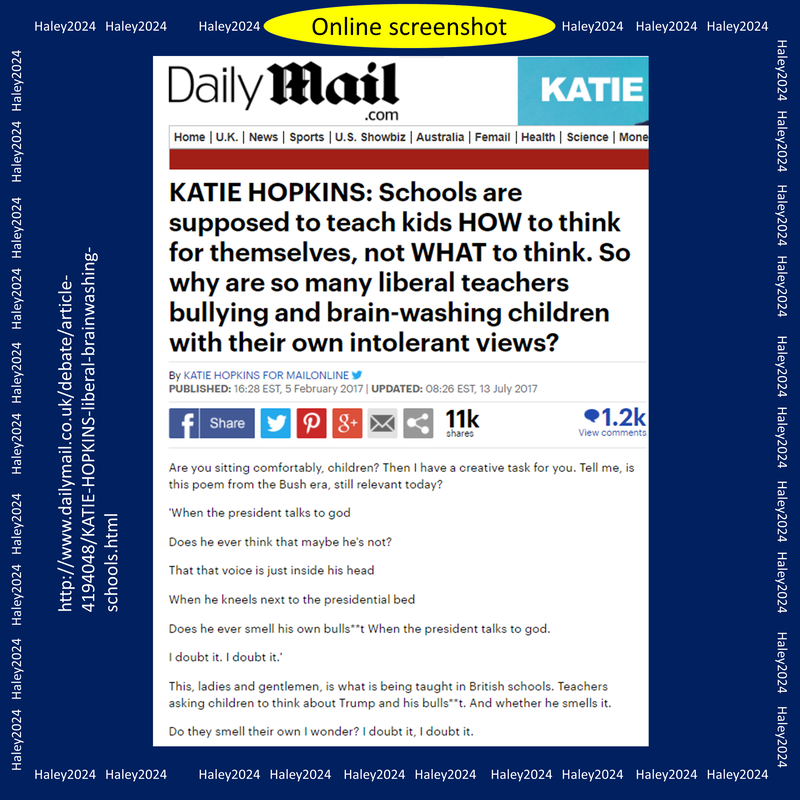
Should the Bible be the basis for morality?  If not, who gets to decide?  Are we allowed to teach stealing is wrong or is that mixing church and state in public schools?  Is the non-aggression principle the highest ideal?  Should education undermine your values?  Should education teach us how to think or what to think or both?  Should you be taught to be intolerant of, immorality or intolerance?  
Picture
Picture
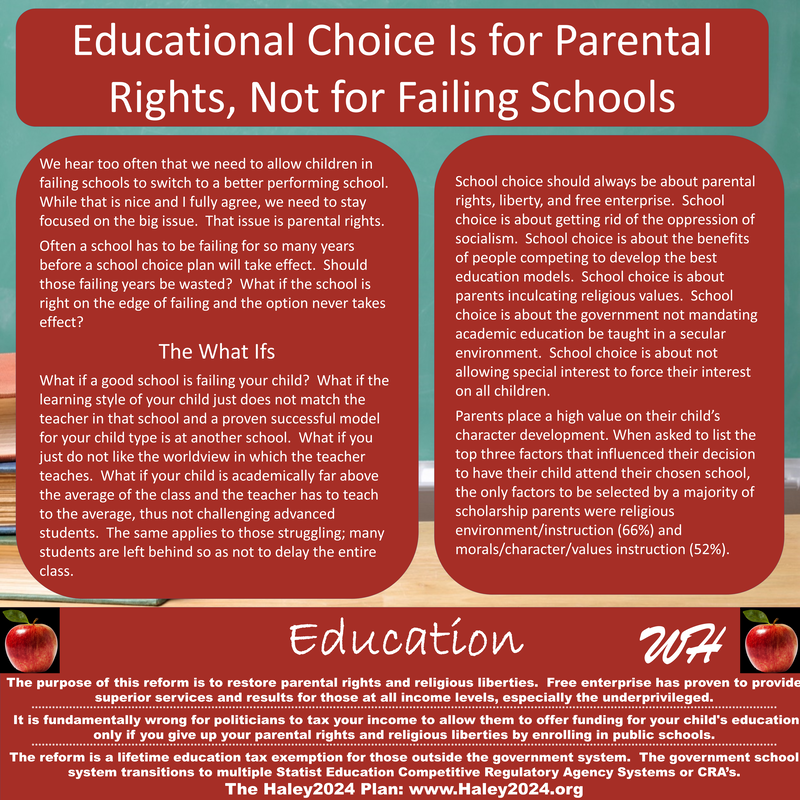
​Too many people make the case that there are better ways and worse ways to educate children on all these issues and want to force ALL students to their perception of the superior choice.  Many even claim educational child abuse or child education neglect when parents choose certain pathways.  
Too many people think that they have discovered the ‘TRUTH’ or the ‘MORALITY’ and wish to impose THEIR way of thinking on everyone.  Too many claim science has determined; thus it is a fact when smart and educated people have real questions about the science.  Too many determine that studies PROVE a certain issue thus it must be taught to everyone.     
Picture
Picture
Some people advocate that children should ONLY be taught how to think and not what to think.  Others whole heartily disagree and make a strong case for a healthy balance of both.  Many parents understand that young children are impressionable and need clear and ongoing morals training.  Older adults that have lived a long life and have many decades of continued studies on all these issues still have major differences on the values to instill.
When there is a monopoly on education and every child must be taught the same, there is a fierce battle over what is taught.  When the winner takes all, the stakes are very high.  Counterfactuals are eliminated or minimized.  People use every political and legal weapon to take down the other side in their efforts to have their children educated within their viewpoint.  Protests and ill-will from the losing sides sow discord among the people.  Many parents feel they need to correct the teacher which undermines the education constantly.   
Picture
Picture
​When parents do not have a say other than being one of the millions of voters on what THEIR children are taught, there is despair and a real feeling that parental responsibility is diminished.  The 30 hours in class, plus travel time and homework per week monopolizes a child’s time and leaves little time to teach issues that are wrong or missing in the schools.  It is far better to have those academic hours to inculcate the lessons, values, principles, and morals you, the parents, determine are the most important.    
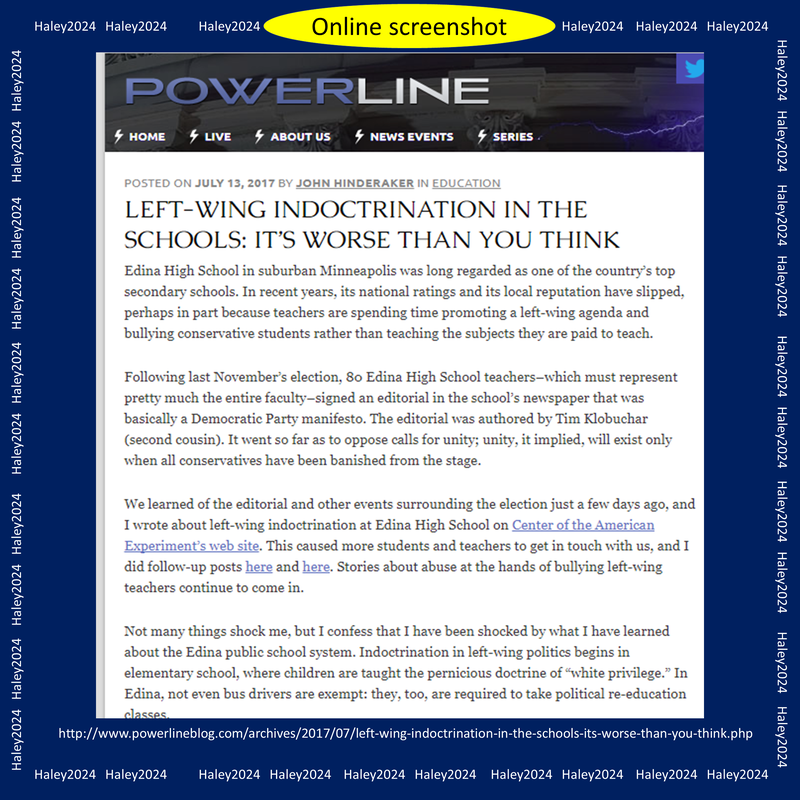
​Some think that it is good to have that monopoly, so that all children can be taught patriotism, until the other side wins and ‘America-the-oppressor’ is taught to everyone.  A healthy Judeo-Christian sex education yields to perversion.  Liberty education yields to socialism.  The values of the traditional family yields to anything goes.  Self-esteem built from achievement yields to simply self-esteem.  Morality based on the Bible yields to self-defined morality   
Picture
Picture
​In conclusion, parents and students have the RIGHT to pick the world-view in which their or their children’s academic education is taught.  The free enterprise system creates many options and parents are empowered to pick the option that is best for the student.  Having many counterfactuals, parents will have more information to make the right chooses.  Different parents will always have different ideas about the desired methods and outcomes; however, when everyone chooses, better outcomes will result.  Liberty will be preserved.    
Picture
Picture
Picture
Picture
Picture
Picture
Picture
Picture
Picture
Picture
Picture
Picture
Picture
Picture
Picture
Picture
Picture
0 Comments

Another Great School Plan

11/28/2015

 
Second Best in Education
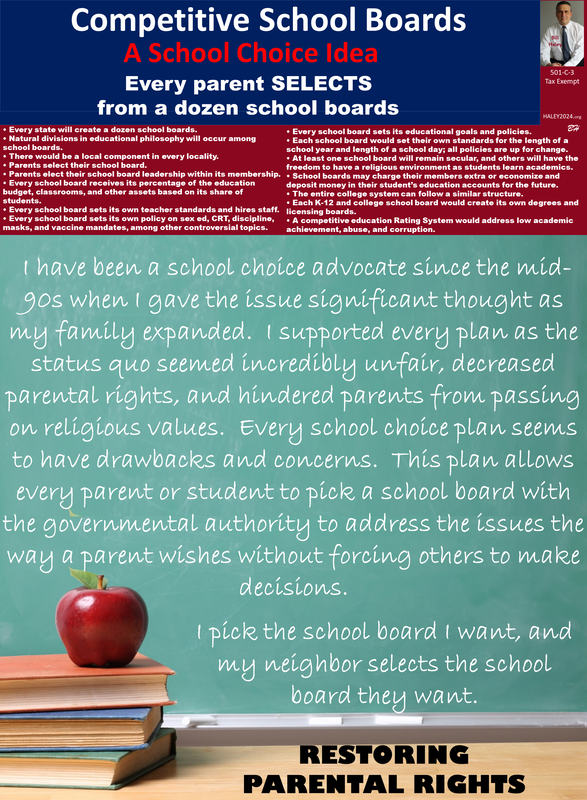
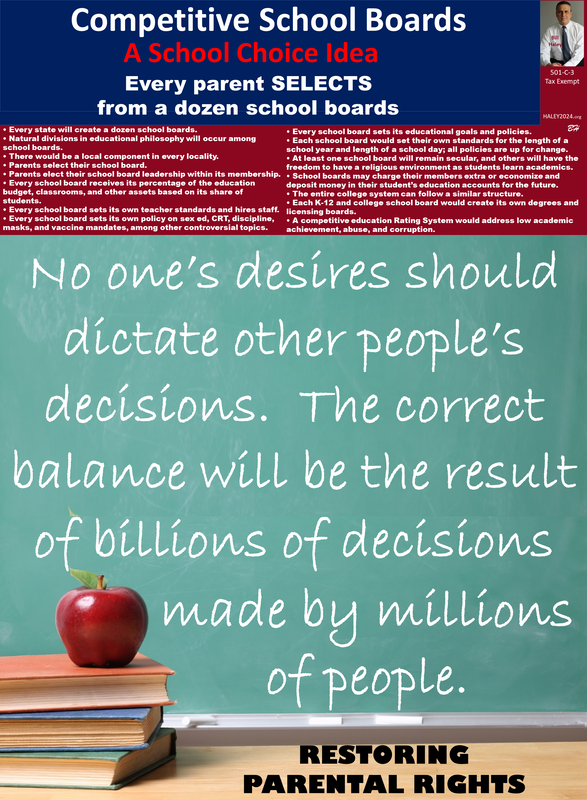
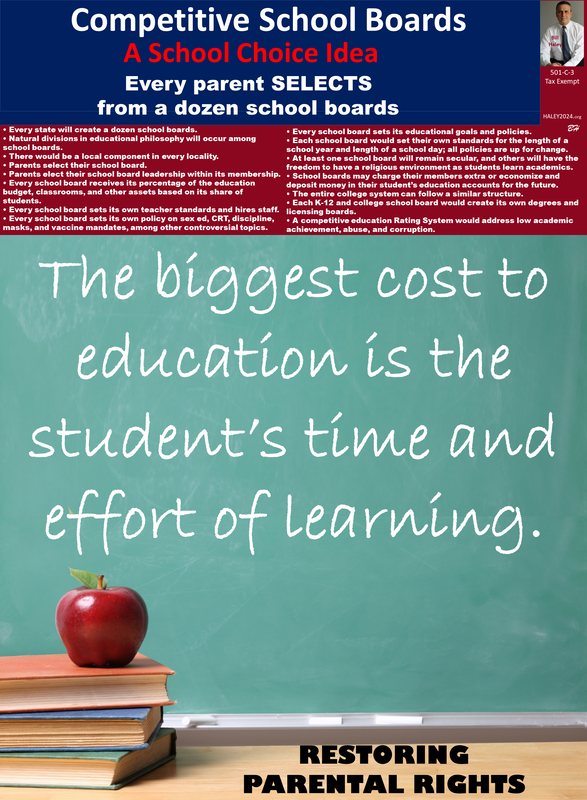
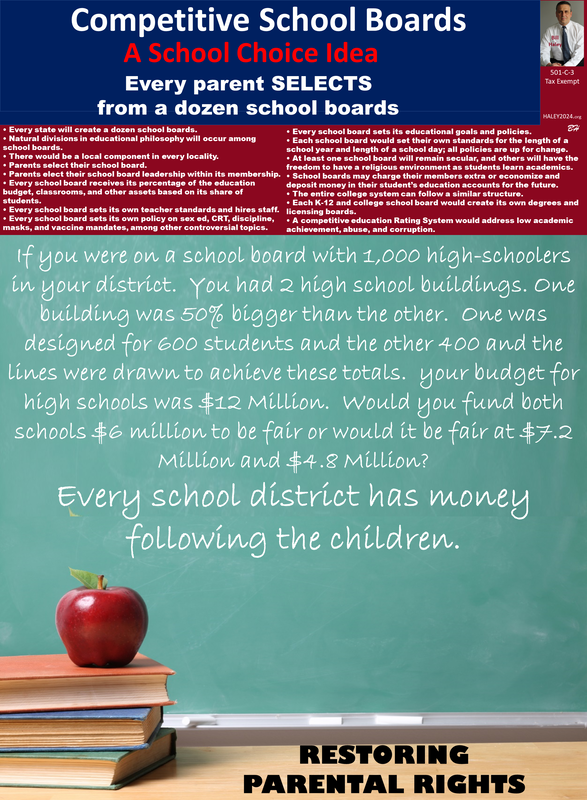
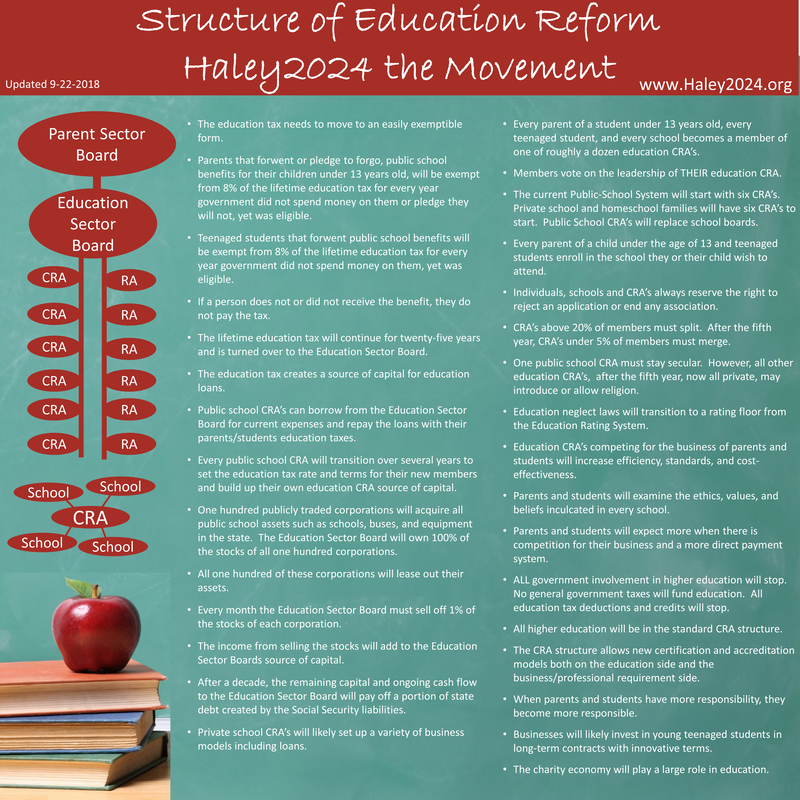
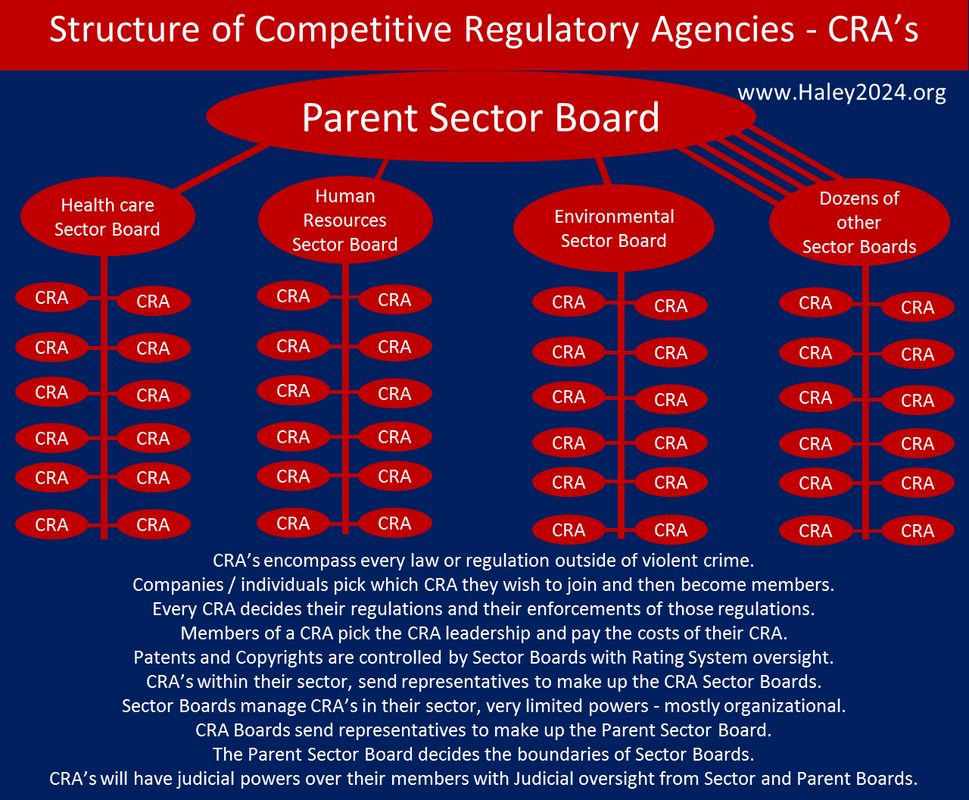
Allow a dozen Public School Boards (CRA’s on my charts) to exist within each city or county.  Every parent with an eligible child would pick which School board (CRA) they wish to control their child’s education.  All parents of students who choose that school board, elects their school board members.
Picture
Picture
Since there are many choices, roughly a dozen, all restrictions would be lifted on inculcating religion during academic teaching.  One school board CRA would still be run by the government with all the restrictions.  However, the others would be free to be run similar to private schools now.
All current laws requiring a minimum number of days and length of days would be lifted.  The current system is swimming in hundreds of requirement that is best left to the free enterprise system.  The new school boards would make these or allow the schools under them have considerable leeway in creating their own regulations.  The best is only achieved when people have the freedom to innovate.  
Picture
Picture
Every school board is given an equal amount of funds per student.  Special needs students have a separate budget.  If the school board can achieve cost savings, the savings are deposited in each student’s educational saving account.  Educational saving accounts can be used in that current year for tutors, online educational assistance, approved extracurricular activities (sports, music, and clubs) among others.
Money can also roll over to future years of k-12 or into college.  Trade schools and other approved expenses would qualify.  If a school Board wishes to add an additional tuition per child, they can.  Any funds not used always stays in that person’s personal educational saving account and could be applied to their children.
Picture
Picture
The school board CRA parent group will coordinate all assets of the schools and divide them up and create publicly traded corporations on each.  One percent of the stocks of each corporation would be sold per month in the manner described here.  Rentals of buildings, buses, and equipment would be standard with long-term rent to own, or other arrangements agreed to by all parties.
​
Once the people owning the stocks completely own these corporations, all options are open.  All money from the sale of these stocks will go back into the education budget and be added to the per-student payout.  The sale of stocks will last about 8.5 years.   
Picture
Picture
Every parent/ student will now have many options for high-quality education.  Many new business/ educational models would emerge.  School boards would run their own system and would be able to compete for students.  States and cities would have policies for students to cross state, city or county lines.    
Current private or homeschool families would likely go into these School board CRA’s because there would be several that would be entirely open to parental control or academic education infused with religious inculcation.
Picture
Picture
Nevertheless, one CRA would be designated for current private schools or home educated and would only disperse money in the educational saving accounts.   At the age of thirty, if any money is still in a person’s personal account, they will have the option of donating to another’s account or to pay off some taxes.  Of course, they could always keep the funds in their account for future education. 

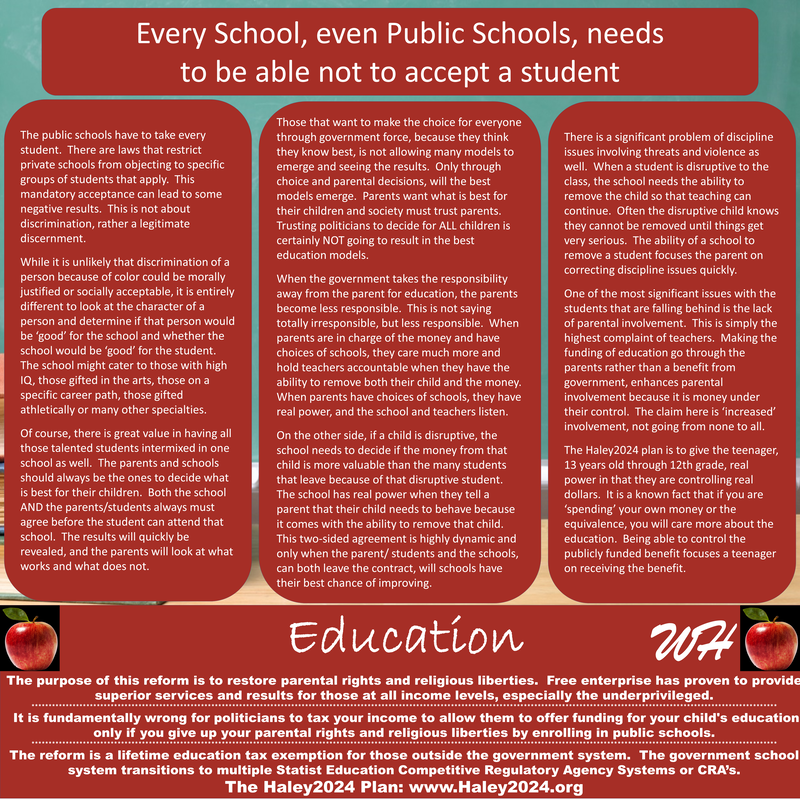
Every School, even Public Schools, needs to be able not to accept a student

11/8/2015

 
The public schools have to take every student.  There are laws that restrict private schools from objecting to specific groups of students that apply.  This mandatory acceptance can lead to some negative results.  This is not about discrimination, rather a legitimate discernment.  

Picture
Picture
While it is unlikely that discrimination of a person because of color could be morally justified or socially acceptable, it is entirely different to look at the character of a person and determine if that person would be ‘good’ for the school and whether the school would be ‘good’ for the student.  The school might cater to those with high IQ, those gifted in the arts, those on a specific career path, those gifted athletically or many other specialties. 
Of course, there is great value in having all those talented students intermixed in one school as well.  The parents and schools should always be the ones to decide what is best for their children.  Both the school AND the parents/students always must agree before the student can attend that school.  The results will quickly be revealed, and the parents will look at what works and what does not.
Picture
Picture
Those that want to make the choice for everyone through government force, because they think they know best, is not allowing many models to emerge and seeing the results.  Only through choice and parental decisions, will the best models emerge.  Parents want what is best for their children and society must trust parents.  Trusting politicians to decide for ALL children is certainly NOT going to result in the best education models. 
When the government takes the responsibility away from the parent for education, the parents become less responsible.  This is not saying totally irresponsible, but less responsible.  When parents are in charge of the money and have choices of schools, they care much more and hold teachers accountable when they have the ability to remove both their child and the money.  When parents have choices of schools, they have real power, and the school and teachers listen.
Picture
Picture
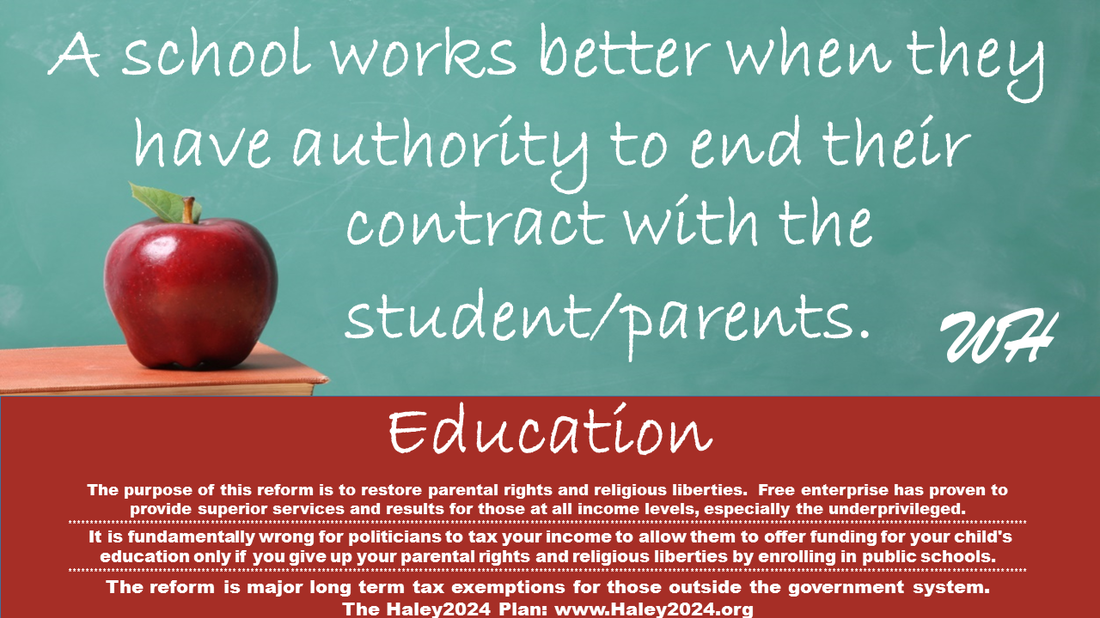
On the other side, if a child is disruptive, the school needs to decide if the money from that child is more valuable than the many students that leave because of that disruptive student.  The school has real power when they tell a parent that their child needs to behave because it comes with the ability to remove that child.  This two-sided agreement is highly dynamic and only when the parent/ students and the schools, can both leave the contract, will schools have their best chance of improving.   
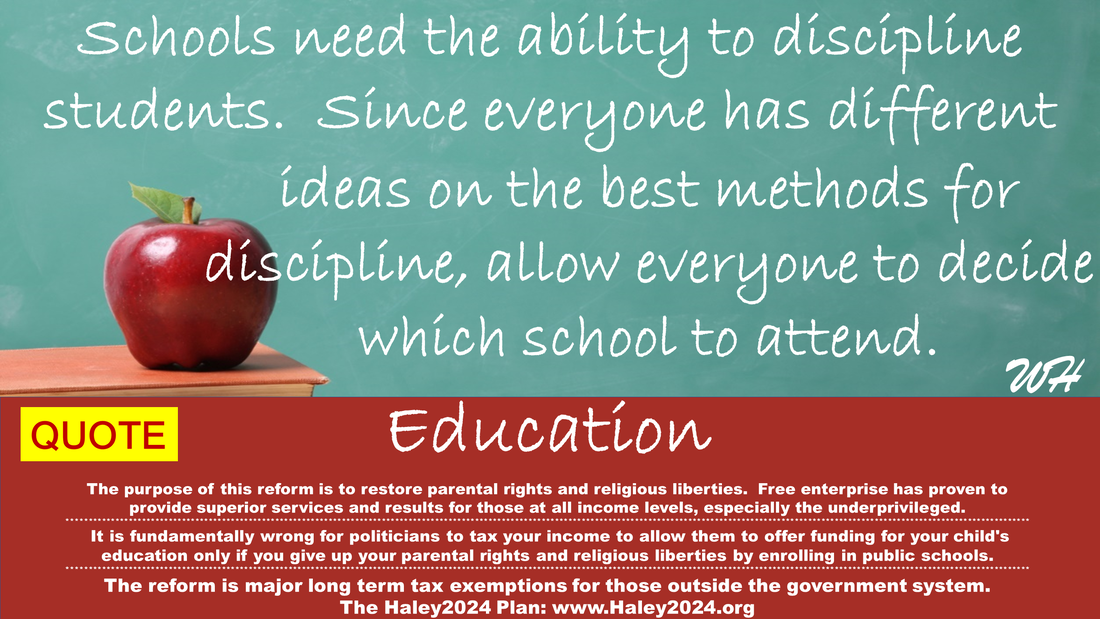
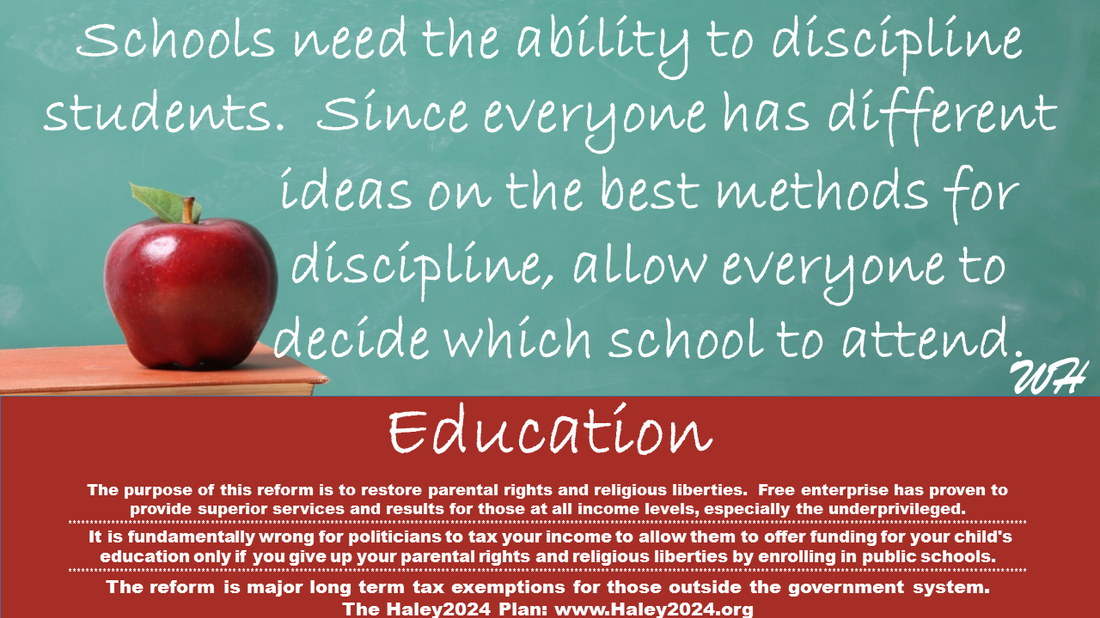
There is a significant problem of discipline issues involving threats and violence as well.  When a student is disruptive to the class, the school needs the ability to remove the child so that teaching can continue.  Often the disruptive child knows they cannot be removed until things get very serious.  The ability of a school to remove a student focuses the parent on correcting discipline issues quickly.  
Picture
One of the most significant issues with the students that are falling behind is the lack of parental involvement.  This is simply the highest complaint of teachers.  Making the funding of education go through the parents rather than a benefit from government, enhances parental involvement because it is money under their control.  The claim here is ‘increased’ involvement, not going from none to all.
​The Haley2024 plan is to give the teenager, 13 years old through 12th grade, real power in that they are controlling real dollars.  It is a known fact that if you are ‘spending’ your own money or the equivalence, you will care more about the education.  Being able to control the publicly funded benefit focuses a teenager on receiving the benefit.  
Picture
Picture

The Public School System Inhibiting Religion 

11/1/2015

 
This 7th Grader was shone hostility and doubt towards her religion.

​Many parents want their children to be encouraged spiritually and inculcated in their faith during the crucial hours learning their academics. Many people want teachers who are also believers of their same faith.  A lack of hostility is excellent; however, parents desire to pick a school that is proactively positive to their religion.
​
Picture
<<Previous
Please spread the word of these new government reforms.  Share this website with friends in emails and please link or share on social media. ​ Haley2024 the Movement

Contact

All Social Media Sites
This Haley2024 website is strictly non-profit: Educational on public policy. 
Contact: [email protected] or  [email protected]
​
Text 757-408-8255
This searches only www.Haley2024.org
Picture