COMPETITIVE GOVERNANCE

  • Haley2024
    • Home
    • FaceBook Pages 1-10 >
      • Competitive School Boards
      • End Welfare: Transition to Competitive Charity
      • Competitive Governance
      • Competitive Representative Agencies
      • 70% Democracy
      • Competitive Police
      • Competitive Military
      • Competitive Social Security
      • From Government to Societal Oversight
      • Competitive Roads
    • Facebook Pages 11-20 >
      • Competitive Currencies
      • Pockets of Freedom
      • Competitive Rating System
      • Competitive Prisons
      • Competitive HealthCare Systems
      • Competitive Family Law
      • Separate Government Authority into 30 Sectors
  • THE CORE
    • All Reforms In Constitutional Form >
      • Constitutional Amendment Creating the CRA Structure
    • Competitive Regulatory Agencies >
      • CRA Structure
      • The 30 Sectors >
        • The Food Sector
        • The Manufacturing Sector
        • The Human Resources and Sales Sector
        • The Identity Sector: Personal and Business
        • The Environmental Sector
        • The Work Safety and Disability Sector
        • The Media and Communications Sector
        • The Land and Water Sector
      • CRA Bullet Points
      • CRA: The Need for a New System
      • Media for CRAs
    • The Rating System >
      • Rating Structure
    • Welfare to Charity >
      • The Charity System
      • The Charity Structure
      • The Charty Sector
      • The Charitable Distribution Association - CDA Sector
      • The Charity Assessor Organization - AO Sector
      • The Family Law Sector
      • The Religious Sector
      • Media for Charity
    • Education >
      • Education Structure
      • Colleges
      • The Public School System Is Unconstitutional
      • Education articles and Videos
    • Structure of the Foreign Policy and Private Military >
      • The Diplomatic Foreign Policy - DFP Sector
      • The Commander in Chief - CIC Sector
      • The Military Corporations Sector
      • The Military Capabilities System MCS Sector
      • The Military Authorization Agency - MAA Sector
    • Social Security and Medicare >
      • The Insurance Sector
    • Roads / Transportation >
      • Media on Road
  • Others
    • Monetary Policy >
      • Financial Sectors 18 and 19
      • Monetary Policy Structure
      • Monetary Policy Media
    • Health Care >
      • Heath Care Media
    • Fighting Federal Control >
      • Governor's Repeal
      • The Supreme Court
      • A New Court System
      • Changing the Head of the Inspectors General
    • Haleynomics >
      • Educational Media and Books
      • Laffer Curve
    • Statism organizations
    • A Citizens Responsibility
  • More
    • Violent Crime Mitigation System >
      • The Violent Crime (VC) Sector
      • Police >
        • Police Structure
      • Law Enforcement Authorization (LEA)
      • The Judicial Authorities Sector
      • Prison and Corrections
    • Corporate Proxy Groups
    • Haley2024 taxes >
      • Taxes
    • Debt
    • Foreign Policy: Pockets of Freedom
  • Blogs
    • Blog on Welfare to Charity
    • Blog on Haleynomics
    • Blog on Monetary Policy
    • Blog on Haley2024 the Movement
    • Blog on issues of the day
    • Blog on Education
    • Blog on Competitive Regulatory Agencies
    • Blog on Health Care
    • Blog on Ratings
    • Blog on EPA
    • Blog on Roads
    • Blog on Pockets of Freedom
    • Blog on Social Security
    • Blog on Military
    • Blog Statism Organizations
    • Blog on Social Issues
  • About the Movement
    • About Bill
    • MY STUDY
    • Social Media
  • Donate
    • Volunteer!

The Military Corporations Sector
Competitive Governance within every geographic jurisdiction

Picture
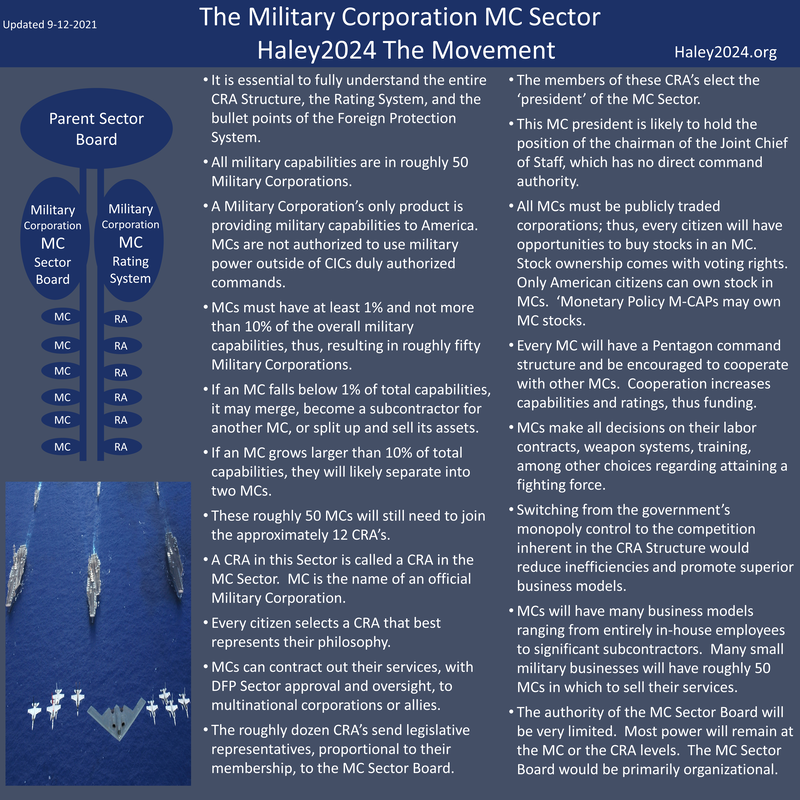
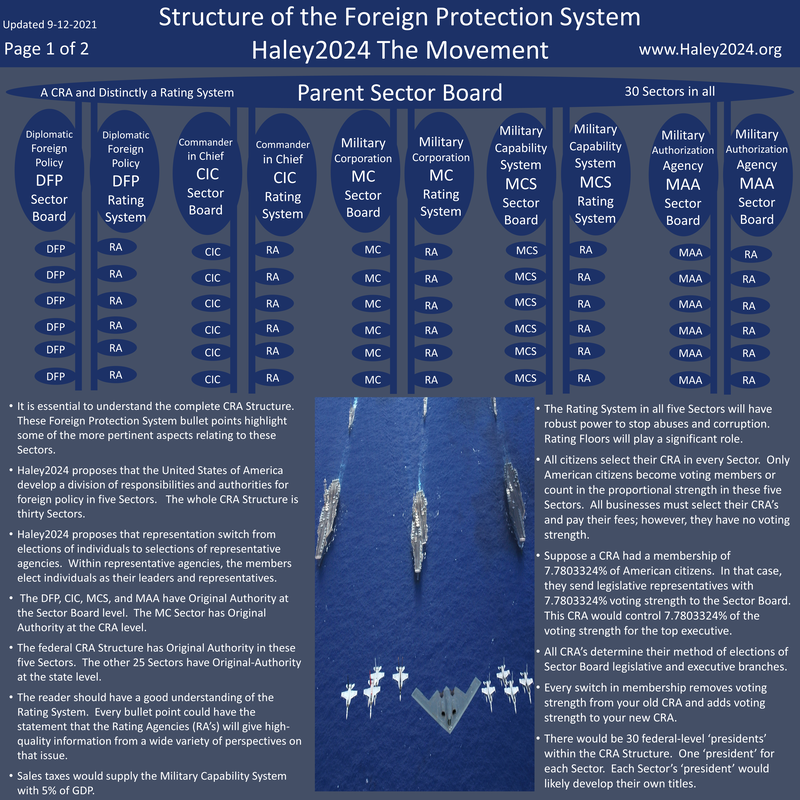
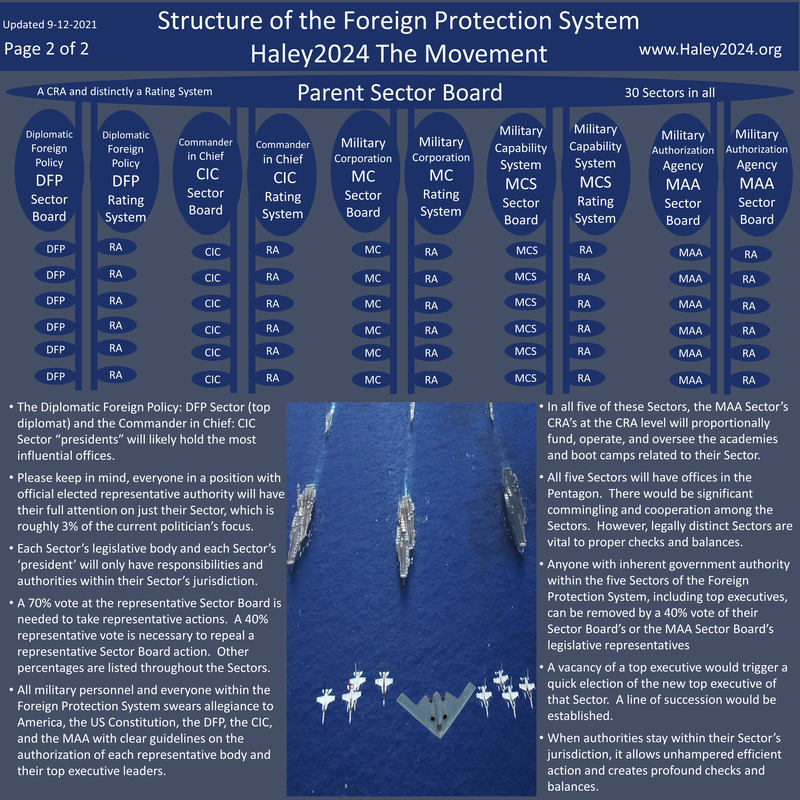
•It is essential to fully understand the entire CRA Structure, the Rating System, and the bullet points of the Foreign Protection System.

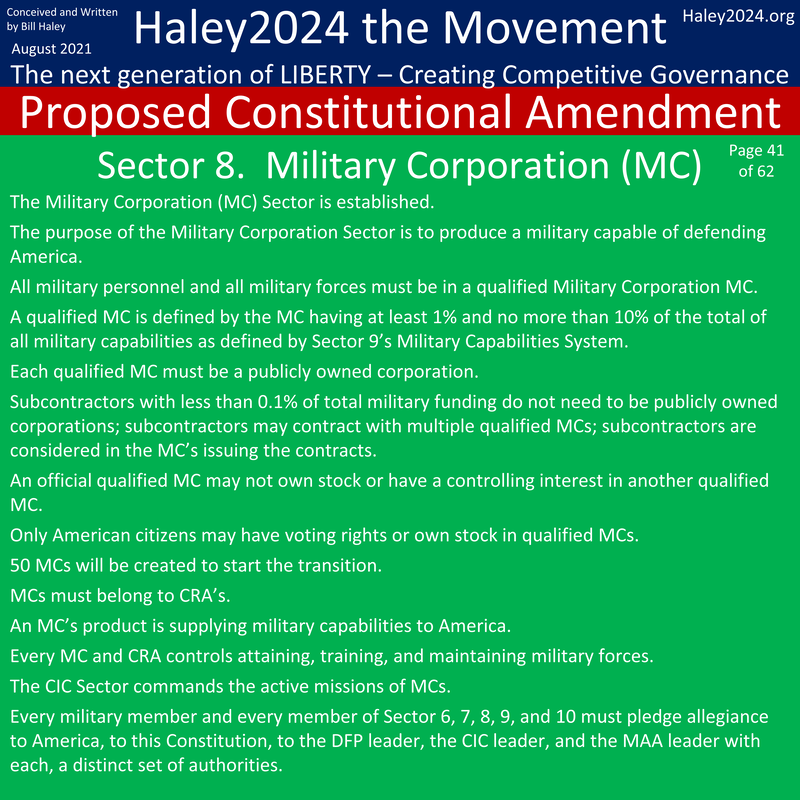
•All military capabilities are in roughly 50 Military Corporations. 

•A Military Corporation’s only product is providing military capabilities to America.  MCs are not authorized to use military power outside of CICs duly authorized commands.  

•MCs must have at least 1% and not more than 10% of the overall military capabilities, thus, resulting in roughly fifty Military Corporations.

•If an MC falls below 1% of total capabilities, it may merge, become a subcontractor for another MC, or split up and sell its assets. 
Picture
Picture
•If an MC grows larger than 10% of total capabilities, they will likely separate into two MCs.  

•These roughly 50 MCs will still need to join the approximately 12 CRA’s. 

•A CRA in this Sector is called a CRA in the MC Sector.  MC is the name of an official Military Corporation. 

•Every citizen selects a CRA that best represents their philosophy. 

•MCs can contract out their services, with DFP Sector approval and oversight, to multinational corporations or allies.
​

•The roughly dozen CRA’s send legislative representatives, proportional to their membership, to the MC Sector Board. 
•The members of these CRA’s elect the ‘president’ of the MC Sector. 

•This MC president is likely to hold the position of the chairman of the Joint Chief of Staff, which has no direct command authority.  

•All MCs must be publicly traded corporations; thus, every citizen will have opportunities to buy stocks in an MC.   Stock ownership comes with voting rights.  Only American citizens can own stock in MCs.  ‘Monetary Policy M-CAPs may own MC stocks.  

•Every MC will have a Pentagon command structure and be encouraged to cooperate with other MCs.  Cooperation increases capabilities and ratings, thus funding.
Picture
Picture
​•MCs make all decisions on their labor contracts, weapon systems, training, among other choices regarding attaining a fighting force.  

•Switching from the government’s monopoly control to the competition inherent in the CRA Structure would reduce inefficiencies and promote superior business models. 

•MCs will have many business models ranging from entirely in-house employees to significant subcontractors.  Many small military businesses will have roughly 50 MCs in which to sell their services.   
​

•The authority of the MC Sector Board will be very limited.  Most power will remain at the MC or the CRA levels.  The MC Sector Board would be primarily organizational.
Please spread the word of these new government reforms.  Share this website with friends in emails and please link or share on social media. ​ Haley2024 the Movement

Contact

All Social Media Sites
This Haley2024 website is strictly non-profit: Educational on public policy. 
Contact: BillHaleywithHaley2024@gmail.com or  HopewithHaley2024@gmail.com
​
Text 757-408-8255
This searches only www.Haley2024.org
Picture