COMPETITIVE GOVERNANCE

  • HOME
    • FaceBook Versions
  • REFORMS
    • Constitution Creating all Reforms >
      • Constitution Videos page 1 >
        • Constitution Videos page 2
      • Constitution Images
    • Competitive Regulatory Agencies >
      • Videos: Competitive Governance >
        • Videos on competitive governance page 2
      • CRA Structure >
        • 70% Democracy FaceBook
        • Blog Statism Organizations
        • CRA: The Need for a New System
        • From Government to Societal Oversight Facebook
      • The 30 Sectors >
        • Separate Government Authority into 30 Sectors FaceBook
        • The Food Sector
        • The Manufacturing Sector
        • The Human Resources and Sales Sector
        • The Identity Sector: Personal and Business
        • The Environmental Sector >
          • Blog on EPA
        • The Work Safety and Disability Sector
        • The Media and Communications Sector
        • The Land and Water Sector
      • CRA Bullet Points
      • Blog on Competitive Regulatory Agencies
      • CRA Organization: Exclusive Control
      • Competitive Governance FaceBook
      • Media for CRAs
      • Competitive Representative Agencies FaceBook
    • The Rating System >
      • Videos the Rating System >
        • Videos: The Rating System per Sector
      • Rating Structure
      • Competitive Rating System Facebook
      • Blog on Ratings
    • Welfare to Charity >
      • The Charity System
      • The Charity Structure
      • The Charty Sector
      • Blog on Welfare to Charity
      • Videos on Welfare to Charity >
        • Videos on Charity page 2
        • Videos on Charities page 3
      • The Charitable Distribution Association - CDA Sector
      • The Charity Assessor Organization - AO Sector
      • The Family Law Sector >
        • Competitive Family Law Facebook
      • The Religious Sector
      • Media for Charity
      • End Welfare: Transition to Competitive Charity Facebook
    • Education >
      • Competitive School Boards FaceBook
      • Videos on education page 1 >
        • Videos on Education page 2
      • Education Structure
      • Colleges
      • Blog on Education
      • The Public School System Is Unconstitutional
      • Education articles and Videos
  • REFORMS2
    • Structure of the Foreign Policy and Private Military >
      • Competitive Military Facebook
      • Blog on Military
      • The Diplomatic Foreign Policy - DFP Sector
      • The Commander in Chief - CIC Sector
      • The Military Corporations Sector
      • The Military Capabilities System MCS Sector
      • The Military Authorization Agency - MAA Sector
    • Foreign Policy: Pockets of Freedom >
      • Pockets of Freedom Facebook
      • Blog on Pockets of Freedom
      • Videos POCKETS OF FREEDOMS
    • Social Security and Medicare >
      • Competitive Social Security Facebook
      • Blog on Social Security
      • The Insurance Sector
    • Roads / Transportation >
      • Competitive Roads FaceBook
      • Blog on Roads
      • Media on Road
    • Monetary Policy >
      • Videos Competitive Currency >
        • videos on Monetary policy page 2
      • Blog on Monetary Policy
      • Financial Sectors 18 and 19
      • Monetary Policy Structure
      • Competitive Currencies Facebook
      • Monetary Policy Media
    • Health Care >
      • Blog on Health Care
      • Competitive HealthCare Systems FaceBook
      • Heath Care Media
    • Violent Crime Mitigation System >
      • The Violent Crime (VC) Sector
      • Police >
        • Police Structure
        • Competitive Police Facebook
      • Law Enforcement Authorization (LEA)
      • The Judicial Authorities Sector
      • Prison and Corrections >
        • Competitive Prisons Facebook
  • Reforms3
    • Blog on issues of the day
    • Blog on Social Issues
    • RANDOM >
      • QIP's
    • Statism organizations
    • Haleynomics >
      • Laffer Curve
      • Haleynomics Videos >
        • HALEYNOMICS VIDEOS PAGE 2
      • Blog on Haleynomics
      • Educational Media and Books
    • Haley2024 taxes
    • Taxes
    • Debt
    • Corporate Proxy Groups
    • A Citizens Responsibility
    • Fighting Federal Control: 12 Proposed US Constitutional Amendments >
      • Fighting Federal Control Images and videos
      • Governor's Repeal
      • The Supreme Court
      • A New Court System
      • Changing the Head of the Inspectors General
  • VIDEOS/BLOGS
    • List of All Video Pages
    • BLOGS >
      • Haley2024 the movement Articles page 1
      • Haley2024 the movement Articles page 2
      • Haley2024 the Movement Articles page 3
    • Videos, improving the current system
    • Blog Images and Links
    • Blog on Haley2024 the Movement
    • Videos Haley2024 the Movement >
      • Videos Haley2024 the Movement Page 2
  • DONATE/ABOUT
    • Donate >
      • Volunteer!
    • About Bill
    • MY STUDY
    • Social Media

How Are Representatives and Leaders Chosen or Elected?

4/13/2019

 
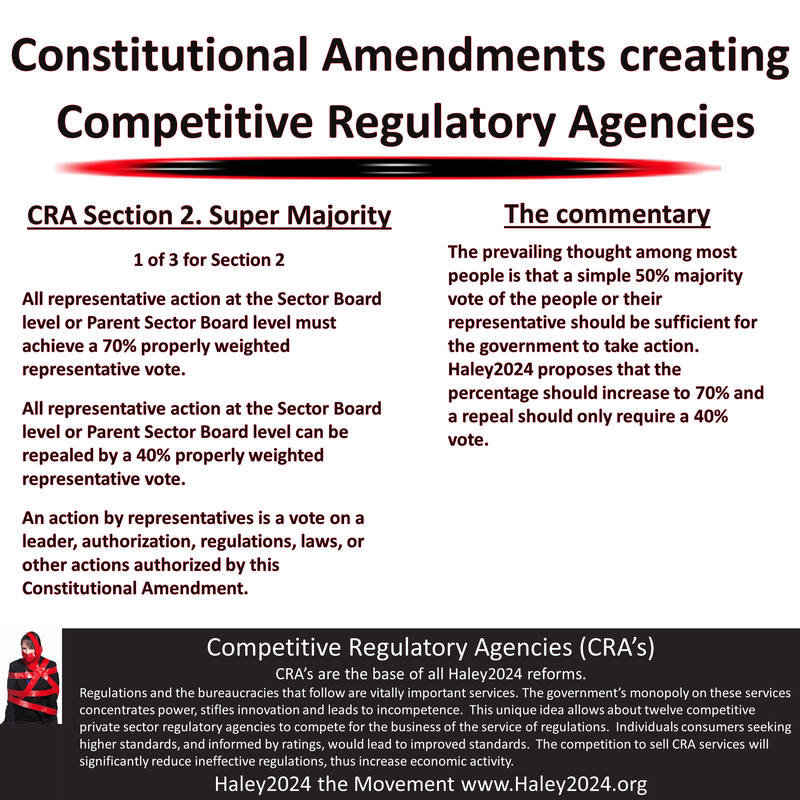
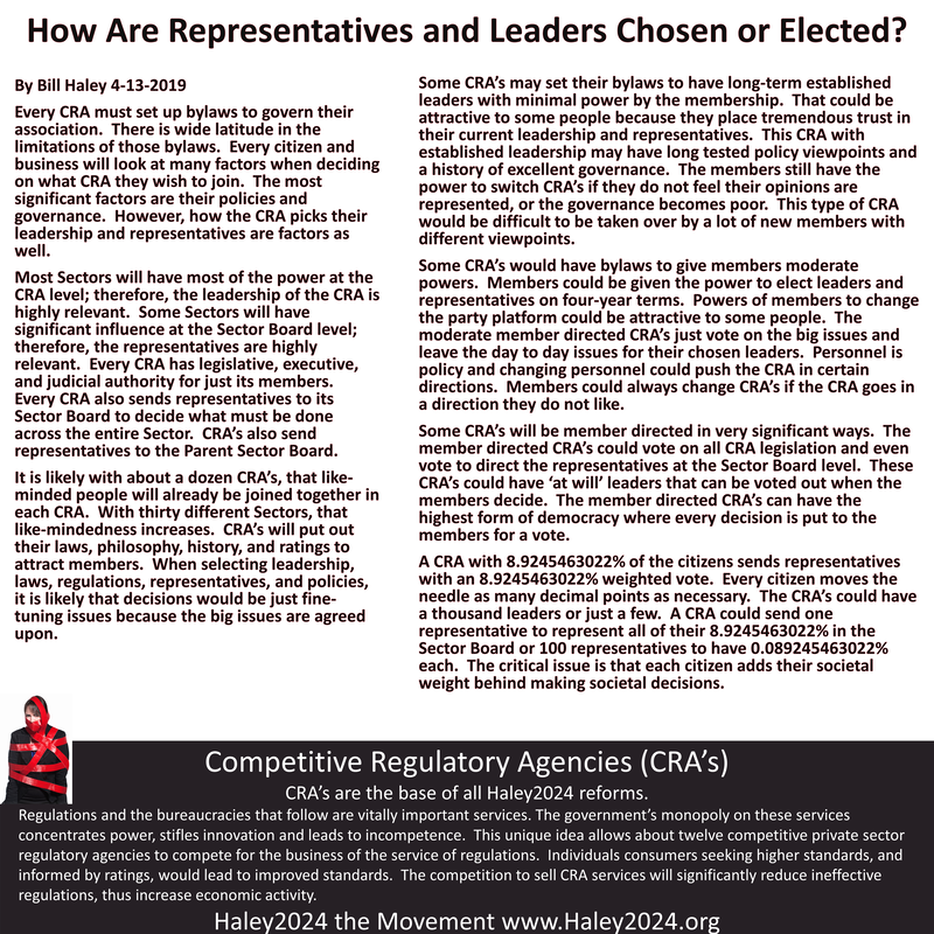
Every CRA must set up bylaws to govern their association.  There is wide latitude in the limitations of those bylaws.  Every citizen and business will look at many factors when deciding on what CRA they wish to join.  The most significant factors are their policies and governance.  However, how the CRA picks their leadership and representatives are factors as well. 
Picture
Picture
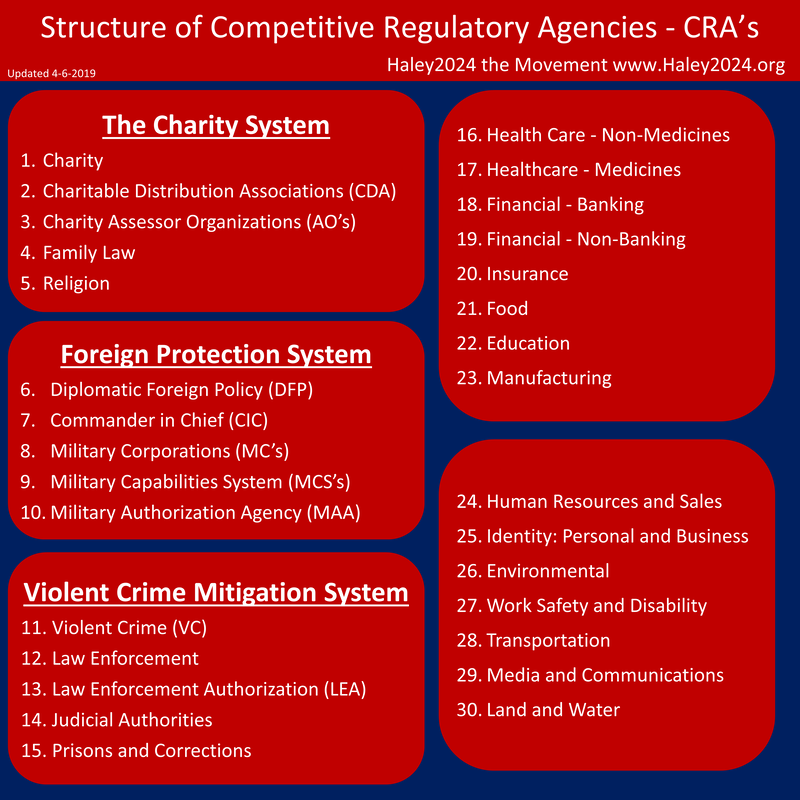
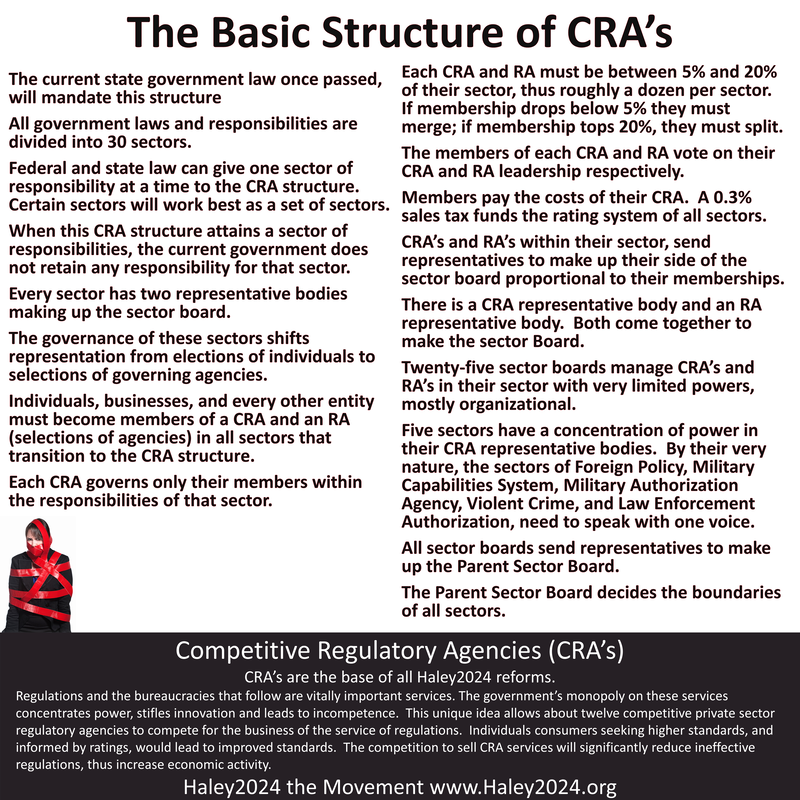
Most Sectors will have most of the power at the CRA level; therefore, the leadership of the CRA is highly relevant.  Some Sectors will have significant influence at the Sector Board level; therefore, the representatives are highly relevant.  Every CRA has legislative, executive, and judicial authority for just its members.  Every CRA also sends representatives to its Sector Board to decide what must be done across the entire Sector.  CRA’s also send representatives to the Parent Sector Board. 
It is likely with about a dozen CRA’s, that like-minded people will already be joined together in each CRA.  With thirty different Sectors, that like-mindedness increases.  CRA’s will put out their laws, philosophy, history, and ratings to attract members.  When selecting leadership, laws, regulations, representatives, and policies, it is likely that decisions would be just fine-tuning issues because the big issues are agreed upon.   
Picture
Picture
Some CRA’s may set their bylaws to have long-term established leaders with minimal power by the membership.  That could be attractive to some people because they place tremendous trust in their current leadership and representatives.  This CRA with established leadership may have long tested policy viewpoints and a history of excellent governance.  The members still have the power to switch CRA’s if they do not feel their opinions are represented, or the governance becomes poor.  This type of CRA would be difficult to be taken over by a lot of new members with different viewpoints. 
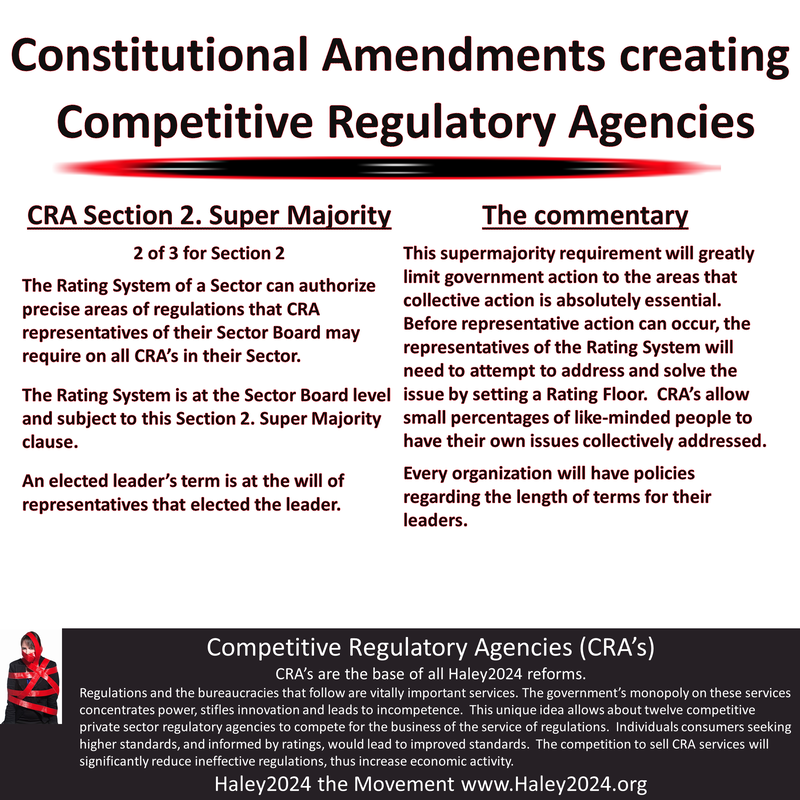
Some CRA’s would have bylaws to give members moderate powers.  Members could be given the power to elect leaders and representatives on four-year terms.  Powers of members to change the party platform could be attractive to some people.  The moderate member directed CRA’s just vote on the big issues and leave the day to day issues for their chosen leaders.  Personnel is policy and changing personnel could push the CRA in certain directions.  Members could always change CRA’s if the CRA goes in a direction they do not like. 
​
Picture
Picture
Some CRA’s will be member directed in very significant ways.  The member directed CRA’s could vote on all CRA legislation and even vote to direct the representatives at the Sector Board level.  These CRA’s could have ‘at will’ leaders that can be voted out when the members decide.  The member directed CRA’s can have the highest form of democracy where every decision is put to the members for a vote.   
​
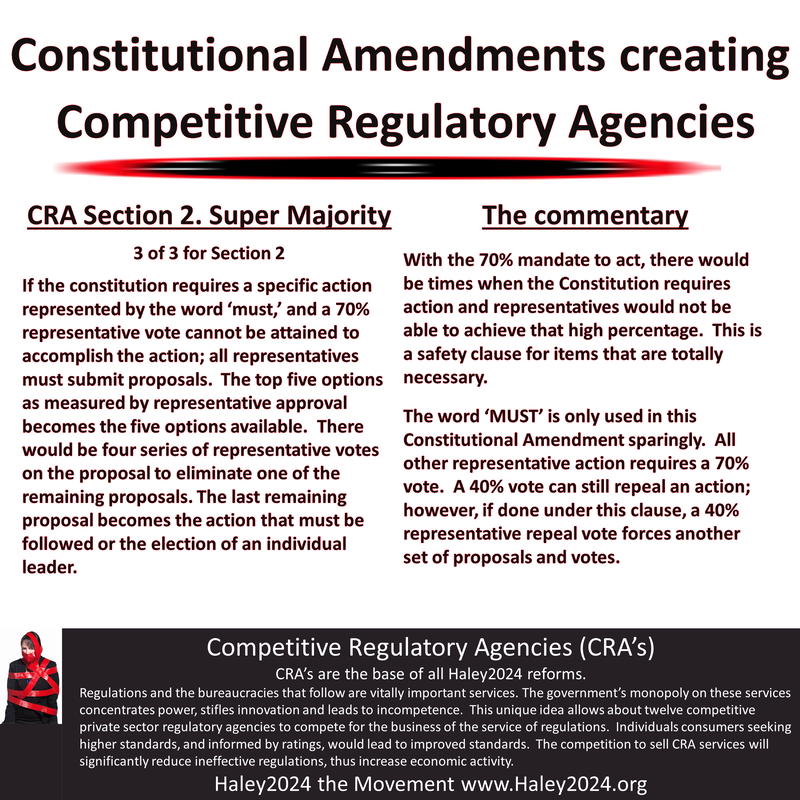
A CRA with 8.9245463022% of the citizens sends representatives with an 8.9245463022% weighted vote.  Every citizen moves the needle as many decimal points as necessary.  The CRA’s could have a thousand leaders or just a few.  A CRA could send one representative to represent all of their 8.9245463022% in the Sector Board or 100 representatives to have 0.089245463022% each.  The critical issue is that each citizen adds their societal weight behind making societal decisions. 
Picture
Picture

Comments are closed.
Please spread the word of these new government reforms.  Share this website with friends in emails and please link or share on social media. ​ Haley2024 the Movement

Contact

All Social Media Sites
This Haley2024 website is strictly non-profit: Educational on public policy. 
Contact: [email protected]
​Text 757-408-8255
This searches only www.Haley2024.org
Picture