A Constitutional Amendment
Creating the Competitive
Regulatory Agency-CRA Structure
Competitive Governance within every geographic jurisdiction
I, Bill Haley, started writing this Amendment in 2015, based on the reforms started in 2013. I update this Amendment on a regular basis. A major rewrite occurred the fall of 2020 through February 2021. The constitution videos started February 13, 2021. A minor update occurred 8-22-2021. An update occurred 9-14-2023.
The Final draft used for the Haley2024.org website
Conceived and Written by Bill Haley
All 76 videos on this proposed Amendment YOUTUBE but go to THIS page to read the constitution as you watch the videos.
The Final draft used for the Haley2024.org website
Conceived and Written by Bill Haley
All 76 videos on this proposed Amendment YOUTUBE but go to THIS page to read the constitution as you watch the videos.
A Constitutional Amendment Creating the Competitive Regulatory Agency-CRA Structure
Written by Bill Haley. Major revision: 8-22-2021; minor updates and grammar edits applied May 2026.
Haley2024.org website
14,291 words – Roughly 600 Clauses
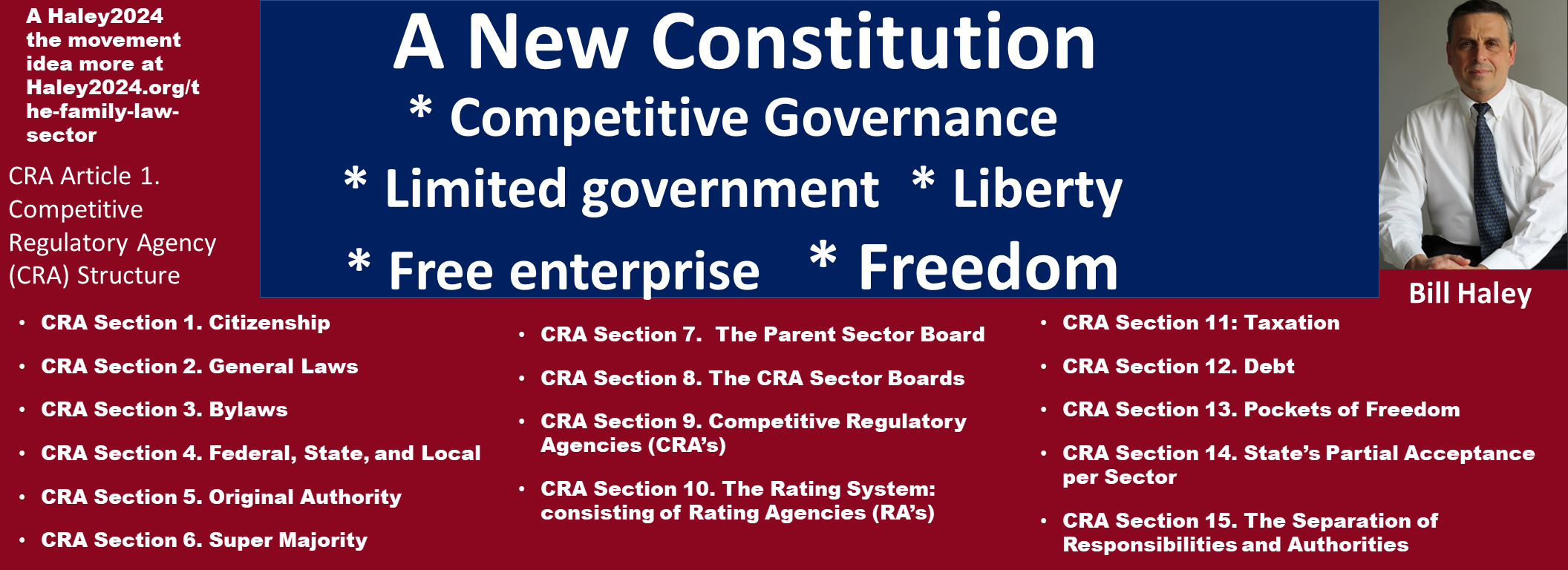
Competitive Regulatory Agency (CRA) Structure: 15 Sections
CRA Section 1. Citizenship
CRA Section 2. General Laws
CRA Section 3. Bylaws
CRA Section 4. Federal, State, and Local
CRA Section 5. Original Authority
CRA Section 6. Super Majority
CRA Section 7. The Parent Sector Board
CRA Section 8. The CRA Sector Boards
CRA Section 9. Competitive Regulatory Agencies (CRAs)
CRA Section 10. The Rating System: consisting of Rating Agencies (RA's)
CRA Section 11: Taxation
CRA Section 12. Debt
CRA Section 13. Pockets of Freedom
CRA Section 14. State's Partial Acceptance per Sector
CRA Section 15. The Separation of Responsibilities and Authorities
The list of 30 Sectors
The Charity System
Sector 1. Charity
Sector 2. Charitable Distribution Association (CDA)
Sector 3. Charity Assessor Organization (AO)
Sector 4. Family Law
Sector 5. Religion
The Foreign Protection System
Sector 6. Diplomatic Foreign Policy (DFP)
Sector 7. Commander in Chief (CIC)
Sector 8. Military Corporation (MC)
Sector 9. Military Capability System (MCS)
Sector 10. Military Authorization Agency (MAA)
The Violent Crime Mitigation System
Sector 11. Violent Crime (VC)
Sector 12. Law Enforcement
Sector 13. Law Enforcement Authorization (LEA)
Sector 14. Judicial Authority
Sector 15. Prison and Correction
Assorted Sectors
Sector 16. Health Care
Sector 17. Healthcare - Medicine
Sector 18. Financial
Sector 19. Financial - Banking
Sector 20. Insurance
Sector 21. Food
Sector 22. Education
Sector 23. Manufacturing
Sector 24. Human Resources and Sales
Sector 25. Identity: Personal and Business
Sector 26. Environmental
Sector 27. Work Safety and Disability
Sector 28. Transportation
Sector 29. Media and Communication
Sector 30. Land and Water
CRA Article 1. Competitive Regulatory Agency (CRA) Structure
Preamble: We, the American people, establish with this Constitutional Amendment, the CRA Social Contract in the form of the CRA Structure, as the rules for the land in which we citizens jointly have federal, state, and local government-ownership-sovereignty in order to establish the rule of law, repel foreign threats, establish save-havens for the world's oppressed people, tolerate the freedom of others, protect individual liberty, care for substantial unmet needs, recognize self-ownership, establish citizen obligations, permit freedom of contract, acknowledge individual property ownership, and allow for self, family, and competitive governance in a system of diversified authorities.
This Amendment, CRA Article 1. Competitive Regulatory Agency (CRA) Structure is a complete replacement for the US Constitution, every state Constitution, and creates distinct local Constitutions in America; this new Constitution creates three levels of government with one federal government, many state governments, and many local governments within each state.
Once 75% of the states accept this new federal Constitutional Amendment under the current US Constitution Article 5 provisions, America, American states, and American localities are subject to this Constitutional Amendment.
This Amendment is to be read in its entirety and is structural in nature; it has clauses that limit other clauses, and all clauses have the caveat of unless otherwise addressed in this Amendment; this Amendment is to be read as CRA centric, with the rest of the sections as supports for the CRA.
CRA Section 1. Citizenship
America is a citizen ownership model of government.
Every American citizen owns an equal percentage of the federal government.
Every citizen of a state owns an equal percentage of their state government.
Every citizen of a local government owns an equal percentage of their local government.
Ownership of a government conveys an equal representation of the government's elected leaders; ownership of a government may not be bought or sold and does not convey property or wealth; ownership of a government requires a positive obligation and has inherent benefits.
Every American has the right to become a citizen of any local government and any state in America.
Americans may hold multiple state and local citizenships.
Mandatory citizen obligations may be divided among numerous cities and states as determined by the relevant Rating System.
An act of an individual signing the CRA Social Contract creates a permanent American citizen.
The CRA Social Contract is an American's agreement to become a member of a CRA and RA in all 30 Sectors of their local, their state, and the federal CRA Structures.
When this Amendment is ratified, every current American citizen has the right for two years to sign the CRA Social Contract; American citizens must sign the CRA Social Contract to remain an American citizen.
At the time of the child's birth, a child born to an American citizen is an American citizen until the age of 30 and has the right to sign the CRA Social Contract from the age of 13 until the age of 30.
Only American citizens have voting rights within CRAs and RA's.
Every person and entity in America must abide by the CRA Social Contract.
An American citizen has the right to resign their citizenship; every person has the right to leave America, except for serving a criminal sentence; a reinstatement of citizenship requires a 50% federal Sector 25 vote for anyone under 30 years of age.
A 70% federal Sector 25 vote is required to allow a non-American individual to enter or remain in America; a 40% vote repeals the allowance; the legislative representatives may set conditions and limitations.
A 70% federal Sector 25 vote is required to allow a non-American individual to sign the CRA Social Contract to become an American citizen.
An 80% federal Sector 25 vote is required to revoke citizenship and expel an American citizen.
CRA Section 2. General Clauses
Every legal entity must be a person, a business, or an organization.
Each business and organization must be under the control of one or more people.
Every person, business, and organization is a legal entity.
For the purposes of this Constitutional Amendment, an entity is either an American legal entity or a foreign entity legally residing or doing business in America.
An American citizen starts to progressively become an independent legal entity 13 years after their birth.
Only American citizens may hold an official office within a CRA Structure.
Every membership, transaction, contract, or interaction must have an all-parties-involved agreement.
Once this Amendment passes, the current government, the Sector Boards, and the Parent Sector Board have broad powers in a five-year window to implement a transition plan consistent with moving towards this CRA Structure.
The Federal Parent Rating System must determine whether the transition plans are consistent with moving towards this CRA Structure.
All laws, regulations, spending, and taxing by the government before this Amendment was passed are void after the 5-year transition period; CRAs adopt all current laws and regulations within their jurisdiction unless this Amendment addresses the law or CRAs directly address that law and regulation.
This US Constitution is amended by a 75% vote of all federal CRA Parent Sector Board representatives; constitutional clauses are not subject to repeal or amendment with less than a 75% vote of all federal CRA Parent Sector Board representatives.
The US post office will transition to the free enterprise system; thus, it is subject to the Section 12 standard transition; mail delivery will be regulated by CRAs in Sector 29.
No governing body may pass any Bill of Attainder, ex post facto Law, or Law that impairs the Obligation of Contracts.
Unless this Amendment states otherwise, all percentage votes listed in this Amendment are from the legislative branch of the stated Sector Board or the Parent Sector Board.
No Sector Board or Parent Sector Board may inhibit, restrict, favor, or hamper trade, as broadly defined, with other jurisdictions within America or the Pockets of Freedom.
At the Sector Board or Parent Sector Board, taxes and regulations must be the same for trade within a jurisdiction and across jurisdictions.
These free trade clauses broadly define trade to include products, services, labor, financial transactions, 'online' activity, charity work, and other activities.
These free trade clauses neither denote nor permit Sector Board or Parent Sector Board authority; they restrict Sector Board or Parent Sector Board authority otherwise authorized by this Amendment.
The preceding free trade clause applies worldwide; however, it is subject to the foreign policy approved by the federal Sector 6, to restrictions on non-Americans crossing American borders, to the 5% Charity tax on foreign trade, to the 5% Military Capability System tax, and to other taxes authorized by this Amendment.
At the Sector Board level, individuals, organizations, businesses, charities, CRAs, and others, broadly defined, are not limited to interactions, transactions, contracts, assistance, protection, and other activities with only members of the same CRA; this is all-inclusive.
The federal Parent Sector Board must uniformly define an entity's income, per capita income, and gross domestic product (GDP).
Unless explicitly stated in this Amendment, every threshold, definition, and subjective term must be given clear meaning and effect by the Judicial Sector's Rating System.
Every RA may pose a clarifying question to the Judicial Sector's Rating System, for which an answer must be provided within nine months.
CRA Section 3. Bylaws
Every agency, CRA, RA, board, organization, legislative branch, judicial branch, executive branch, or group within this CRA Structure must set up governing bylaws consistent with this CRA Structure.
Bylaws must address the term duration of elected representatives.
Bylaws must address membership.
Bylaws must address membership voting.
Bylaws must address members’ delegation of their proxy votes to representatives within their CRA.
Bylaws must address fees and taxation.
Bylaws must address the separation of powers among the legislative, judicial, and executive authorities.
Bylaws must address prosecutorial powers; all prosecutors must obtain authority from Sector 13.
Bylaws must address the Super Majority multi-step voting system in Section 6.
Bylaws must address a vacancy in an official office by establishing an appropriate line of succession.
Bylaws must address leadership.
Bylaws must address information transparency, for which a Rating Floor is required.
Bylaws must address all issues necessary to fulfill constitutional obligations.
Bylaws may address any issue proper for the sound management of the group.
CRAs have extensive autonomy to create their own CRA bylaws.
The CRA Parent Sector Board must create the bylaws for each Sector Board and for the Rating Parent Sector Board. The Rating Parent Sector Board must create the bylaws for each Rating System and for the CRA Parent Sector Board.
CRA Section 4. Federal, State, and Local
The Federal Government will have one CRA Structure comprising every American entity and sovereignty over all American land and water rights.
Every American state will have one distinct CRA Structure comprising its entities and sovereignty over its entire land and water rights.
The Federal Parent Sector Board has the authority to create and reconfigure American states and territories, subject to a 70% vote of the Parent Sector Board in each affected state.
Creating a new state from a Pocket of Freedom requires a 70% DFP vote and approval from 70% of the state's Parent Sector Board’s top executive leaders.
All American territories collectively become one state; each territory becomes at least one locality within the new state.
Every American local government will have one distinct CRA Structure, consisting of its entities and sovereignty over its entire land and water rights; a local government may not have more than 15% of the state's population.
The State Parent Sector Board has authority over the creation and reconfiguration of local governments.
A local government, or several contiguous local governments collectively with a population of more than 500,000 citizens, may become a distinct American state with a 50% vote of the local Parent Sector Board; the respective states or the federal Parent Sector Boards may not block this action.
A state with fewer than 500,000 citizens must merge with another contiguous state.
The Federal Sector 6 Sector Board must establish an obligation system that allows states to claim water rights in the open ocean.
Federal-level CRA Sector Boards may not fund state- or local-level CRA Sector Boards.
CRA Section 5. Original-Authority
Original-Authority is defined in this Amendment as the foundational source of authority; thus, stating that an individual, agency, or board has Original-Authority signifies the highest jurisdiction or the basis of power.
People have the Original-Authority to own real, personal, and intellectual property; people have the Original-Authority to join together under contracts; landowners have the Original-Authority to set rules for the land they own; ownership rights and contracts necessitate obligations; therefore, a citizen ownership model of government derives from these Original-Authorities and obligations.
Authority rests with the individual, agency, or board assigned Original-Authority by this Amendment, with the understanding that this Amendment further divides, allocates, and designates jurisdiction and Original-Authority with additional clauses.
Original Authority originates with the individual person.
A person owns their body and has Original-Authority to protect their body, as well as their property, possessions, liberty, and freedom; this same Original-Authority extends to protecting their family and fellow man; this Original-Authority creates a civil liberty to own, possess, and carry weapons necessary to achieve that protection.
Individuals, businesses, and organizations have Original-Authority, to or not to, interact, associate, transact, contract, employ, and make agreements with other individuals, businesses, and organizations.
The freedom of association, along with the freedom not to associate, is an individual, business, and organization’s civil liberty that must not be infringed; CRAs and RA's hold these rights.
Entities have the right to select their representatives throughout this CRA Structure. This requires a two-sided agreement; therefore, a CRA or RA may decline membership. Sector Boards may not reject legally established CRAs.
When designating authority, each proposal and vote must address a narrowly defined, highly specific issue.
State-level Sectors will have Original-Authority over federal- and local-level Sectors, except for the Foreign Protection System Sectors 6, 7, 8, 9, and 10, where federal-level Sectors have Original-Authority.
State-level Parent Sector Boards will have Original-Authority over federal- and local-level Parent Sector Boards, except for the jurisdiction of the Foreign Protection System.
The state-level Sector Boards must delegate authority to the Federal-level and local-level Sectors, except for the Foreign Protection System.
All State-level Sector Board legislators, per Sector, must meet to establish a consistent level of federal authority across all states, with equal representation of states for 50% of the vote and proportional representation for the remaining 50%. A 70% vote is required to transfer additional authority and jurisdiction to the Federal level; a 40% vote repeals federal authority. This does not apply to the Foreign Protection System.
The Federal Parent Sector Board must determine the boundaries of the Foreign Protection System Sectors 6, 7, 8, 9, and 10.
The Foreign Protection System Sectors 6, 7, 8, 9, and 10 will have Original-Authority at the federal level; the Federal Sector Boards must designate state and local authorities.
The authority to designate authority among federal, state, and local levels of government does not confer the authority to adjust authority among the CRA, Sector Board, or Parent Sector Board levels.
CRA Sectors 6, 7, 9, 10, and 13 have Original-Authority at the Sector Board level, whereas all other Sectors have Original-Authority at the CRA level.
Every Rating System has Original-Authority to set Rating Floors and must set them on CRAs that fulfill the purpose of their Sector listed in this Amendment and their Sector's mission statement.
The Rating System has the Original-Authority to address fraud and abuse, broadly defined.
CRA Section 6. Super Majority
All representative action at the Sector Board level or the Parent Sector Board level must achieve a 70% representative vote, except for specific clauses narrowly tailored in this Amendment that use the word 'must.'
A 40% representative vote can repeal representative action at the Sector Board or Parent Sector Board level; this does not apply to Constitutional clauses.
An action by Sector Board or Parent Sector Board representatives is a vote on a leader, tax, fee, authorization, regulations, laws, or other activities that are appropriately, narrowly tailored, and expressly authorized to a Sector Board or Parent Sector Board by this Amendment.
Mandatory Sector Board actions must use the following multi-step voting system if a 70% vote is not attainable. If this Amendment requires a specific action by the Sector Board or Parent Sector Board, indicated by the word 'MUST,' and a 70% representative vote cannot be achieved to accomplish the action, all relevant representatives must submit proposals; the top five proposals, as measured by representative approval, become the five options available; there would be three series of representative votes to eliminate one of the remaining proposals; a positive vote on the remaining two proposals creates law or elects the top executive leader.
Repeal of any action required by this Amendment that uses the word 'must' will prompt a new multi-step vote that must conclude within 30 days; a repeal with less than a 50% vote will be delayed by 30 days.
CRA Section 7. The Parent Sector Board
A CRA Parent Sector Board is a governmental organization controlled by representatives of all the entities within the governed area.
Members of CRAs from all 30 Sectors send representatives to form the Parent Sector Board.
CRA representatives to the Parent Sector Board carry a weighted vote equal to their Sector Board-determined CRA weight divided by the number of Sectors.
The CRA Parent Sector Board must have legislative, executive, and judicial branches.
Members of CRAs must send legislative representatives to create the CRA Parent Sector Board's legislative organization.
Members of CRAs must elect a top executive to the CRA Parent Sector Board.
CRAs must proportionally send judicial officials to the Parent Sector Board.
CRAs must proportionally staff all three branches of the Parent Sector Board.
CRAs must fund their representatives and staff to the Parent Sector Board and proportionally fund Parent Sector Board expenses.
The CRA Parent Sector Board must define the parameters of responsibilities and authorities for all Sectors.
The CRA Parent Sector Board must develop a mission statement for every Sector.
A Sector's mission statement must be non-regulatory in nature and limited to broad topics; a 40% Parent Sector Board vote may curtail its scope or reduce its regulatory nature.
The Parent Sector Board may establish, reconfigure, or consolidate Sectors as it deems appropriate.
Except for the direct and precise clauses within this Amendment, the responsibilities and authorities of the Parent Sector Board are limited to ensuring that all Sectors remain within their respective jurisdictions and within the structure of this Constitutional Amendment.
The Parent Sector Board has jurisdiction over CRAs or Sector Boards that take actions outside their Sector's authority.
There is no general or broad grant of authority to the Parent Sector Board.
The Parent Sector Board may establish a rapid-response plan for an existential constitutional crisis; a 65% representative vote of both the CRA Parent Sector Board and the Rating System Parent Sector Board is required to implement a short-term solution, beyond constitutional limitations, to resolve a crisis consistent with saving America and returning to this Constitution; a 65% vote of the judicial branch of the federal Judicial Sector is required to state that every element of these requirements is satisfied; these votes must occur every 30 days to maintain the plans; these plans may not limit or restrict citizens from changing CRAs or RAs and the corresponding change in representation.
CRA Section 8. CRA Sector Boards
A CRA Sector Board is a governmental organization controlled by representatives of all the entities within the governed area.
A CRA Sector Board governs all the people within the governed area, with only powers properly authorized and within the jurisdiction of that Sector's precise and specific responsibilities and authorities. There is no general or broad grant of authority to the Sector Board.
Representatives from all the CRAs within a Sector proportionally constitute the CRA Sector Board.
CRA Sector Boards must include legislative, executive, and judicial branches.
Members of CRAs must proportionally send legislative representatives to form the CRA Sector Board's legislative organization.
Members of CRAs must elect a top executive to the CRA Sector Board.
CRAs must proportionately send judicial officials to the Sector Board.
CRAs must staff all three branches of their Sector Board proportionally.
CRAs must fund their representatives and staff sent to the Sector Board and proportionally fund Sector Board expenses.
A CRA Sector Board must ensure the integrity of its Sector's responsibilities and authorities relative to those of other Sectors.
A CRA Sector Board must ensure the integrity of its sector's structure.
A CRA Sector Board must govern through its CRAs, except in specific areas where governance is impractical or creates negative externalities, as defined by the Rating System.
A 70% vote of the respective Rating System is required to transfer governance of precise, narrowly tailored, and strictly defined areas of regulation from CRAs to the Sector Board; 70% of the respective Sector Board's judicial branch must certify that Rating Floors and CRA cooperation failed to adequately address a significant negative externality before the Rating System may vote to transfer governance to the Sector Board.
A CRA Sector Board must decide how CRA representation is weighted within the Board.
One-half of the Sector Board's weighted vote comes equally from individual American citizens of the governed area.
A CRA Sector Board at the state and local levels must decide how representation is weighted within the Sector Board that deals with American entities, including citizens, businesses, and organizations.
For a federal-level CRA Sector Board, the state-level CRA legislative branches must send representatives to the respective federal-level Sector Board legislative branch to make up 50% of its membership, with every state having equal representation.
Every voting threshold listed in this Amendment uses properly weighted representatives.
Only American entities may contribute to voting strength in CRAs.
Foreign entities living or operating in America must become CRA members; however, without voting rights.
The Sector 6 Sector Board must establish a quick, low-cost system for foreign entities staying in America for fewer than 30 days per year.
Every Sector Board must establish Intellectual Property (IP) regulations at its level.
Every CRA must enforce its Sector's IP regulations through its Sector 25 CRA.
CRA Section 9. Competitive Regulatory Agencies (CRAs)
A CRA is a semi-private governmental organization composed solely of its members within the governed area and is sector-specific.
Every entity within the governed area must select and become a member of a CRA and an RA in all 30 Sectors of their local, state, and federal CRA Structures.
A CRA governs only its members within its Sector's jurisdiction.
A CRA is a semi-governmental organization that gains CRA authority through the membership of at least 5% of the entities in the governed area.
A Sector Board comprises several qualified CRAs.
Non-American entities and Americans who have not yet signed the CRA Social Contract must become CRA members in all thirty Sectors, but they may not vote.
A CRA must have memberships of at least 5% of all entities, weighted appropriately.
A CRA must have memberships of no more than 20% of all entities, weighted appropriately.
All laws, regulations, bureaucracy, and governance occur within CRAs unless properly assigned to a Sector Board or Parent Sector Board; thus, CRAs have Original Authority.
Every CRA must be a member of a CRA in every Sector.
Every CRA must have legislative, executive, and judicial branches.
Members of a CRA vote on leadership and representatives for their CRA across all three branches.
A person may hold only one official office within a CRA Structure at any time. A person may hold a similar official office in multiple CRA Structures. A similar office is defined by the same level (federal, state, or local); the CRA side or the Rating System side; the CRA, Sector Board, or Parent Sector Board level; and the same branch of executive, legislative, or judicial.
CRAs may choose to share leadership, staff, assets, and representatives with other CRAs that have similar official offices within other CRA Structures.
CRAs proportionally staff their Sector Board and the Parent Sector Board.
A CRA may adopt socialist or other statist ideologies; however, a CRA never has the authority to tax, require funding, or impose obligations on entities outside its membership.
A CRA Organization is a semi-private governmental organization that groups CRAs across all Sectors and at the federal, state, and local levels of government.
A CRA Organization may have more than one CRA per Sector.
If a CRA Organization has CRAs from 15 Sectors, it can lower the 5% threshold to 2% to create CRAs in the other Sectors. If a CRA Organization has CRAs from all Sectors at the state level, it may lower the 5% threshold to 2% to create local-level CRAs.
A CRA Organization may request, and if approved by 30% of the state Parent Rating System, 70% of the population, and 50% of the existing locality, gain exclusive control of a geographic area with a population of fewer than 10,000. Once granted, a new locality is created in which the CRA Organization's local and state CRAs exclusively govern that locality.
Once a CRA Organization is granted exclusive control, the population may increase.
A CRA Organization’s exclusively controlled locality may acquire additional contiguous land that meets the same qualifications.
A CRA Organization's exclusively controlled locality has the authority to approve or exclude CRAs.
A CRA Organization’s exclusively controlled locality may exclude individuals, organizations, or businesses from that locality.
A CRA Organization’s exclusively controlled locality has significant control over civil liberty Rating Floors within that locality.
The state Rating Systems may limit the CRA Organization's exclusively controlled localities to mitigate negative externalities outside those localities.
CRA Section 10. The Rating System
The CRA Structure consists of a CRA regulatory system side and a Rating System side.
The Rating System side has the same structure as the CRA regulatory system and is subject to the full scope of this Constitution.
The Rating System Parent Sector Board has the same structure as the CRA's Parent Sector Board. The Rating System has the same structure as the CRA Sector Board, and Sector Board restrictions apply to Rating Systems.
The Rating Agency (RA) has the same structure as the CRA.
The Rating System side is not subject to an additional, complete Rating System. Every Sector's Rating System must rate its RAs on integrity, consistency, truthfulness, reliability, and mission fulfillment.
The Rating Agencies and the Rating Systems cannot regulate.
The purpose of the Rating System and every RA is to provide quality information, evaluate and rate CRA regulations and their actual results, and restrict regulatory standards that allow significant negative externalities.
Every Rating System has original authority to address, through the courts, a lack of integrity, including self-dealing, abuse, corruption, fraud, and other broadly defined integrity-destroying conduct.
A Rating Floor is a rating level established by the Rating System to address significant negative externalities. A CRA must strengthen regulatory standards to achieve a rating level above the Rating Floor.
A Rating Floor must not be regulatory in nature; Rating Floors must allow multiple regulatory methods to reduce significant negative externalities.
A 50% Rating System vote establishes or raises a Rating Floor; A 55% Rating System vote lowers the Rating Floor.
A societal negative externality in this Amendment is defined as general harm to most entities in society, including moral, cultural, and societal factors; a 60% Rating System vote establishes or increases a societal negative externality Rating Floor; a 45% Rating System vote lowers a societal negative externality Rating Floor.
An individual living an impoverished life is a societal negative externality; however, this category requires a 70% vote to increase and a 35% vote to lower an Impoverished Life Societal Negative Externality Rating Floor.
A 50% vote of the Rating System of the Judicial Sector is required to declare a narrow set of issues as a negative externality or a societal negative externality.
An RA may force a Rating System to vote on any specific question within 60 days.
A Civil Liberty Rating Floor is defined in this Amendment as a limitation of Sector Board actions that infringe civil liberties.
Civil liberty violations in this Amendment concern actions by a Rating System or a Sector Board that restrict citizens, organizations, or businesses from engaging in activities protected as civil liberties.
Rating System and Sector Board actions, laws, and regulations attempting to solve negative externalities and societal negative externalities must respect other civil liberties and be subject to strict scrutiny.
Civil liberties under this Amendment are not obligations at the Sector Board or Rating System level to provide funds, products, or services to people.
The Judicial Authority Sector's Rating System, with a 30% vote, may set or raise Civil Liberty Rating Floors to protect civil liberties within narrowly drawn categories across all Sectors; a 75% vote lowers those Floors.
Civil Liberties Rating Floors are also protections in the Violent Crime Mitigation System.
Violent Crime Mitigation Civil Liberties Rating Floors are restrictions on the Sector Board level, the CRA level, and anyone with inherent government authority in the Violent Crime Mitigation System.
Every Rating System in the Violent Crime Mitigation System may set or increase Violent Crime Mitigation Civil Liberties Rating Floors to protect civil liberties, per a narrowly drawn category, with a 30% vote; a 75% vote lowers Violent Crime Mitigation Civil Liberties Rating Floors.
The Judicial Authority Sector's Rating System, within the legislative branch, must address all civil liberties in the Bill of Rights, the entire US Constitution, and the common law, and then set Rating Floors for each narrowly defined right. The civil liberties of the replaced Constitution remain until properly addressed with Rating Floors.
The executive leader of every Rating System has the authority to grant reprieves and pardons for offenses within their Sector's jurisdiction; a pardon or reprieve must be granted at least twice, with at least 60 days between grants, to take effect.
The Rating System must mandate the prominent display of ratings at the point of purchase, in advertisements, and in other prominent places as defined by 40% of the Rating System.
The federal Rating System Parent Sector Board must set a Rating Floor to ensure proper respect, cooperation, and full faith and credit among and within all CRA Structures at all levels, within narrowly drawn categories; a 40% vote sets or increases the Rating Floor, and a 70% vote lowers it.
Rating Agencies must debate other Rating Agencies; the debate must be robust, as defined by 40% of the Rating System.
Rating Systems with a 40% vote may set a Rating Floor for integrity, widely defined, and a 70% vote lowers the integrity Rating floors.
CRA Section 11: Taxation
Every person and entity must pay the membership fee for their/its CRA in each Sector.
All CRAs set their own membership fees.
Individual membership fees and funding obligations begin at age 13. Fees and obligations start at $0 and increase by 1.66% per month, based on the full funding and obligation amount, until the person fully assumes their funding obligations at age 18. No one may shelter their fees or funding obligations by conducting transactions through a person with a lower tax or fee obligation. These graduated fees and tax obligations do not include sales taxes, business taxes, organization taxes, or other obligations controlled by others.
When this Amendment requires CRA funding, fees, proportional taxes, and other obligations, a person or entity implicitly has the option to contract with private businesses regulated by their/its CRA to fulfill those obligations.
Taxes, fees, loan payments, and other obligations may be collected through work in the Charity Economy rather than in cash.
The fair market value of work in the Charity Economy requires agreement among all parties involved; if payment is mandatory under the Sector Board or this Amendment, 50% of the respective Rating System must also agree on the value of the work on the high side.
The Rating System for every Sector must establish a Rating Floor to ensure adequate funding.
With a 70% vote, the respective Rating System may require CRA funding as a percentage of an entity's income, sales, real estate value, or another suitable proportional measure.
Membership fees must include a head tax that collects at least 10% of a Sector's overall funding if a proportional funding method is required; the head tax must be credited against the proportional tax.
A mandated proportional tax under this amendment or a Rating System funding method of taxation may not use deductions, exemptions, or credits that exceed the head tax.
The tax code at the Sector Board/Rating System level may not be used for welfare; the tax code or fee schedule may collect funds but not distribute them; this clause does not authorize taxes at the Sector Board level; this clause limits the Sector Board’s authority.
The Parent Sector Board may set temporary one-month emergency taxes by a 70% vote to address a significant negative externality; a 40% vote repeals the emergency tax; and the Parent Sector Board must designate which Sector's CRAs will collect the tax.
70% of the Sector 3 Sector Board may, on personal hardship grounds, subjectively exempt a person from taxes or CRA fees, in whole or in part; the AO Sector Board must distribute the burden of any exemption among all CRAs.
A Share-Loan is defined as a percentage of a well-defined property or real-estate value, or of an entity's income, over a well-defined period of time; traditional tax methods may be converted into individualized Share-Loans and sold as an asset to a Sector 19 M-CAP.
Expected future tax revenue may be sold as an asset to a Sector 19 M-CAP.
CRA Section 12. Debt
The Parent Sector Boards of federal, state, and local governments must take ownership of all current government assets and liabilities as defined in the 5-year transition plans.
The Parent Sector Boards must use Sectors 24, 25, and 30 to collect taxes to pay the outstanding debt.
This Amendment calls for many revenue streams to pay down the debt; the outstanding debt in this and the subsequent five clauses refers to debt expected to remain after all other revenue streams have been considered.
Sector 24 must collect 30% of the debt taxes from the sales tax.
Sector 24 must collect 30% of the debt taxes from an entity's income taxes, with a minimum tax of 25% of the average per capita debt income tax.
Sector 25 must collect 10% of the debt tax as a head tax.
Sector 25 must collect 30% of the debt tax in the form of a proportional real-estate tax.
The debt tax described must achieve at least a 2% paydown of the original debt principal per year, plus finance charges.
The expected revenue of a Share-Loan is an actual item with real value, thus an asset eligible for a Sector 19 M-CAP.
The expected revenue from a clearly defined future tax is an actual item with real value, thus an asset eligible for inclusion in a Sector 19 M-CAP.
After the fifth year of this Amendment taking effect, these future tax assets must be converted into well-defined, individualized share-Loans and sold to M-CAPs at a rate of 1% of the original debt principal per month until all debt is equally matched with assets within M-CAPs.
All new debt properly issued by Sector Boards or Parent Sector Boards must be matched with well-defined future individualized share loans and sold to an M-CAP.
Section 12's Standard Transition of current government assets to the CRA Structure to pay down the debt:
All current government-owned and controlled assets must be turned over to the Parent Sector Board within the approved transition period and sold on the free market; this clause is all-inclusive and applies to every Sector.
The standard transition from the current government-owned and controlled assets to the privately owned and controlled assets must have the following qualities:
The government assets are roughly equally distributed among at least 100 publicly owned corporations in each relevant Sector; the Parent Sector Board would own all the stock.
The Parent Sector Board must determine, per Sector, the number of publicly owned corporations designated as Public Asset Corporations.
The Parent Sector Board would sell an additional 1% of the stock in the open trading markets each month.
Every Public Asset Corporation will lease assets in the open market, subject to fiduciary obligations.
The Public Asset Corporations may sell assets on the open market after 50% of the stock is sold.
Revenue from all public asset corporations will be applied to the debt.
CRAs may purchase stocks or other assets like any other free-market entity.
Every Parent Sector Board, working through Sector Boards, must implement a divestment plan for all government assets consistent with this standard transition.
Any deviation from this standard transition requires a 70% vote of the Parent Sector Board.
CRA Section 13. Pockets of Freedom
A Pocket of Freedom is an area of real estate where people worldwide can immigrate to escape tyranny.
Sector 6 may ethically acquire land and water rights outside U.S. borders to establish Pockets of Freedom.
The Federal Sector 6 Sector Board must establish a system of obligations that Sector 6 CRAs must fulfill to claim water rights in the open ocean.
A Sector 6 CRA may propose a Pocket of Freedom and, if approved by a 40% federal Sector 6 Sector Board vote, take the lead on that Pocket of Freedom; a 60% federal Sector 6 Sector Board vote removes the lead CRA; the CRA with the most federal Sector 6 Sector Board support may take the lead of a Pocket of Freedom without a lead CRA.
The Sector 6 CRA approved as the lead must establish a distinct legislative, executive, and judicial body, named Sector 6 CRA Lead. All federal Sector 6 CRAs must proportionally appoint legislative and judicial members to make up 30% of each distinct Sector 6 CRA Lead. The Sector 6 CRA Lead appoints 70% of the legislative and judicial members and the top executive.
The Sector 6 CRA Lead must establish regulations for those entering their Pocket of Freedom.
Each Pocket of Freedom is limited to one million people before admission is restricted.
The Sector 6 CRA Lead may expel a person from a Pocket of Freedom by a 30% vote.
The federal Sector 7 has Original-Authority to protect the land, property, and people within the Pockets of Freedom from outside threats.
Every Pocket of Freedom will have one state-level CRA structure and numerous local CRA structures.
Pockets of Freedom CRA Structures are initially under the full control of the Sector 6 CRA Lead.
The Sector 6 CRA Lead's complete control includes the ability to adjust Rating Floors, tax and fee amounts, and charitable requirements, as well as to assign leadership personnel to Sector 13, among other controls.
The Sector 6 CRA Lead's complete control must yield to the Pocket of Freedom CRA Structure’s control as the Pocket of Freedom reaches the Rating Floor thresholds set by the Federal Sector 6 Rating System.
The Sector 6 CRA Lead may invite CRA Organizations to organize CRAs and RAs.
Sector 24 of the Pocket of Freedom must collect 5% of the Pocket of Freedom's GDP to fund the federal Sector 9; the Pocket of Freedom's GDP is part of the national GDP.
Every non-American living in a Pocket of Freedom must sign a CRA Social contract for their Pocket of Freedom, thereby becoming a CRA and RA member in every Sector.
Non-American members of Pockets of Freedom build proportional voting rights in their Pocket of Freedom, state and local CRAs, and RAs at a 5% per year rate.
A Pocket of Freedom social contract does not convey American citizenship.
Non-American members of the Pockets of Freedom do not have voting rights at the federal level CRA.
Americans, living or doing business in Pockets of Freedom, have full voting rights.
The CDA's within Pockets of Freedom may increase with a 40% representative vote, charitable giving, and charitable work hours in the Charity Economy.
A 40% vote of the Law Enforcement Sector Board may require additional work hours and extra funding to provide adequate law enforcement in a Pocket of Freedom.
CRA Section 14. State's Partial Acceptance per Sector
Once this Constitutional Amendment is passed, each state's current legislative branch may vote to reject any Sector individually, except for Sectors 6, 7, 8, 9, and 10.
Sectors 6, 7, 8, 9, and 10 take effect upon adoption of this Constitutional Amendment; the current state government structure will continue for any Sector that is rejected.
Adopting this Amendment voids federal involvement in all Sectors outside Sectors 6, 7, 8, 9, and 10; the other 25 Sectors may authorize federal power as defined in Section 5.
The Federal Parent Sector Board must address significant concerns arising from states' rejections of specific Sectors.
The five-year transition period proposals must address States that do not accept Sectors.
The Federal Parent Rating System determines significant, narrowly defined concerns by a 50% vote.
A 50% vote of the state Parent Sector Board may adopt the CRA Structure for any Sector previously rejected.
CRA Section 15. The Separation of Responsibilities and Authorities
All government power in America must be divided into thirty Sectors, each with distinct elected and selected leadership.
The Parent Sector Board has the authority, by a 70% vote, to add, reduce, or reconfigure the number and nature of the Sectors.
The Parent Sector Board must, within six months of the ratification of this Amendment, finalize Sector Board lines of jurisdiction consistent with this Amendment, using the Section 6 multi-step voting system; the proposals and votes must be Sector-specific and narrowly tailored.
Any CRA may submit to the Parent Sector Board a request for clarification of a narrowly tailored dispute of jurisdiction; the Parent Sector Board must provide clarification within six months.
The State Parent Sector Boards must collectively determine the authority and responsibilities for all Sectors, except the Foreign Protection System; the Federal Parent Sector Board must determine the authority and responsibilities for the Foreign Protection System Sectors 6, 7, 8, 9, and 10; a dispute over whether a responsibility or authority falls within the Foreign Protection System is resolved collectively by the State Parent Sector Boards.
List of Sectors
The following list of Sectors is a subset of Section 15.
All Sectors are subject to all Sections and clauses of this Amendment.
Clauses within a Section or Sector are most relevant to that Section or Sector; however, using sound reasoning and relevance, every clause is applicable across all Sections and Sectors.
Many clauses reference and link Sectors together.
The CRA Structure is intentional in interweaving relevant Sectors with the balance of legally distinct Sectors and CRAs.
Sectors 1, 2, 3, 4, and 5 are considered part of the Charity System.
Foreign entities legally doing business in America are subject to the Charity Contribution requirement, the same as American entities. In addition, a 5% tax on trade crossing American borders must be contributed to the federal CDA selected by the American entity. Trade, as defined in this clause, includes services and products traded into or out of America. Foreign trade Charity Contributions are designated for world poverty relief.
The Charity System has no obligation to assist any specific person; no person has a claim on assistance; any part of the Charity System may decline to provide charity to specific cases or groups of cases; no laws in this regard are allowed at the Sector Board level or by Rating Floors outside of fraud.
Sectors 1, 2, and 3 CRA fees fund organizational overhead; Sector 2 mandatory proportional fees fund the operations of Sectors 1, 2, and 3.
Sector 1. Charity
A Sector regulating charities is established.
The purpose of the Charity Sector is to help fulfill significant unmet needs.
Charities assist those in need.
Every Charity CRA must establish a Charity Economy, which, in part, is a system that requests charitable labor hours from those being assisted by charities.
The Charity CRA Rating System must set a Rating Floor on the cooperation necessary to create a joint Charity Economy.
The Charity Sector's Rating System must set a Rating Floor for charities regarding respect for Assessor Organizations.
Sector 2. Charitable Distribution Association (CDA)
A Sector regulating Charitable Distribution Associations is established.
The purpose of the Charitable Distribution Association Sector is to fund charities.
The CDA Sector must raise at least 5% of GDP.
The CDA Sector Board must adjust mandatory contribution levels to reach 5% of GDP.
A head tax CDA fee must collect 1% of GDP, which is part of the 5% GDP requirement.
The reasonable value of work hours in the Charity Economies, counted toward mandatory contributions, is considered in the 5% requirement.
The mandatory portion of membership fees for CDAs must be a fixed percentage of each citizen's and each business's income, without deductions, exemptions, or credits that exceed the head tax.
These CDA minimum compulsory contributions are distributed to the federal CDA at 20%, the state CDA at 40%, and the local CDA at 40%.
The CDA Sector's Rating System must establish a Rating Floor for CDAs adequately funding Assessor Organizations.
A person seeking assistance must begin at their CDA and be assigned an Assessor Organization.
A person may change CDAs at will.
Sector 3. Charity Assessor Organization (AO)
A Sector regulating AOs is established.
The purpose of the Charity Assessor Organizations Sector is to case-manage those receiving help from charities.
An AO determines and coordinates the assistance from charities for the people under the AO’s management.
An AO may use individual subjective determinations to set requirements for work, education, lifestyle, among others, for individuals and families under the AO’s management.
Funds earned from work required or requested by AO's go to the associated CDAs.
Sector 4. Family Law
A Sector regulating family law is established.
The purpose of the Family Law Sector is to regulate matters related to family law.
Parents control and are responsible for their children; parents hold 100% of their children's civil liberties until the child is 13 years of age; starting at age 13 and continuing until their 18th birthday, teenagers progressively, at a rate of 1.66% per month, share that control and their civil liberties with their parents; at age 18, a person assumes the full responsibilities of a citizen and complete control of their civil liberties.
The Family Law Sector's Rating System must set Rating Floors for Family Law CRAs across many areas of abuse and parental responsibilities; a 70% Rating System vote increases Family Law Rating Floors, and a 40% vote lowers them.
American citizens’ lives are protected from conception under their parents' Family Law CRA.
Sector 5. Religion
A Sector regarding religion is established.
The purpose of the Religion Sector is organizational and to ensure religious liberty.
Religious freedom, broadly defined, is an individual civil liberty that must not be infringed.
Sector Boards and Parent Sector Boards within the full CRA Structure may not address religion; this includes regulating, limiting, promoting, funding, diminishing, or inhibiting, all broadly defined. CRAs may address or involve religion, broadly defined.
The Religion Sector's Rating System may set a Rating Floor only with an 80% vote regarding abuse and significant negative externalities.
Sectors 6, 7, 8, 9, and 10 constitute the Foreign Protection System
Law enforcement must faithfully enforce immigration and other DFP laws on a routine, consistent basis; however, Sector 9 may fund domestic law enforcement when there is a significant burden in this area.
The mission of space exploration is in Sector 8's jurisdiction.
Space exploration must be funded within the MCS budget, with the same proportional funding method based on capabilities and achievements.
The inclusion of space exploration in the Foreign Protection System does not exclude non-military uses of the funding; neither does it exclude funding and control of private space exploration outside the Foreign Protection System.
A 70% vote of the CIC Sector Board is required to allow the CIC to control any private domestic property and resources designated as non-military, with double the just compensation.
Sectors 6, 7, 8, 9, and 10 CRA fees are intended to cover CRA organizational overhead; the taxes collected by Sector 9 are intended to fund Foreign Protection System operations.
Sector 6. Diplomatic Foreign Policy (DFP)
A Diplomatic Foreign Policy (DFP) Sector is established.
The purpose of the Diplomatic Foreign Policy (DFP) Sector is to enable America to negotiate with foreign nations.
The DFP Sector has Original-Authority at the Sector Board level.
A 70% vote of the DFP Sector Board is required to authorize the use of military force outside American borders; this includes either a full declaration of war or a detailed, specific authorization. Authorizations are limited to one year.
A 40% DFP Sector Board vote is required to repeal or curtail authorization for the use of military force outside American borders.
The DFP Sector Board must establish broad rules for military engagement involving forces outside American borders; detailed rules for military engagement must be set by the Sector Board of Sector 7.
The DFP Sector Board must meet within 48 hours of a qualifying military engagement or threat to decide whether to approve or reject the use of military force outside American borders.
30% of DFP Sector Board representatives may force a vote on a specific action within 48 hours.
If the US military occupies territory following an authorized, victorious war, the DFP CRAs may apply to establish numerous Pockets of Freedom within the occupied territory. The DFP will have a ten-year window to exert significant control over the land and people using military resources.
Pockets of Freedom may take double the percentage of the conquered land, equal to the percentage of citizens of that land who voluntarily entered those Pockets of Freedom. The DFP may also take land to establish buffer zones.
The DFP Sector Board must establish immigration law.
A 70% vote of the DFP Sector Board is required to make a treaty; a treaty requires two votes, 6 months apart; a treaty may not be made for more than a ten-year period beginning on the date of the second approval vote; a 60% vote of the DFP Sector Board is required to repeal a treaty.
The DFP Sector's Rating System, with a 40% vote, may set or increase Rating Floors in Law Enforcement, Identification, and other relevant Sectors for specific areas of concern involving the enforcement of immigration laws, among other DFP policies regarding foreigners unlawfully in America, and can require enhanced removal efforts; a 70% vote lowers these Rating Floors.
A 40% vote of the federal-level DFP Sector Board has the authority to establish new Pockets of Freedom under CRA Section 13; a Sector 6 CRA must propose and, if approved, take the lead in a Pocket of Freedom; a CRA may lead more than one Pocket of Freedom.
The federal-level Sector 6 Sector Board may adjust the foreign trade tax level by country and by category of goods in conducting foreign policy, but not to exceed 5% of the gross trading value per category; funds collected must be given to the federal-level Sector 9; trade to and from Pockets of Freedom and American states is not considered foreign trade.
Sector 7. The Commander in Chief (CIC) Sector
The Commander in Chief (CIC) Sector is established.
The purpose of the Commander in Chief (CIC) Sector is to command the military.
The CIC Sector has Original Authority at the Sector Board level.
The CIC executive leader has the unhampered authority to protect Americans, property, and real estate on American soil from non-American threats.
The executive leader of any Law Enforcement Sector Board may request, with the consent of 70% of the Law Enforcement Sector Board, assistance from the CIC Sector for domestic threats.
The CIC Leader is authorized to use military force outside American borders only when properly sanctioned by Sector 6.
All CIC commanders must follow the lead of the CIC Sector Board executive leader on appropriately authorized actions.
Sector 8. Military Corporation (MC)
The Military Corporation (MC) Sector is established.
The purpose of the Military Corporation Sector is to produce a military force capable of defending America.
All military personnel and all military forces must be part of a qualified Military Corporation (MC).
A qualified MC is defined as having at least 1% and no more than 10% of the total of all military capabilities, as defined by Sector 9's Military Capabilities System.
Each qualified MC must be a publicly owned corporation. Subcontractors of qualified MCs with military funding between 0.1% and 1% must also be publicly owned corporations.
Subcontractors with less than 0.1% of total military funding do not need to be publicly owned corporations; subcontractors may contract with multiple qualified MCs; subcontractors are considered in the MC's issuing the contracts.
An officially qualified MC may not own stock or hold a controlling interest in another qualified MC.
Only American citizens may have voting rights or own stock in qualified MCs. Sector 19 M-CAPs may own stock in MCs.
50 MCs will be created to start the transition.
MCs must become members of a CRA.
An MC's product is providing military capabilities to America.
Every MC and CRA controls the attainment, training, and maintenance of military forces.
The CIC Sector commands the active missions of MCs. CICs are fully incorporated in MCs.
Every military member and every member of Sectors 6, 7, 8, 9, and 10 must pledge allegiance to America, to this Constitution, and to the DFP, CIC, and MAA executive leaders, each with a distinct set of authorities. The Federal Parent Sector Board must establish distinct, detailed pledges.
Sector 9. Military Capability System (MCS)
The Military Capability System (MCS) Sector is established.
The purpose of the MCS Sector is to fund the military.
The MCS Sector has Original-Authority at the Sector Board level.
A total of 5% of national GDP must be allocated to the Foreign Protection System.
Every state-level Sector 24 must collect 3.5% of its state's GDP to fund the federal-level Sector 9 and 1.5% of its state's GDP to fund its state-level Sector 9.
Foreign entities legally doing business in America are subject to the state-level uniform taxes used to attain the Sector 9 funding requirement.
The Federal Sector 24 Sector Board must collect a uniform 5% of the gross value of goods crossing American borders, both entering and leaving the country, to fund the federal-level Sector 9. This foreign trade tax is an addition to the 5% national GDP requirement and is designed to facilitate trade.
20% of the Sector 9 funding must remain in escrow until a specific amount is released by a 70% vote of the DFP; the release of the funds must be accompanied by authorization to use force; the release vote must be renewed every 30 days; the escrow account must hold only the Sector 19 currency, the Backed Dollar; this escrow account is named 'Declaration of war escrow Account.'
The Declaration of war escrow Account can be released by 50% of the federal Parent Sector Board if the military action is on or approaching American soil; the release vote must be renewed every 30 days.
The Federal Parent Sector Board has the authority, with a 70% vote, to increase the GDP tax rate and issue debt for a significant military action. This increase must be renewed monthly.
The MCS Sector funds Sectors 6, 7, 8, 9, and 10, including the five Rating Systems.
The MCS representatives must establish a funding arrangement to produce a suitable military force; there must be free competition among Military Corporations for each part of the military budget.
Sector 9's funding for MCs must be proportional to each MC's share of overall military capabilities.
Other than funding MCs, Sector 9 must fund in proportion to CRAs' and RAs' membership.
Foreign aid must be funded from the Sector 9 budget and requires a 70% vote from Sector 6 and Sector 9; a 40% vote from either Sector repeals the foreign aid; this clause does not affect the Charitable foreign aid in the Charity System.
Sector 10. Military Authorization Agency (MAA)
The Military Authorization Agency (MAA) Sector is established.
The purpose of the MAA Sector is to authorize all individuals and entities within the Foreign Protection System.
The MAA Sector Board authorizes everyone within Sectors 6, 7, 8, 9, and 10; no entity may exercise inherent governmental powers without MAA authorization as defined by the MAA Rating System
Every person within Sectors 6, 7, 8, 9, and 10, including employees and subcontractors with military or governmental powers, as defined by the relevant Rating Systems, must swear allegiance to America, the US Constitution, the DFP, the CIC, and the MAA, with clear guidelines governing the authorization of each representative body and its top executive leaders.
The MAA Sector has Original-Authority at the Sector Board level.
The MAA Sector Board authorizes with a 70% vote and repeals authorization with a 40% MAA vote; the Sector 10 Rating System must have a Rating Floor to ensure suitable staffing of people with inherent governmental authority.
The MAA executive leader is authorized to command military forces regarding the enforcement of an unacceptance of the repeal of military authority.
The CRAs within the MAA Sector are proportionally responsible for robust basic and continuing training relevant to the MAA; this clause includes the entire Foreign Protection System and a narrowly focused educational mission that begins at age 13.
The executive MAA Sector Board leader and the executive leader of every CRA in the MAA Sector will have unhampered access to all records within the entire Foreign Protection System; this includes the executive leaders of every RA and the Rating System within the MAA Sector.
Sectors 11,12,13,14, and 15 are considered the Violent Crime Mitigation System.
In violent crime cases, a defendant's Judicial Authority CRA must provide the defendant with a lawyer.
Sector 25 CRAs must have a continuously available, rapidly accessible system that allows authorized law enforcement personnel to obtain criminal record information for the CRA member.
Relevant Violent Crime Mitigation System entities must log all encounters that meet or exceed the Sector 25 Rating Floor established thresholds within 24 hours.
Every person with inherent government authority within the Violent Crime Mitigation System must gain authority from the LEA Sector Board and pledge allegiance to the LEA leadership.
Every Sector Board must develop a process regarding an arrest through the end of a trial that respects properly passed Violent Crime Mitigation Civil Liberty Rating Floors.
Every Violent Crime CRA, judicial Authority CRA, and LEA CRA must proportionally staff a continuous, never-ending Grand Jury.
When there is an arrest for a violent crime, the following must occur at the Sector Board level: the Grand Jury will evaluate the evidence of every arrest within 6 hours of the arrest and daily while a suspect is in custody; the person arrested has the right to address the Grand Jury at every evaluation; a 50% proportional vote of the Grand Jury is required to keep the suspect in custody; the Grand Jury may place conditions on release, such as bail or monitoring, among other relevant tools; the Grand Jury can require services from the prison and correction Sector; a defendant's Judicial Authority CRA must supply a lawyer to the defendant in violent crime cases; the law enforcement officers and the prosecutor of the victim's VC CRA must submit all evidence to the Grand Jury, the defendant's lawyer, and the court; the Judicial Authorities Sector Board must supply a judge to oversee this process; this Sector Board judge and 60% of the Grand Jury are needed to affirm an indictment; the Judicial Sector Board's legislative branch must set up a system consistent with these principles and the respect for civil liberty Rating Floors; the actual criminal trial is separate from the preceding arrest through the end of the trial process.
Sector 11. Violent Crime (VC)
The Violent Crime (VC) Sector is established.
The purpose of the VC is to define violent crime, set the range of punishment for each type of violent crime, and carry out the prosecution of crime.
The VC Sector has Original-Authority at the Sector Board level to define violent crime and the range of punishments.
There is only one set of violent crime laws established by the VC Sector Board; CRAs do not create their own.
Violent crime is a credible threat or actual bodily harm.
A violent crime infringes on an individual's fundamental right to be secure in their person; thus, the VC Sector Board’s legislative branch is not subject to the 70% supermajority vote; laws are set by a 50% representative vote.
The judicial branch of the victim's Sector 11 CRA must conduct the criminal trial for the violent crime.
The executive branch of the victim's Sector 11 CRA must provide the prosecutor.
The VC Rating System must set Rating Floors for narrowly defined violent crime rate categories; the VC Sector Board must strengthen the laws and expand the punishment range if a Rating Floor is exceeded.
The VC Sector Board must set a bar for the severity of the crime and the standard of evidence for death penalty cases; if the prosecutor declares the evidence meets the death penalty standard, the trial must begin 30 days after that declaration and reach verdict 30 days after the trial starts; if the jury convicts on death penalty grounds, all appellate courts have 30 days to rule; if the conviction stands, the execution must occur 40 days after the conviction date.
The prosecutors of all crimes within all 30 Sectors are in Sector 11.
Sector 12. Law Enforcement
The Law Enforcement Sector is established.
The purpose of the Law Enforcement Sector is to regulate law enforcement and first responders.
Every entity must purchase law enforcement from a CRA-regulated law enforcement business or Sector 12 CRA.
The Law Enforcement Sector's Rating System must establish a Rating Floor sufficient to ensure adequate funding and law enforcement levels. Sector 11 crime-rate ratings must be considered.
25% of the Rating Floor level of law enforcement funding must come from a citizen head tax.
25% of the Rating Floor level for law enforcement funding must be funded by a proportional real estate tax.
50% of the Rating Floor level of law enforcement funding must come from proportional sales taxes, which fund the business owners’ Sector 12 CRA.
Sector 12 CRAs may charge more than the Rating Floor level for law enforcement funding.
If a Rating Floor on a VC Sector's crime rate is exceeded, funding contracts to law enforcement businesses must increase.
The Law Enforcement Sector's Rating System must set a Rating Floor sufficient to enable cooperation to attain joint patrols and joint higher-level law enforcement organizations.
The Law Enforcement Sector Board must establish regulations governing authorized police officers to protect everyone, regardless of membership status.
All law enforcement officers and businesses must protect everyone, regardless of membership, in accordance with the mandated regulations.
The Law Enforcement Sector Board must set the conditions under which and to what extent the Law Enforcement Sector Board's executive leaders are authorized to command law enforcement CRAs; however, this authority must not exceed 10% of management, as defined by the Rating System; 30% of the Rating System may lower Sector Board command authority.
Rating Floors may consider appropriate cooperation among police CRAs.
Sector 13. Law Enforcement Authorization (LEA)
The Law Enforcement Authorization (LEA) Sector is established.
The purpose of the Law Enforcement Authorization Sector is to authorize and revoke authorization for all individuals and businesses that have inherent governmental authority within Sectors 11, 12, 13, 14, and 15.
The LEA Sector has Original-Authority at the Sector Board level.
The LEA Sector Board must ensure that law enforcement officers respect the people's civil liberties, including the right to be secure in their persons, houses, papers, records, documents, and effects, as defined by Rating Floors.
The LEA Sector authorizes with a 70% vote and repeals authorization with a 40% vote; the Sector 13 Rating System must include a Rating Floor to ensure appropriate staffing of individuals with inherent governmental authority.
The LEA executive leader has the authority to direct all law enforcement regarding the enforcement of an unacceptance of the repeal of law enforcement authority.
The CRAs within the LEA Sector are responsible for law enforcement academies proportional to their membership; this clause includes similar academies for the entire Violent Crime Mitigation System and a narrowly focused educational mission starting at age 13.
A 70% vote of the Sector 13 Sector Board is required to impose weapon restrictions based on negative externalities; a 40% vote lifts or curtails them. Using these percentages, the Sector 13 Sector Board must establish a ranked scale of weapon restrictions based on age, training, violent criminal convictions, mental illness, weapon magnitude, and other relevant factors.
The right to own, purchase, possess, and carry weapons in public places is an individual civil liberty.
Sector 14. Judicial Authorities
The Judicial Authorities Sector is established.
The purpose of the Judicial Authorities Sector is to provide a high-quality court system for the United States.
Judicial branches in every part of the CRA Structure are considered part of Sector 14.
All cases fall under the jurisdiction of one of the thirty sectors; the Parent Sector Board has the authority to make the final determination.
The Judicial Authorities Sector Board must create a system of judicial warrants that properly respects civil liberties, as established by the Violent Crime Mitigation Civil Liberties Rating Floors.
Every contract or transaction must fall under the jurisdiction of a specific CRA; a CRA’s judicial branch addresses disputes.
A clear contract assigns jurisdiction to a CRA; however, in the absence of clarity, the default jurisdictions are the seller's CRA, the employer's CRA, the victim's CRA, and the injured entity's CRA.
Every Sector Board must set rules for disputes or injuries that occur outside a contract or transaction; however, the default jurisdiction is the injured party's Sector 25's CRA; the judicial branch of the victim's relevant Sector CRA must hold the trial for disputes.
Private courts regulated by the Judicial Authority CRAs are the trial courts.
Parties involved in cases spanning more than one CRA, more than one Sector, more than one level of the CRA Structure, more than one CRA Structure, and more than one level of government may retain a single private court to litigate the entire case.
The Rating System for every Sector must establish Rating Floors for cooperation on judicial proceedings among multiple CRAs, Sectors, CRA levels, and CRA Structures.
The Sector Board's judicial branch in every Sector must establish the first appellate court.
The Judicial Authority's Sector Board establishes the highest appellate court.
The Judicial Authority's Rating System will have an appellate court that strictly deals with corruption.
Any branch of a CRA Structure, at every level of government, always has standing to bring suit.
The judicial branch of the Judicial Authorities Sector consists of one court comprising one justice per Judicial Authority CRA; each justice brings their CRA's proportional vote, where a majority rules; however, overturning clear constitutional case law requires a 55% vote.
The judicial branch of the Judicial Authorities Sector will be an appellate court that establishes case law regarding conflicts between two or more entities' civil liberties; Justices must carefully consider Civil Liberty Rating Floor levels.
30% of the Judicial Authorities Sector's judicial branch may require any group within the CRA Structures authorized in this Amendment to vote or decide on a specific, well-defined, and narrow question within 30 days.
The judicial branch of the Judicial Authorities Sector will serve as an appellate court for the proper interpretation of this Amendment.
The Parent Sector Board’s judicial branch will have an appellate court that strictly deals with Sector jurisdiction.
Sector 15. Prisons and Corrections
The Prison and Corrections Sector is established.
The purpose of the Prison and Corrections Sector is to provide prison and correctional services to people lawfully convicted of crimes and sentenced.
CRAs of all Sectors, other than Sector 11, fund prisons resulting from those convicted through its CRAs Judicial System.
Sector 15 CRAs may imprison only people properly convicted and sentenced by Sector 14.
Prison and Correction businesses may require labor hours from people convicted and in their custody; prison labor may comingle with the Charity Economy.
Every Sector 15 CRA must proportionally take custody of people properly convicted of a Sector 11 crime, with 'proportionally' taking into account many factors related to expenses as determined by the Sector Board.
50% of the funding required for violent crime prison terms must come from a citizen head tax paid to the citizens' CRA in Sector 15.
50% of the funding needed for violent-crime prison terms must come from businesses and organizations, proportional to their sales, and be remitted to the Sector 15 Sector Board.
The Sector 15 Sector Board must use the Sector 15 Rating System's ratings as a significant factor in funding prison and correction CRAs, with the goal of improving ratings; ratings must, in large part, include restoration, compensation, and reparations to the victims of crimes, as well as low recidivism rates and the long-term prosperity of the people convicted.
Sector 16. Health Care
The Health Care Sector is established.
The purpose of the Health Care Sector is to regulate health care not covered by Sector 17.
The Rating System must set a Rating Floor for accessible, mandatory emergency healthcare; a person's healthcare CRA is responsible for uncompensated care unless otherwise addressed. A CRA may require work in the Charity Economy in exchange for funding a member's healthcare.
Sector 17. Healthcare – Medicines
The Healthcare - Medicines Sector is established.
The purpose of the Health Care – Medicines Sector is to regulate medicines and medical devices.
A 70% vote of the Sector 17 Sector Board and Rating System is required to ban the problematic use of any narrowly specified substance that is declared to have a negative externality; vigorous attempts using Rating Floors and mitigation efforts must be made before any ban, as determined by 60% of each of the Rating Systems of the complete Violent Crime Mitigation System; a 70% vote of the Judicial Sector is required to declare a substance to be a negative externality.
Sector 18. Financial
The Financial Sector is established.
The purpose of the Financial Sector is to regulate financial institutions and financial contracts not covered in Sector 19.
Financial CRAs in Sector 18 and Sector 19 may set strong privacy protections for their members; financial privacy is a civil liberty. The Rating System may set or increase a privacy Rating Floor with a 30% vote; a 75% vote lowers privacy Rating Floors.
Sector 19. Financial – Banking
The Financial-Banking Sector is established.
The purpose of the Financial-Banking Sector is to regulate banks and issue currency.
Banks are allowed to offer, and citizens may use anonymous digital bank accounts; owners of anonymous accounts retain their voting rights, where applicable, on assets they own through their Sector 25 CRAs.
Every state-level Financial-Banking CRA must create and issue its own digital currency.
Every state-level Financial-Banking CRA must create a Monetary-Currency Asset Portfolio (M-CAP).
An M-CAP is defined as a portfolio of actual items of real value.
Each CRA deposits its assets, in the form of actual items, into its M-CAP.
Any asset traded in an open market is eligible for the M-CAP.
A loan contract is an asset with real value, thus eligible for the M-CAP.
The expected revenue from a clearly defined future tax is an actual item with real value, thus eligible for the M-CAP.
A share loan, which is revenue from a percentage of well-defined future earnings, is an actual item with real value and thus eligible for the M-CAP.
Every Financial-Banking CRA has broad latitude in determining its assets for its M-CAP.
An M-CAP must synchronize the value of a unit of its currency with the Backed Dollar (BD); an M-CAP must issue the number of units of its currency to match the value of the M-CAP's total assets; all CRA currency must be 100% backed by items in its M-CAP and readily exchangeable for those actual items.
The owners of the CRA Currency own all assets in the M-CAP; each unit of currency represents ownership of a percentage of the M-CAP equal to the M-CAP's total asset value divided by the number of units of currency issued by the M-CAP.
The Sector 19 Rating System must establish a Rating Floor to ensure honest pricing of M-CAPs and the ease of asset transfer.
The Federal-level Sector 19 CRA Sector Board must create and issue paper and coin currency, fully and proportionally backed by state-level CRA currencies, known as the Backed Dollar (BD). M-CAPs are required to facilitate.
The federal Sector Board must initially target the value of the BD to the current US Dollar.
The federal Sector Board must establish a clearinghouse where all state M-CAPs exchange other M-CAP currencies for its currency. Differences are addressed by transferring assets between M-CAPs. All M-CAPs must ensure immediate asset transferability.
Every CRA currency must continuously adjust the number of currency units so that each unit's value matches that of a BD unit.
The current US Dollar is a government liability and will be given value by government assets; the Federal Reserve's assets are government assets; these liabilities and assets are addressed in Section 12 of this Amendment.
Every currency issued under a constitutionally established M-CAP is legal tender and must be accepted as payment in America.
Any entity holding an M-CAP currency may demand any asset from the M-CAP in exchange for the currency, or demand that the M-CAP exchange the entity's currency for the BD.
Sector 20. Insurance
The Insurance Sector is established.
The purpose of the Insurance Sector is to regulate insurance.
The Insurance Sector Board must ensure a responsible transition from Social Security and Medicare by fulfilling promises consistent with the following relevant clauses and this Amendment. During the 5-year transition period, both current taxes and benefits will cease.
Every citizen over the age of 70 will receive a lump sum deposited into an annuity that will match their Social Security distribution and healthcare premiums; citizens lose 0.417% of that lump-sum amount for each month under the age of 70; the citizen's age is determined at the ratification of this Amendment; funds needed for these annuities are government liabilities; thus, it adds to the debt subject to Section 12.
To partially defray Social Security and Medicare debt liabilities, for 50 years after this Amendment passes, Sector 25 CRAs must place a 5% income Share-Loan on their members, with a minimum of 3% of the state average per capita income, until the member reaches age 50; the revenue derived from these Share-Loans must be applied to the debt subject to Section 12.
The Insurance Rating System may set or increase societal negative externality Rating Floors with a 70% vote in many areas of concern; a 35% vote lowers the Rating Floors. Insurance CRAs must ensure that its members reduce their likelihood of becoming a burden on society in retirement, healthcare, dependent care, and other categories that achieve a 70% Rating System vote.
If 60% of Sector 2 Sector Board representatives declare that a specific area of need is too high and could be addressed by better insurance, the Insurance Rating System must raise its Rating Floor for that specific area.
Sector 21. Food
The Food Sector is established.
The purpose of the Food Sector is to regulate food.
Sector 22. Education
The Education Sector is established.
The purpose of the Education Sector is to regulate education.
The Education Sector Board must create a responsible transition across all government-funded education; this includes K-12 and colleges and is all-inclusive from birth to death.
The current education tax will continue for people who directly benefited from government-funded education before the transition to this CRA Structure, as a way of repaying the investment in their human capital; the funds collected will pay down government debt subject to Section 12; this tax is prorated based on the years enrolled in government-funded education, subject to the subsequent three clauses.
The education tax will transition to Share-Loans under Sector 25's jurisdiction; therefore, any debt obligation information will be provided to Sector 25. Real estate-value Share-Loans are on the personal residence, and income Share-Loans are individual income.
For each year a child under age 13 directly benefited from government-funded education, the parents will have a lifetime obligation to pay a 0.5% income Share-Loan and a 0.07% yearly real-estate-value Share-Loan; these annual parental Share-Loans have a minimum of 0.2% of the average per capita national income and a 0.04% average per capita national real-estate-value Share-Loans; these parental Share-Loans have a maximum accumulation of 5% income and a 0.5% yearly real-estate-value.
For every year a person over the age of 13 directly benefited from government-funded education before the passage of this Amendment, that person will have a lifetime obligation to pay a 0.5% income Share-Loan and a 0.07% yearly real-estate-value Share-Loan; these per-year Share-Loans have a minimum of 0.2% of the average per capita national income and an average of 0.04% of the average per capita national real-estate-value Share-Loans.
Parents have the right to control their children's education, subject to a parent's Family Law CRA; starting at age 13, teenagers progressively take control of their education; control of education is a civil liberty.
The Education Rating System must set a Rating Floor regarding child education neglect; Family Law CRAs enforce child education neglect violations.
Sector 23. Manufacturing
The Manufacturing Sector is established.
The purpose of the Manufacturing Sector is to regulate manufacturing and service work.
Sector 24. Human Resources and Sales
The Human Resources and Sales Sector is established.
The purpose of the Human Resources and Sales Sector is to regulate employment and economic transactions within businesses and organizations.
Sector 24 is a taxing Sector. Many Sectors may use Sector 24 to collect their taxes.
Every state-level Sector 24 Sector Board must collect 5% of its state's GDP to fund Sector 9, as stated in Sector 9; the Sector 24 Sector Board must develop a method to assign each Sector 24 CRA a percentage of the GDP for which it is responsible; 50% of the taxing obligations must be assigned to the business side, and 50% to the individual side; CRAs have broad latitude in determining their tax codes to meet their obligations; the head tax clause in the (CRA Section 11: Taxation) applies only to the individual side for Sector 9 funding.
Sector 24's Rating System may set a Rating Floor for integrity with a 40% vote, and a 70% vote lowers integrity Rating floors.
Sector 25. Identity: Personal and Business
The Identity: Personal and Business Sector is established.
The purpose of the Identity: Personal and Business Sector is to regulate identity and ownership rights for citizens and other entities; thus, Sector 25 CRAs would handle identification cards, education records, criminal records, credit reports, licenses, elections, certifications, warranties, and other matters within the identity and ownership category.
The Sector 25 Sector Board determines citizenship; Sector 25 CRAs maintain citizenship records.
Sector 25 is a taxing sector.
Sector 25 CRAs must ensure that all entities are members of a CRA and an RA across all 30 Sectors and within the federal, state, and local CRA Structures.
Sector 25 CRAs are responsible for ensuring and coordinating CRA fees, tax obligations, and debt repayments for their members within the full CRA Structure and for proper distribution.
Sector 25 facilitates all elections across all CRA Structures; the Sector 25 Sector Board must set standards consistent with this Amendment for voting eligibility and assign each CRA a percentage of the Sector; each Sector 25 CRA is exclusively responsible for operating its CRA elections and submitting its voting results to the CRA Sector Boards.
Sector 25 would handle all elections within publicly traded corporations and other entities where an entity has ownership and voting rights; publicly traded corporations must provide all pertinent ownership information to an entity's Sector 25 CRA; mutual funds, Sector 19 M-CAPs, and other investments that hold stocks from many corporations must determine and distribute voting rights to Sector 25 CRAs.
The term 'Current government' in this Amendment is defined as the elected, seated legislators or executives at the time this Amendment is ratified; the date of ratification is the day the 38th state ratifies this Amendment; ratification of this Amendment halts any further elections in the old constitutional system, and current elected leaders remain in office through the five-year transition period; all current government officials lose all governmental authority five years after ratification; failures to meet timeline deadlines trigger the Section 6 multi-step voting system, with 50% current government legislators and 50% Sector Board legislators, to be concluded within two months.
A transition timeline from ratification: the current government must establish a system by which every American can select a Sector 25 CRA within two months; every current government legislator must appoint initial CRA leaders in all three branches of every Sector to form CRAs within two months; CRA leaders must form their CRA Sector Board and the Parent Sector Board within four months; citizens, organizations, and businesses must select CRAs within four months and begin paying CRA fees four months after ratification; the Parent Sector Board must finalize Sector Board lines of jurisdiction within six months; every Sector Board and the current government must have a transition of power timeline within eight months; no governing power can be transferred to CRAs until one year after ratification.
CRA leadership and representative votes must occur every three months for the first two years, then yearly for the next ten years; the current government may fund CRA expenses for only the first six months.
Sector 25 collects the 10% head tax and any other head taxes required by this Constitution when a Sector Board establishes a proportional tax.
Sector 26. Environmental
The Environmental Sector is established.
The purpose of the Environmental Sector is to protect the natural environment.
Sector 27. Work Safety and Disability
The Work Safety and Disability Sector is established.
The purpose of the Work Safety and Disability Sector is to regulate workplace areas and set standards for accommodations for people with disabilities. The Parent Sector Board will place certain current government authorities into Sector 27 that do not fall within the other Sectors.
Sector 28. Transportation
The Transportation Sector is established.
The purpose of the Transportation Sector is to regulate transportation infrastructure and related matters.
Roads that were previously open to the public must be owned by a public corporation where citizens may buy stock, share profits, and have voting rights.
The Transportation Sector's Rating System must establish a Rating Floor for common traffic laws and signage, as well as other issues related to proper road system management.
The Transportation Sector Board must create a standardized, anonymous transponder payment system. The public road corporation sets its prices.
Roads previously open to the public must remain open to the public, subject to Sector 28 and Sector 30 regulations.
Sector 29. Media and Communications
The Media and Communications Sector is established.
The purpose of the Media and Communications Sector is to regulate the media and communications.
The freedoms of speech and of the press are civil liberties and must not be infringed.
Sector 30. Land and Water
The Land and Water Sector is established.
The purpose of the Land and Water Sector is to regulate land and water.
Sector 25 must collect proportional real-estate taxes when properly authorized; real-estate taxes must be assessed to the occupant regardless of ownership; if there is no occupant, the owner must pay the tax.
The Land and Water Sector must control zoning and quality-of-life ordinances.
State- or local-level Sector 30 Sector Boards with a 50% vote may designate small subdivisions, homeowner associations, business areas, and similar entities with control over specific aspects of responsibilities.
If 50% of Rating System representatives declare that removing or diminishing a regulation would negatively impact citizens' quality of life or property values in the area, the regulations must remain; the Rating System may set a Rating Floor on quality-of-life issues.
100% of American land and water must be privately owned, including CRAs; Sector Boards may rent only necessary office space.
A state Sector 30 CRA may become exclusive to a geographic area containing fewer than 10,000 entities; a CRA may start a new subdivision or may become exclusive with an agreement of 70% of the entities within the well-defined geographic area; the state-level CRA governs its CRA-exclusive areas for Sector 30 responsibilities.
A percentage of the land and water per CRA must be owned by publicly traded corporations whose stock is available to all citizens; the Rating System must establish a Rating Floor for that percentage.
A percentage of the land and water per CRA must be designated as public spaces where any American citizen may lawfully enter or travel; the Rating System must establish a Rating Floor for that percentage that includes ease of travel.
Sector 30 CRAs must proportionally create nature parks open to the public and provide protection for nature; that percentage must be set by the Environmental Sector's Rating System as a Rating Floor.
A 60% Rating System vote may declare a company a utility; this vote forces the company to become a publicly traded corporation where any citizen may purchase stock; this vote also requires the corporation to be open to all customers and to respect civil liberty Rating Floors; the Rating System may compile a partial list of requirements or create a customized list for a corporation; the Rating System may set requirements for a class of companies; these Rating System requirements must meet the standard of addressing significant negative externalities.
A 70% vote of each of the CRA Sector Boards and Rating Systems of Sectors 25 and Sector 30 is required for eminent domain, and the price must be at least double the fair market value.
The federal Parent Rating System must establish Rating Floors regarding population density.
Written by Bill Haley. Major revision: 8-22-2021; minor updates and grammar edits applied May 2026.
Haley2024.org website
14,291 words – Roughly 600 Clauses
Competitive Regulatory Agency (CRA) Structure: 15 Sections
CRA Section 1. Citizenship
CRA Section 2. General Laws
CRA Section 3. Bylaws
CRA Section 4. Federal, State, and Local
CRA Section 5. Original Authority
CRA Section 6. Super Majority
CRA Section 7. The Parent Sector Board
CRA Section 8. The CRA Sector Boards
CRA Section 9. Competitive Regulatory Agencies (CRAs)
CRA Section 10. The Rating System: consisting of Rating Agencies (RA's)
CRA Section 11: Taxation
CRA Section 12. Debt
CRA Section 13. Pockets of Freedom
CRA Section 14. State's Partial Acceptance per Sector
CRA Section 15. The Separation of Responsibilities and Authorities
The list of 30 Sectors
The Charity System
Sector 1. Charity
Sector 2. Charitable Distribution Association (CDA)
Sector 3. Charity Assessor Organization (AO)
Sector 4. Family Law
Sector 5. Religion
The Foreign Protection System
Sector 6. Diplomatic Foreign Policy (DFP)
Sector 7. Commander in Chief (CIC)
Sector 8. Military Corporation (MC)
Sector 9. Military Capability System (MCS)
Sector 10. Military Authorization Agency (MAA)
The Violent Crime Mitigation System
Sector 11. Violent Crime (VC)
Sector 12. Law Enforcement
Sector 13. Law Enforcement Authorization (LEA)
Sector 14. Judicial Authority
Sector 15. Prison and Correction
Assorted Sectors
Sector 16. Health Care
Sector 17. Healthcare - Medicine
Sector 18. Financial
Sector 19. Financial - Banking
Sector 20. Insurance
Sector 21. Food
Sector 22. Education
Sector 23. Manufacturing
Sector 24. Human Resources and Sales
Sector 25. Identity: Personal and Business
Sector 26. Environmental
Sector 27. Work Safety and Disability
Sector 28. Transportation
Sector 29. Media and Communication
Sector 30. Land and Water
CRA Article 1. Competitive Regulatory Agency (CRA) Structure
Preamble: We, the American people, establish with this Constitutional Amendment, the CRA Social Contract in the form of the CRA Structure, as the rules for the land in which we citizens jointly have federal, state, and local government-ownership-sovereignty in order to establish the rule of law, repel foreign threats, establish save-havens for the world's oppressed people, tolerate the freedom of others, protect individual liberty, care for substantial unmet needs, recognize self-ownership, establish citizen obligations, permit freedom of contract, acknowledge individual property ownership, and allow for self, family, and competitive governance in a system of diversified authorities.
This Amendment, CRA Article 1. Competitive Regulatory Agency (CRA) Structure is a complete replacement for the US Constitution, every state Constitution, and creates distinct local Constitutions in America; this new Constitution creates three levels of government with one federal government, many state governments, and many local governments within each state.
Once 75% of the states accept this new federal Constitutional Amendment under the current US Constitution Article 5 provisions, America, American states, and American localities are subject to this Constitutional Amendment.
This Amendment is to be read in its entirety and is structural in nature; it has clauses that limit other clauses, and all clauses have the caveat of unless otherwise addressed in this Amendment; this Amendment is to be read as CRA centric, with the rest of the sections as supports for the CRA.
CRA Section 1. Citizenship
America is a citizen ownership model of government.
Every American citizen owns an equal percentage of the federal government.
Every citizen of a state owns an equal percentage of their state government.
Every citizen of a local government owns an equal percentage of their local government.
Ownership of a government conveys an equal representation of the government's elected leaders; ownership of a government may not be bought or sold and does not convey property or wealth; ownership of a government requires a positive obligation and has inherent benefits.
Every American has the right to become a citizen of any local government and any state in America.
Americans may hold multiple state and local citizenships.
Mandatory citizen obligations may be divided among numerous cities and states as determined by the relevant Rating System.
An act of an individual signing the CRA Social Contract creates a permanent American citizen.
The CRA Social Contract is an American's agreement to become a member of a CRA and RA in all 30 Sectors of their local, their state, and the federal CRA Structures.
When this Amendment is ratified, every current American citizen has the right for two years to sign the CRA Social Contract; American citizens must sign the CRA Social Contract to remain an American citizen.
At the time of the child's birth, a child born to an American citizen is an American citizen until the age of 30 and has the right to sign the CRA Social Contract from the age of 13 until the age of 30.
Only American citizens have voting rights within CRAs and RA's.
Every person and entity in America must abide by the CRA Social Contract.
An American citizen has the right to resign their citizenship; every person has the right to leave America, except for serving a criminal sentence; a reinstatement of citizenship requires a 50% federal Sector 25 vote for anyone under 30 years of age.
A 70% federal Sector 25 vote is required to allow a non-American individual to enter or remain in America; a 40% vote repeals the allowance; the legislative representatives may set conditions and limitations.
A 70% federal Sector 25 vote is required to allow a non-American individual to sign the CRA Social Contract to become an American citizen.
An 80% federal Sector 25 vote is required to revoke citizenship and expel an American citizen.
CRA Section 2. General Clauses
Every legal entity must be a person, a business, or an organization.
Each business and organization must be under the control of one or more people.
Every person, business, and organization is a legal entity.
For the purposes of this Constitutional Amendment, an entity is either an American legal entity or a foreign entity legally residing or doing business in America.
An American citizen starts to progressively become an independent legal entity 13 years after their birth.
Only American citizens may hold an official office within a CRA Structure.
Every membership, transaction, contract, or interaction must have an all-parties-involved agreement.
Once this Amendment passes, the current government, the Sector Boards, and the Parent Sector Board have broad powers in a five-year window to implement a transition plan consistent with moving towards this CRA Structure.
The Federal Parent Rating System must determine whether the transition plans are consistent with moving towards this CRA Structure.
All laws, regulations, spending, and taxing by the government before this Amendment was passed are void after the 5-year transition period; CRAs adopt all current laws and regulations within their jurisdiction unless this Amendment addresses the law or CRAs directly address that law and regulation.
This US Constitution is amended by a 75% vote of all federal CRA Parent Sector Board representatives; constitutional clauses are not subject to repeal or amendment with less than a 75% vote of all federal CRA Parent Sector Board representatives.
The US post office will transition to the free enterprise system; thus, it is subject to the Section 12 standard transition; mail delivery will be regulated by CRAs in Sector 29.
No governing body may pass any Bill of Attainder, ex post facto Law, or Law that impairs the Obligation of Contracts.
Unless this Amendment states otherwise, all percentage votes listed in this Amendment are from the legislative branch of the stated Sector Board or the Parent Sector Board.
No Sector Board or Parent Sector Board may inhibit, restrict, favor, or hamper trade, as broadly defined, with other jurisdictions within America or the Pockets of Freedom.
At the Sector Board or Parent Sector Board, taxes and regulations must be the same for trade within a jurisdiction and across jurisdictions.
These free trade clauses broadly define trade to include products, services, labor, financial transactions, 'online' activity, charity work, and other activities.
These free trade clauses neither denote nor permit Sector Board or Parent Sector Board authority; they restrict Sector Board or Parent Sector Board authority otherwise authorized by this Amendment.
The preceding free trade clause applies worldwide; however, it is subject to the foreign policy approved by the federal Sector 6, to restrictions on non-Americans crossing American borders, to the 5% Charity tax on foreign trade, to the 5% Military Capability System tax, and to other taxes authorized by this Amendment.
At the Sector Board level, individuals, organizations, businesses, charities, CRAs, and others, broadly defined, are not limited to interactions, transactions, contracts, assistance, protection, and other activities with only members of the same CRA; this is all-inclusive.
The federal Parent Sector Board must uniformly define an entity's income, per capita income, and gross domestic product (GDP).
Unless explicitly stated in this Amendment, every threshold, definition, and subjective term must be given clear meaning and effect by the Judicial Sector's Rating System.
Every RA may pose a clarifying question to the Judicial Sector's Rating System, for which an answer must be provided within nine months.
CRA Section 3. Bylaws
Every agency, CRA, RA, board, organization, legislative branch, judicial branch, executive branch, or group within this CRA Structure must set up governing bylaws consistent with this CRA Structure.
Bylaws must address the term duration of elected representatives.
Bylaws must address membership.
Bylaws must address membership voting.
Bylaws must address members’ delegation of their proxy votes to representatives within their CRA.
Bylaws must address fees and taxation.
Bylaws must address the separation of powers among the legislative, judicial, and executive authorities.
Bylaws must address prosecutorial powers; all prosecutors must obtain authority from Sector 13.
Bylaws must address the Super Majority multi-step voting system in Section 6.
Bylaws must address a vacancy in an official office by establishing an appropriate line of succession.
Bylaws must address leadership.
Bylaws must address information transparency, for which a Rating Floor is required.
Bylaws must address all issues necessary to fulfill constitutional obligations.
Bylaws may address any issue proper for the sound management of the group.
CRAs have extensive autonomy to create their own CRA bylaws.
The CRA Parent Sector Board must create the bylaws for each Sector Board and for the Rating Parent Sector Board. The Rating Parent Sector Board must create the bylaws for each Rating System and for the CRA Parent Sector Board.
CRA Section 4. Federal, State, and Local
The Federal Government will have one CRA Structure comprising every American entity and sovereignty over all American land and water rights.
Every American state will have one distinct CRA Structure comprising its entities and sovereignty over its entire land and water rights.
The Federal Parent Sector Board has the authority to create and reconfigure American states and territories, subject to a 70% vote of the Parent Sector Board in each affected state.
Creating a new state from a Pocket of Freedom requires a 70% DFP vote and approval from 70% of the state's Parent Sector Board’s top executive leaders.
All American territories collectively become one state; each territory becomes at least one locality within the new state.
Every American local government will have one distinct CRA Structure, consisting of its entities and sovereignty over its entire land and water rights; a local government may not have more than 15% of the state's population.
The State Parent Sector Board has authority over the creation and reconfiguration of local governments.
A local government, or several contiguous local governments collectively with a population of more than 500,000 citizens, may become a distinct American state with a 50% vote of the local Parent Sector Board; the respective states or the federal Parent Sector Boards may not block this action.
A state with fewer than 500,000 citizens must merge with another contiguous state.
The Federal Sector 6 Sector Board must establish an obligation system that allows states to claim water rights in the open ocean.
Federal-level CRA Sector Boards may not fund state- or local-level CRA Sector Boards.
CRA Section 5. Original-Authority
Original-Authority is defined in this Amendment as the foundational source of authority; thus, stating that an individual, agency, or board has Original-Authority signifies the highest jurisdiction or the basis of power.
People have the Original-Authority to own real, personal, and intellectual property; people have the Original-Authority to join together under contracts; landowners have the Original-Authority to set rules for the land they own; ownership rights and contracts necessitate obligations; therefore, a citizen ownership model of government derives from these Original-Authorities and obligations.
Authority rests with the individual, agency, or board assigned Original-Authority by this Amendment, with the understanding that this Amendment further divides, allocates, and designates jurisdiction and Original-Authority with additional clauses.
Original Authority originates with the individual person.
A person owns their body and has Original-Authority to protect their body, as well as their property, possessions, liberty, and freedom; this same Original-Authority extends to protecting their family and fellow man; this Original-Authority creates a civil liberty to own, possess, and carry weapons necessary to achieve that protection.
Individuals, businesses, and organizations have Original-Authority, to or not to, interact, associate, transact, contract, employ, and make agreements with other individuals, businesses, and organizations.
The freedom of association, along with the freedom not to associate, is an individual, business, and organization’s civil liberty that must not be infringed; CRAs and RA's hold these rights.
Entities have the right to select their representatives throughout this CRA Structure. This requires a two-sided agreement; therefore, a CRA or RA may decline membership. Sector Boards may not reject legally established CRAs.
When designating authority, each proposal and vote must address a narrowly defined, highly specific issue.
State-level Sectors will have Original-Authority over federal- and local-level Sectors, except for the Foreign Protection System Sectors 6, 7, 8, 9, and 10, where federal-level Sectors have Original-Authority.
State-level Parent Sector Boards will have Original-Authority over federal- and local-level Parent Sector Boards, except for the jurisdiction of the Foreign Protection System.
The state-level Sector Boards must delegate authority to the Federal-level and local-level Sectors, except for the Foreign Protection System.
All State-level Sector Board legislators, per Sector, must meet to establish a consistent level of federal authority across all states, with equal representation of states for 50% of the vote and proportional representation for the remaining 50%. A 70% vote is required to transfer additional authority and jurisdiction to the Federal level; a 40% vote repeals federal authority. This does not apply to the Foreign Protection System.
The Federal Parent Sector Board must determine the boundaries of the Foreign Protection System Sectors 6, 7, 8, 9, and 10.
The Foreign Protection System Sectors 6, 7, 8, 9, and 10 will have Original-Authority at the federal level; the Federal Sector Boards must designate state and local authorities.
The authority to designate authority among federal, state, and local levels of government does not confer the authority to adjust authority among the CRA, Sector Board, or Parent Sector Board levels.
CRA Sectors 6, 7, 9, 10, and 13 have Original-Authority at the Sector Board level, whereas all other Sectors have Original-Authority at the CRA level.
Every Rating System has Original-Authority to set Rating Floors and must set them on CRAs that fulfill the purpose of their Sector listed in this Amendment and their Sector's mission statement.
The Rating System has the Original-Authority to address fraud and abuse, broadly defined.
CRA Section 6. Super Majority
All representative action at the Sector Board level or the Parent Sector Board level must achieve a 70% representative vote, except for specific clauses narrowly tailored in this Amendment that use the word 'must.'
A 40% representative vote can repeal representative action at the Sector Board or Parent Sector Board level; this does not apply to Constitutional clauses.
An action by Sector Board or Parent Sector Board representatives is a vote on a leader, tax, fee, authorization, regulations, laws, or other activities that are appropriately, narrowly tailored, and expressly authorized to a Sector Board or Parent Sector Board by this Amendment.
Mandatory Sector Board actions must use the following multi-step voting system if a 70% vote is not attainable. If this Amendment requires a specific action by the Sector Board or Parent Sector Board, indicated by the word 'MUST,' and a 70% representative vote cannot be achieved to accomplish the action, all relevant representatives must submit proposals; the top five proposals, as measured by representative approval, become the five options available; there would be three series of representative votes to eliminate one of the remaining proposals; a positive vote on the remaining two proposals creates law or elects the top executive leader.
Repeal of any action required by this Amendment that uses the word 'must' will prompt a new multi-step vote that must conclude within 30 days; a repeal with less than a 50% vote will be delayed by 30 days.
CRA Section 7. The Parent Sector Board
A CRA Parent Sector Board is a governmental organization controlled by representatives of all the entities within the governed area.
Members of CRAs from all 30 Sectors send representatives to form the Parent Sector Board.
CRA representatives to the Parent Sector Board carry a weighted vote equal to their Sector Board-determined CRA weight divided by the number of Sectors.
The CRA Parent Sector Board must have legislative, executive, and judicial branches.
Members of CRAs must send legislative representatives to create the CRA Parent Sector Board's legislative organization.
Members of CRAs must elect a top executive to the CRA Parent Sector Board.
CRAs must proportionally send judicial officials to the Parent Sector Board.
CRAs must proportionally staff all three branches of the Parent Sector Board.
CRAs must fund their representatives and staff to the Parent Sector Board and proportionally fund Parent Sector Board expenses.
The CRA Parent Sector Board must define the parameters of responsibilities and authorities for all Sectors.
The CRA Parent Sector Board must develop a mission statement for every Sector.
A Sector's mission statement must be non-regulatory in nature and limited to broad topics; a 40% Parent Sector Board vote may curtail its scope or reduce its regulatory nature.
The Parent Sector Board may establish, reconfigure, or consolidate Sectors as it deems appropriate.
Except for the direct and precise clauses within this Amendment, the responsibilities and authorities of the Parent Sector Board are limited to ensuring that all Sectors remain within their respective jurisdictions and within the structure of this Constitutional Amendment.
The Parent Sector Board has jurisdiction over CRAs or Sector Boards that take actions outside their Sector's authority.
There is no general or broad grant of authority to the Parent Sector Board.
The Parent Sector Board may establish a rapid-response plan for an existential constitutional crisis; a 65% representative vote of both the CRA Parent Sector Board and the Rating System Parent Sector Board is required to implement a short-term solution, beyond constitutional limitations, to resolve a crisis consistent with saving America and returning to this Constitution; a 65% vote of the judicial branch of the federal Judicial Sector is required to state that every element of these requirements is satisfied; these votes must occur every 30 days to maintain the plans; these plans may not limit or restrict citizens from changing CRAs or RAs and the corresponding change in representation.
CRA Section 8. CRA Sector Boards
A CRA Sector Board is a governmental organization controlled by representatives of all the entities within the governed area.
A CRA Sector Board governs all the people within the governed area, with only powers properly authorized and within the jurisdiction of that Sector's precise and specific responsibilities and authorities. There is no general or broad grant of authority to the Sector Board.
Representatives from all the CRAs within a Sector proportionally constitute the CRA Sector Board.
CRA Sector Boards must include legislative, executive, and judicial branches.
Members of CRAs must proportionally send legislative representatives to form the CRA Sector Board's legislative organization.
Members of CRAs must elect a top executive to the CRA Sector Board.
CRAs must proportionately send judicial officials to the Sector Board.
CRAs must staff all three branches of their Sector Board proportionally.
CRAs must fund their representatives and staff sent to the Sector Board and proportionally fund Sector Board expenses.
A CRA Sector Board must ensure the integrity of its Sector's responsibilities and authorities relative to those of other Sectors.
A CRA Sector Board must ensure the integrity of its sector's structure.
A CRA Sector Board must govern through its CRAs, except in specific areas where governance is impractical or creates negative externalities, as defined by the Rating System.
A 70% vote of the respective Rating System is required to transfer governance of precise, narrowly tailored, and strictly defined areas of regulation from CRAs to the Sector Board; 70% of the respective Sector Board's judicial branch must certify that Rating Floors and CRA cooperation failed to adequately address a significant negative externality before the Rating System may vote to transfer governance to the Sector Board.
A CRA Sector Board must decide how CRA representation is weighted within the Board.
One-half of the Sector Board's weighted vote comes equally from individual American citizens of the governed area.
A CRA Sector Board at the state and local levels must decide how representation is weighted within the Sector Board that deals with American entities, including citizens, businesses, and organizations.
For a federal-level CRA Sector Board, the state-level CRA legislative branches must send representatives to the respective federal-level Sector Board legislative branch to make up 50% of its membership, with every state having equal representation.
Every voting threshold listed in this Amendment uses properly weighted representatives.
Only American entities may contribute to voting strength in CRAs.
Foreign entities living or operating in America must become CRA members; however, without voting rights.
The Sector 6 Sector Board must establish a quick, low-cost system for foreign entities staying in America for fewer than 30 days per year.
Every Sector Board must establish Intellectual Property (IP) regulations at its level.
Every CRA must enforce its Sector's IP regulations through its Sector 25 CRA.
CRA Section 9. Competitive Regulatory Agencies (CRAs)
A CRA is a semi-private governmental organization composed solely of its members within the governed area and is sector-specific.
Every entity within the governed area must select and become a member of a CRA and an RA in all 30 Sectors of their local, state, and federal CRA Structures.
A CRA governs only its members within its Sector's jurisdiction.
A CRA is a semi-governmental organization that gains CRA authority through the membership of at least 5% of the entities in the governed area.
A Sector Board comprises several qualified CRAs.
Non-American entities and Americans who have not yet signed the CRA Social Contract must become CRA members in all thirty Sectors, but they may not vote.
A CRA must have memberships of at least 5% of all entities, weighted appropriately.
A CRA must have memberships of no more than 20% of all entities, weighted appropriately.
All laws, regulations, bureaucracy, and governance occur within CRAs unless properly assigned to a Sector Board or Parent Sector Board; thus, CRAs have Original Authority.
Every CRA must be a member of a CRA in every Sector.
Every CRA must have legislative, executive, and judicial branches.
Members of a CRA vote on leadership and representatives for their CRA across all three branches.
A person may hold only one official office within a CRA Structure at any time. A person may hold a similar official office in multiple CRA Structures. A similar office is defined by the same level (federal, state, or local); the CRA side or the Rating System side; the CRA, Sector Board, or Parent Sector Board level; and the same branch of executive, legislative, or judicial.
CRAs may choose to share leadership, staff, assets, and representatives with other CRAs that have similar official offices within other CRA Structures.
CRAs proportionally staff their Sector Board and the Parent Sector Board.
A CRA may adopt socialist or other statist ideologies; however, a CRA never has the authority to tax, require funding, or impose obligations on entities outside its membership.
A CRA Organization is a semi-private governmental organization that groups CRAs across all Sectors and at the federal, state, and local levels of government.
A CRA Organization may have more than one CRA per Sector.
If a CRA Organization has CRAs from 15 Sectors, it can lower the 5% threshold to 2% to create CRAs in the other Sectors. If a CRA Organization has CRAs from all Sectors at the state level, it may lower the 5% threshold to 2% to create local-level CRAs.
A CRA Organization may request, and if approved by 30% of the state Parent Rating System, 70% of the population, and 50% of the existing locality, gain exclusive control of a geographic area with a population of fewer than 10,000. Once granted, a new locality is created in which the CRA Organization's local and state CRAs exclusively govern that locality.
Once a CRA Organization is granted exclusive control, the population may increase.
A CRA Organization’s exclusively controlled locality may acquire additional contiguous land that meets the same qualifications.
A CRA Organization's exclusively controlled locality has the authority to approve or exclude CRAs.
A CRA Organization’s exclusively controlled locality may exclude individuals, organizations, or businesses from that locality.
A CRA Organization’s exclusively controlled locality has significant control over civil liberty Rating Floors within that locality.
The state Rating Systems may limit the CRA Organization's exclusively controlled localities to mitigate negative externalities outside those localities.
CRA Section 10. The Rating System
The CRA Structure consists of a CRA regulatory system side and a Rating System side.
The Rating System side has the same structure as the CRA regulatory system and is subject to the full scope of this Constitution.
The Rating System Parent Sector Board has the same structure as the CRA's Parent Sector Board. The Rating System has the same structure as the CRA Sector Board, and Sector Board restrictions apply to Rating Systems.
The Rating Agency (RA) has the same structure as the CRA.
The Rating System side is not subject to an additional, complete Rating System. Every Sector's Rating System must rate its RAs on integrity, consistency, truthfulness, reliability, and mission fulfillment.
The Rating Agencies and the Rating Systems cannot regulate.
The purpose of the Rating System and every RA is to provide quality information, evaluate and rate CRA regulations and their actual results, and restrict regulatory standards that allow significant negative externalities.
Every Rating System has original authority to address, through the courts, a lack of integrity, including self-dealing, abuse, corruption, fraud, and other broadly defined integrity-destroying conduct.
A Rating Floor is a rating level established by the Rating System to address significant negative externalities. A CRA must strengthen regulatory standards to achieve a rating level above the Rating Floor.
A Rating Floor must not be regulatory in nature; Rating Floors must allow multiple regulatory methods to reduce significant negative externalities.
A 50% Rating System vote establishes or raises a Rating Floor; A 55% Rating System vote lowers the Rating Floor.
A societal negative externality in this Amendment is defined as general harm to most entities in society, including moral, cultural, and societal factors; a 60% Rating System vote establishes or increases a societal negative externality Rating Floor; a 45% Rating System vote lowers a societal negative externality Rating Floor.
An individual living an impoverished life is a societal negative externality; however, this category requires a 70% vote to increase and a 35% vote to lower an Impoverished Life Societal Negative Externality Rating Floor.
A 50% vote of the Rating System of the Judicial Sector is required to declare a narrow set of issues as a negative externality or a societal negative externality.
An RA may force a Rating System to vote on any specific question within 60 days.
A Civil Liberty Rating Floor is defined in this Amendment as a limitation of Sector Board actions that infringe civil liberties.
Civil liberty violations in this Amendment concern actions by a Rating System or a Sector Board that restrict citizens, organizations, or businesses from engaging in activities protected as civil liberties.
Rating System and Sector Board actions, laws, and regulations attempting to solve negative externalities and societal negative externalities must respect other civil liberties and be subject to strict scrutiny.
Civil liberties under this Amendment are not obligations at the Sector Board or Rating System level to provide funds, products, or services to people.
The Judicial Authority Sector's Rating System, with a 30% vote, may set or raise Civil Liberty Rating Floors to protect civil liberties within narrowly drawn categories across all Sectors; a 75% vote lowers those Floors.
Civil Liberties Rating Floors are also protections in the Violent Crime Mitigation System.
Violent Crime Mitigation Civil Liberties Rating Floors are restrictions on the Sector Board level, the CRA level, and anyone with inherent government authority in the Violent Crime Mitigation System.
Every Rating System in the Violent Crime Mitigation System may set or increase Violent Crime Mitigation Civil Liberties Rating Floors to protect civil liberties, per a narrowly drawn category, with a 30% vote; a 75% vote lowers Violent Crime Mitigation Civil Liberties Rating Floors.
The Judicial Authority Sector's Rating System, within the legislative branch, must address all civil liberties in the Bill of Rights, the entire US Constitution, and the common law, and then set Rating Floors for each narrowly defined right. The civil liberties of the replaced Constitution remain until properly addressed with Rating Floors.
The executive leader of every Rating System has the authority to grant reprieves and pardons for offenses within their Sector's jurisdiction; a pardon or reprieve must be granted at least twice, with at least 60 days between grants, to take effect.
The Rating System must mandate the prominent display of ratings at the point of purchase, in advertisements, and in other prominent places as defined by 40% of the Rating System.
The federal Rating System Parent Sector Board must set a Rating Floor to ensure proper respect, cooperation, and full faith and credit among and within all CRA Structures at all levels, within narrowly drawn categories; a 40% vote sets or increases the Rating Floor, and a 70% vote lowers it.
Rating Agencies must debate other Rating Agencies; the debate must be robust, as defined by 40% of the Rating System.
Rating Systems with a 40% vote may set a Rating Floor for integrity, widely defined, and a 70% vote lowers the integrity Rating floors.
CRA Section 11: Taxation
Every person and entity must pay the membership fee for their/its CRA in each Sector.
All CRAs set their own membership fees.
Individual membership fees and funding obligations begin at age 13. Fees and obligations start at $0 and increase by 1.66% per month, based on the full funding and obligation amount, until the person fully assumes their funding obligations at age 18. No one may shelter their fees or funding obligations by conducting transactions through a person with a lower tax or fee obligation. These graduated fees and tax obligations do not include sales taxes, business taxes, organization taxes, or other obligations controlled by others.
When this Amendment requires CRA funding, fees, proportional taxes, and other obligations, a person or entity implicitly has the option to contract with private businesses regulated by their/its CRA to fulfill those obligations.
Taxes, fees, loan payments, and other obligations may be collected through work in the Charity Economy rather than in cash.
The fair market value of work in the Charity Economy requires agreement among all parties involved; if payment is mandatory under the Sector Board or this Amendment, 50% of the respective Rating System must also agree on the value of the work on the high side.
The Rating System for every Sector must establish a Rating Floor to ensure adequate funding.
With a 70% vote, the respective Rating System may require CRA funding as a percentage of an entity's income, sales, real estate value, or another suitable proportional measure.
Membership fees must include a head tax that collects at least 10% of a Sector's overall funding if a proportional funding method is required; the head tax must be credited against the proportional tax.
A mandated proportional tax under this amendment or a Rating System funding method of taxation may not use deductions, exemptions, or credits that exceed the head tax.
The tax code at the Sector Board/Rating System level may not be used for welfare; the tax code or fee schedule may collect funds but not distribute them; this clause does not authorize taxes at the Sector Board level; this clause limits the Sector Board’s authority.
The Parent Sector Board may set temporary one-month emergency taxes by a 70% vote to address a significant negative externality; a 40% vote repeals the emergency tax; and the Parent Sector Board must designate which Sector's CRAs will collect the tax.
70% of the Sector 3 Sector Board may, on personal hardship grounds, subjectively exempt a person from taxes or CRA fees, in whole or in part; the AO Sector Board must distribute the burden of any exemption among all CRAs.
A Share-Loan is defined as a percentage of a well-defined property or real-estate value, or of an entity's income, over a well-defined period of time; traditional tax methods may be converted into individualized Share-Loans and sold as an asset to a Sector 19 M-CAP.
Expected future tax revenue may be sold as an asset to a Sector 19 M-CAP.
CRA Section 12. Debt
The Parent Sector Boards of federal, state, and local governments must take ownership of all current government assets and liabilities as defined in the 5-year transition plans.
The Parent Sector Boards must use Sectors 24, 25, and 30 to collect taxes to pay the outstanding debt.
This Amendment calls for many revenue streams to pay down the debt; the outstanding debt in this and the subsequent five clauses refers to debt expected to remain after all other revenue streams have been considered.
Sector 24 must collect 30% of the debt taxes from the sales tax.
Sector 24 must collect 30% of the debt taxes from an entity's income taxes, with a minimum tax of 25% of the average per capita debt income tax.
Sector 25 must collect 10% of the debt tax as a head tax.
Sector 25 must collect 30% of the debt tax in the form of a proportional real-estate tax.
The debt tax described must achieve at least a 2% paydown of the original debt principal per year, plus finance charges.
The expected revenue of a Share-Loan is an actual item with real value, thus an asset eligible for a Sector 19 M-CAP.
The expected revenue from a clearly defined future tax is an actual item with real value, thus an asset eligible for inclusion in a Sector 19 M-CAP.
After the fifth year of this Amendment taking effect, these future tax assets must be converted into well-defined, individualized share-Loans and sold to M-CAPs at a rate of 1% of the original debt principal per month until all debt is equally matched with assets within M-CAPs.
All new debt properly issued by Sector Boards or Parent Sector Boards must be matched with well-defined future individualized share loans and sold to an M-CAP.
Section 12's Standard Transition of current government assets to the CRA Structure to pay down the debt:
All current government-owned and controlled assets must be turned over to the Parent Sector Board within the approved transition period and sold on the free market; this clause is all-inclusive and applies to every Sector.
The standard transition from the current government-owned and controlled assets to the privately owned and controlled assets must have the following qualities:
The government assets are roughly equally distributed among at least 100 publicly owned corporations in each relevant Sector; the Parent Sector Board would own all the stock.
The Parent Sector Board must determine, per Sector, the number of publicly owned corporations designated as Public Asset Corporations.
The Parent Sector Board would sell an additional 1% of the stock in the open trading markets each month.
Every Public Asset Corporation will lease assets in the open market, subject to fiduciary obligations.
The Public Asset Corporations may sell assets on the open market after 50% of the stock is sold.
Revenue from all public asset corporations will be applied to the debt.
CRAs may purchase stocks or other assets like any other free-market entity.
Every Parent Sector Board, working through Sector Boards, must implement a divestment plan for all government assets consistent with this standard transition.
Any deviation from this standard transition requires a 70% vote of the Parent Sector Board.
CRA Section 13. Pockets of Freedom
A Pocket of Freedom is an area of real estate where people worldwide can immigrate to escape tyranny.
Sector 6 may ethically acquire land and water rights outside U.S. borders to establish Pockets of Freedom.
The Federal Sector 6 Sector Board must establish a system of obligations that Sector 6 CRAs must fulfill to claim water rights in the open ocean.
A Sector 6 CRA may propose a Pocket of Freedom and, if approved by a 40% federal Sector 6 Sector Board vote, take the lead on that Pocket of Freedom; a 60% federal Sector 6 Sector Board vote removes the lead CRA; the CRA with the most federal Sector 6 Sector Board support may take the lead of a Pocket of Freedom without a lead CRA.
The Sector 6 CRA approved as the lead must establish a distinct legislative, executive, and judicial body, named Sector 6 CRA Lead. All federal Sector 6 CRAs must proportionally appoint legislative and judicial members to make up 30% of each distinct Sector 6 CRA Lead. The Sector 6 CRA Lead appoints 70% of the legislative and judicial members and the top executive.
The Sector 6 CRA Lead must establish regulations for those entering their Pocket of Freedom.
Each Pocket of Freedom is limited to one million people before admission is restricted.
The Sector 6 CRA Lead may expel a person from a Pocket of Freedom by a 30% vote.
The federal Sector 7 has Original-Authority to protect the land, property, and people within the Pockets of Freedom from outside threats.
Every Pocket of Freedom will have one state-level CRA structure and numerous local CRA structures.
Pockets of Freedom CRA Structures are initially under the full control of the Sector 6 CRA Lead.
The Sector 6 CRA Lead's complete control includes the ability to adjust Rating Floors, tax and fee amounts, and charitable requirements, as well as to assign leadership personnel to Sector 13, among other controls.
The Sector 6 CRA Lead's complete control must yield to the Pocket of Freedom CRA Structure’s control as the Pocket of Freedom reaches the Rating Floor thresholds set by the Federal Sector 6 Rating System.
The Sector 6 CRA Lead may invite CRA Organizations to organize CRAs and RAs.
Sector 24 of the Pocket of Freedom must collect 5% of the Pocket of Freedom's GDP to fund the federal Sector 9; the Pocket of Freedom's GDP is part of the national GDP.
Every non-American living in a Pocket of Freedom must sign a CRA Social contract for their Pocket of Freedom, thereby becoming a CRA and RA member in every Sector.
Non-American members of Pockets of Freedom build proportional voting rights in their Pocket of Freedom, state and local CRAs, and RAs at a 5% per year rate.
A Pocket of Freedom social contract does not convey American citizenship.
Non-American members of the Pockets of Freedom do not have voting rights at the federal level CRA.
Americans, living or doing business in Pockets of Freedom, have full voting rights.
The CDA's within Pockets of Freedom may increase with a 40% representative vote, charitable giving, and charitable work hours in the Charity Economy.
A 40% vote of the Law Enforcement Sector Board may require additional work hours and extra funding to provide adequate law enforcement in a Pocket of Freedom.
CRA Section 14. State's Partial Acceptance per Sector
Once this Constitutional Amendment is passed, each state's current legislative branch may vote to reject any Sector individually, except for Sectors 6, 7, 8, 9, and 10.
Sectors 6, 7, 8, 9, and 10 take effect upon adoption of this Constitutional Amendment; the current state government structure will continue for any Sector that is rejected.
Adopting this Amendment voids federal involvement in all Sectors outside Sectors 6, 7, 8, 9, and 10; the other 25 Sectors may authorize federal power as defined in Section 5.
The Federal Parent Sector Board must address significant concerns arising from states' rejections of specific Sectors.
The five-year transition period proposals must address States that do not accept Sectors.
The Federal Parent Rating System determines significant, narrowly defined concerns by a 50% vote.
A 50% vote of the state Parent Sector Board may adopt the CRA Structure for any Sector previously rejected.
CRA Section 15. The Separation of Responsibilities and Authorities
All government power in America must be divided into thirty Sectors, each with distinct elected and selected leadership.
The Parent Sector Board has the authority, by a 70% vote, to add, reduce, or reconfigure the number and nature of the Sectors.
The Parent Sector Board must, within six months of the ratification of this Amendment, finalize Sector Board lines of jurisdiction consistent with this Amendment, using the Section 6 multi-step voting system; the proposals and votes must be Sector-specific and narrowly tailored.
Any CRA may submit to the Parent Sector Board a request for clarification of a narrowly tailored dispute of jurisdiction; the Parent Sector Board must provide clarification within six months.
The State Parent Sector Boards must collectively determine the authority and responsibilities for all Sectors, except the Foreign Protection System; the Federal Parent Sector Board must determine the authority and responsibilities for the Foreign Protection System Sectors 6, 7, 8, 9, and 10; a dispute over whether a responsibility or authority falls within the Foreign Protection System is resolved collectively by the State Parent Sector Boards.
List of Sectors
The following list of Sectors is a subset of Section 15.
All Sectors are subject to all Sections and clauses of this Amendment.
Clauses within a Section or Sector are most relevant to that Section or Sector; however, using sound reasoning and relevance, every clause is applicable across all Sections and Sectors.
Many clauses reference and link Sectors together.
The CRA Structure is intentional in interweaving relevant Sectors with the balance of legally distinct Sectors and CRAs.
Sectors 1, 2, 3, 4, and 5 are considered part of the Charity System.
Foreign entities legally doing business in America are subject to the Charity Contribution requirement, the same as American entities. In addition, a 5% tax on trade crossing American borders must be contributed to the federal CDA selected by the American entity. Trade, as defined in this clause, includes services and products traded into or out of America. Foreign trade Charity Contributions are designated for world poverty relief.
The Charity System has no obligation to assist any specific person; no person has a claim on assistance; any part of the Charity System may decline to provide charity to specific cases or groups of cases; no laws in this regard are allowed at the Sector Board level or by Rating Floors outside of fraud.
Sectors 1, 2, and 3 CRA fees fund organizational overhead; Sector 2 mandatory proportional fees fund the operations of Sectors 1, 2, and 3.
Sector 1. Charity
A Sector regulating charities is established.
The purpose of the Charity Sector is to help fulfill significant unmet needs.
Charities assist those in need.
Every Charity CRA must establish a Charity Economy, which, in part, is a system that requests charitable labor hours from those being assisted by charities.
The Charity CRA Rating System must set a Rating Floor on the cooperation necessary to create a joint Charity Economy.
The Charity Sector's Rating System must set a Rating Floor for charities regarding respect for Assessor Organizations.
Sector 2. Charitable Distribution Association (CDA)
A Sector regulating Charitable Distribution Associations is established.
The purpose of the Charitable Distribution Association Sector is to fund charities.
The CDA Sector must raise at least 5% of GDP.
The CDA Sector Board must adjust mandatory contribution levels to reach 5% of GDP.
A head tax CDA fee must collect 1% of GDP, which is part of the 5% GDP requirement.
The reasonable value of work hours in the Charity Economies, counted toward mandatory contributions, is considered in the 5% requirement.
The mandatory portion of membership fees for CDAs must be a fixed percentage of each citizen's and each business's income, without deductions, exemptions, or credits that exceed the head tax.
These CDA minimum compulsory contributions are distributed to the federal CDA at 20%, the state CDA at 40%, and the local CDA at 40%.
The CDA Sector's Rating System must establish a Rating Floor for CDAs adequately funding Assessor Organizations.
A person seeking assistance must begin at their CDA and be assigned an Assessor Organization.
A person may change CDAs at will.
Sector 3. Charity Assessor Organization (AO)
A Sector regulating AOs is established.
The purpose of the Charity Assessor Organizations Sector is to case-manage those receiving help from charities.
An AO determines and coordinates the assistance from charities for the people under the AO’s management.
An AO may use individual subjective determinations to set requirements for work, education, lifestyle, among others, for individuals and families under the AO’s management.
Funds earned from work required or requested by AO's go to the associated CDAs.
Sector 4. Family Law
A Sector regulating family law is established.
The purpose of the Family Law Sector is to regulate matters related to family law.
Parents control and are responsible for their children; parents hold 100% of their children's civil liberties until the child is 13 years of age; starting at age 13 and continuing until their 18th birthday, teenagers progressively, at a rate of 1.66% per month, share that control and their civil liberties with their parents; at age 18, a person assumes the full responsibilities of a citizen and complete control of their civil liberties.
The Family Law Sector's Rating System must set Rating Floors for Family Law CRAs across many areas of abuse and parental responsibilities; a 70% Rating System vote increases Family Law Rating Floors, and a 40% vote lowers them.
American citizens’ lives are protected from conception under their parents' Family Law CRA.
Sector 5. Religion
A Sector regarding religion is established.
The purpose of the Religion Sector is organizational and to ensure religious liberty.
Religious freedom, broadly defined, is an individual civil liberty that must not be infringed.
Sector Boards and Parent Sector Boards within the full CRA Structure may not address religion; this includes regulating, limiting, promoting, funding, diminishing, or inhibiting, all broadly defined. CRAs may address or involve religion, broadly defined.
The Religion Sector's Rating System may set a Rating Floor only with an 80% vote regarding abuse and significant negative externalities.
Sectors 6, 7, 8, 9, and 10 constitute the Foreign Protection System
Law enforcement must faithfully enforce immigration and other DFP laws on a routine, consistent basis; however, Sector 9 may fund domestic law enforcement when there is a significant burden in this area.
The mission of space exploration is in Sector 8's jurisdiction.
Space exploration must be funded within the MCS budget, with the same proportional funding method based on capabilities and achievements.
The inclusion of space exploration in the Foreign Protection System does not exclude non-military uses of the funding; neither does it exclude funding and control of private space exploration outside the Foreign Protection System.
A 70% vote of the CIC Sector Board is required to allow the CIC to control any private domestic property and resources designated as non-military, with double the just compensation.
Sectors 6, 7, 8, 9, and 10 CRA fees are intended to cover CRA organizational overhead; the taxes collected by Sector 9 are intended to fund Foreign Protection System operations.
Sector 6. Diplomatic Foreign Policy (DFP)
A Diplomatic Foreign Policy (DFP) Sector is established.
The purpose of the Diplomatic Foreign Policy (DFP) Sector is to enable America to negotiate with foreign nations.
The DFP Sector has Original-Authority at the Sector Board level.
A 70% vote of the DFP Sector Board is required to authorize the use of military force outside American borders; this includes either a full declaration of war or a detailed, specific authorization. Authorizations are limited to one year.
A 40% DFP Sector Board vote is required to repeal or curtail authorization for the use of military force outside American borders.
The DFP Sector Board must establish broad rules for military engagement involving forces outside American borders; detailed rules for military engagement must be set by the Sector Board of Sector 7.
The DFP Sector Board must meet within 48 hours of a qualifying military engagement or threat to decide whether to approve or reject the use of military force outside American borders.
30% of DFP Sector Board representatives may force a vote on a specific action within 48 hours.
If the US military occupies territory following an authorized, victorious war, the DFP CRAs may apply to establish numerous Pockets of Freedom within the occupied territory. The DFP will have a ten-year window to exert significant control over the land and people using military resources.
Pockets of Freedom may take double the percentage of the conquered land, equal to the percentage of citizens of that land who voluntarily entered those Pockets of Freedom. The DFP may also take land to establish buffer zones.
The DFP Sector Board must establish immigration law.
A 70% vote of the DFP Sector Board is required to make a treaty; a treaty requires two votes, 6 months apart; a treaty may not be made for more than a ten-year period beginning on the date of the second approval vote; a 60% vote of the DFP Sector Board is required to repeal a treaty.
The DFP Sector's Rating System, with a 40% vote, may set or increase Rating Floors in Law Enforcement, Identification, and other relevant Sectors for specific areas of concern involving the enforcement of immigration laws, among other DFP policies regarding foreigners unlawfully in America, and can require enhanced removal efforts; a 70% vote lowers these Rating Floors.
A 40% vote of the federal-level DFP Sector Board has the authority to establish new Pockets of Freedom under CRA Section 13; a Sector 6 CRA must propose and, if approved, take the lead in a Pocket of Freedom; a CRA may lead more than one Pocket of Freedom.
The federal-level Sector 6 Sector Board may adjust the foreign trade tax level by country and by category of goods in conducting foreign policy, but not to exceed 5% of the gross trading value per category; funds collected must be given to the federal-level Sector 9; trade to and from Pockets of Freedom and American states is not considered foreign trade.
Sector 7. The Commander in Chief (CIC) Sector
The Commander in Chief (CIC) Sector is established.
The purpose of the Commander in Chief (CIC) Sector is to command the military.
The CIC Sector has Original Authority at the Sector Board level.
The CIC executive leader has the unhampered authority to protect Americans, property, and real estate on American soil from non-American threats.
The executive leader of any Law Enforcement Sector Board may request, with the consent of 70% of the Law Enforcement Sector Board, assistance from the CIC Sector for domestic threats.
The CIC Leader is authorized to use military force outside American borders only when properly sanctioned by Sector 6.
All CIC commanders must follow the lead of the CIC Sector Board executive leader on appropriately authorized actions.
Sector 8. Military Corporation (MC)
The Military Corporation (MC) Sector is established.
The purpose of the Military Corporation Sector is to produce a military force capable of defending America.
All military personnel and all military forces must be part of a qualified Military Corporation (MC).
A qualified MC is defined as having at least 1% and no more than 10% of the total of all military capabilities, as defined by Sector 9's Military Capabilities System.
Each qualified MC must be a publicly owned corporation. Subcontractors of qualified MCs with military funding between 0.1% and 1% must also be publicly owned corporations.
Subcontractors with less than 0.1% of total military funding do not need to be publicly owned corporations; subcontractors may contract with multiple qualified MCs; subcontractors are considered in the MC's issuing the contracts.
An officially qualified MC may not own stock or hold a controlling interest in another qualified MC.
Only American citizens may have voting rights or own stock in qualified MCs. Sector 19 M-CAPs may own stock in MCs.
50 MCs will be created to start the transition.
MCs must become members of a CRA.
An MC's product is providing military capabilities to America.
Every MC and CRA controls the attainment, training, and maintenance of military forces.
The CIC Sector commands the active missions of MCs. CICs are fully incorporated in MCs.
Every military member and every member of Sectors 6, 7, 8, 9, and 10 must pledge allegiance to America, to this Constitution, and to the DFP, CIC, and MAA executive leaders, each with a distinct set of authorities. The Federal Parent Sector Board must establish distinct, detailed pledges.
Sector 9. Military Capability System (MCS)
The Military Capability System (MCS) Sector is established.
The purpose of the MCS Sector is to fund the military.
The MCS Sector has Original-Authority at the Sector Board level.
A total of 5% of national GDP must be allocated to the Foreign Protection System.
Every state-level Sector 24 must collect 3.5% of its state's GDP to fund the federal-level Sector 9 and 1.5% of its state's GDP to fund its state-level Sector 9.
Foreign entities legally doing business in America are subject to the state-level uniform taxes used to attain the Sector 9 funding requirement.
The Federal Sector 24 Sector Board must collect a uniform 5% of the gross value of goods crossing American borders, both entering and leaving the country, to fund the federal-level Sector 9. This foreign trade tax is an addition to the 5% national GDP requirement and is designed to facilitate trade.
20% of the Sector 9 funding must remain in escrow until a specific amount is released by a 70% vote of the DFP; the release of the funds must be accompanied by authorization to use force; the release vote must be renewed every 30 days; the escrow account must hold only the Sector 19 currency, the Backed Dollar; this escrow account is named 'Declaration of war escrow Account.'
The Declaration of war escrow Account can be released by 50% of the federal Parent Sector Board if the military action is on or approaching American soil; the release vote must be renewed every 30 days.
The Federal Parent Sector Board has the authority, with a 70% vote, to increase the GDP tax rate and issue debt for a significant military action. This increase must be renewed monthly.
The MCS Sector funds Sectors 6, 7, 8, 9, and 10, including the five Rating Systems.
The MCS representatives must establish a funding arrangement to produce a suitable military force; there must be free competition among Military Corporations for each part of the military budget.
Sector 9's funding for MCs must be proportional to each MC's share of overall military capabilities.
Other than funding MCs, Sector 9 must fund in proportion to CRAs' and RAs' membership.
Foreign aid must be funded from the Sector 9 budget and requires a 70% vote from Sector 6 and Sector 9; a 40% vote from either Sector repeals the foreign aid; this clause does not affect the Charitable foreign aid in the Charity System.
Sector 10. Military Authorization Agency (MAA)
The Military Authorization Agency (MAA) Sector is established.
The purpose of the MAA Sector is to authorize all individuals and entities within the Foreign Protection System.
The MAA Sector Board authorizes everyone within Sectors 6, 7, 8, 9, and 10; no entity may exercise inherent governmental powers without MAA authorization as defined by the MAA Rating System
Every person within Sectors 6, 7, 8, 9, and 10, including employees and subcontractors with military or governmental powers, as defined by the relevant Rating Systems, must swear allegiance to America, the US Constitution, the DFP, the CIC, and the MAA, with clear guidelines governing the authorization of each representative body and its top executive leaders.
The MAA Sector has Original-Authority at the Sector Board level.
The MAA Sector Board authorizes with a 70% vote and repeals authorization with a 40% MAA vote; the Sector 10 Rating System must have a Rating Floor to ensure suitable staffing of people with inherent governmental authority.
The MAA executive leader is authorized to command military forces regarding the enforcement of an unacceptance of the repeal of military authority.
The CRAs within the MAA Sector are proportionally responsible for robust basic and continuing training relevant to the MAA; this clause includes the entire Foreign Protection System and a narrowly focused educational mission that begins at age 13.
The executive MAA Sector Board leader and the executive leader of every CRA in the MAA Sector will have unhampered access to all records within the entire Foreign Protection System; this includes the executive leaders of every RA and the Rating System within the MAA Sector.
Sectors 11,12,13,14, and 15 are considered the Violent Crime Mitigation System.
In violent crime cases, a defendant's Judicial Authority CRA must provide the defendant with a lawyer.
Sector 25 CRAs must have a continuously available, rapidly accessible system that allows authorized law enforcement personnel to obtain criminal record information for the CRA member.
Relevant Violent Crime Mitigation System entities must log all encounters that meet or exceed the Sector 25 Rating Floor established thresholds within 24 hours.
Every person with inherent government authority within the Violent Crime Mitigation System must gain authority from the LEA Sector Board and pledge allegiance to the LEA leadership.
Every Sector Board must develop a process regarding an arrest through the end of a trial that respects properly passed Violent Crime Mitigation Civil Liberty Rating Floors.
Every Violent Crime CRA, judicial Authority CRA, and LEA CRA must proportionally staff a continuous, never-ending Grand Jury.
When there is an arrest for a violent crime, the following must occur at the Sector Board level: the Grand Jury will evaluate the evidence of every arrest within 6 hours of the arrest and daily while a suspect is in custody; the person arrested has the right to address the Grand Jury at every evaluation; a 50% proportional vote of the Grand Jury is required to keep the suspect in custody; the Grand Jury may place conditions on release, such as bail or monitoring, among other relevant tools; the Grand Jury can require services from the prison and correction Sector; a defendant's Judicial Authority CRA must supply a lawyer to the defendant in violent crime cases; the law enforcement officers and the prosecutor of the victim's VC CRA must submit all evidence to the Grand Jury, the defendant's lawyer, and the court; the Judicial Authorities Sector Board must supply a judge to oversee this process; this Sector Board judge and 60% of the Grand Jury are needed to affirm an indictment; the Judicial Sector Board's legislative branch must set up a system consistent with these principles and the respect for civil liberty Rating Floors; the actual criminal trial is separate from the preceding arrest through the end of the trial process.
Sector 11. Violent Crime (VC)
The Violent Crime (VC) Sector is established.
The purpose of the VC is to define violent crime, set the range of punishment for each type of violent crime, and carry out the prosecution of crime.
The VC Sector has Original-Authority at the Sector Board level to define violent crime and the range of punishments.
There is only one set of violent crime laws established by the VC Sector Board; CRAs do not create their own.
Violent crime is a credible threat or actual bodily harm.
A violent crime infringes on an individual's fundamental right to be secure in their person; thus, the VC Sector Board’s legislative branch is not subject to the 70% supermajority vote; laws are set by a 50% representative vote.
The judicial branch of the victim's Sector 11 CRA must conduct the criminal trial for the violent crime.
The executive branch of the victim's Sector 11 CRA must provide the prosecutor.
The VC Rating System must set Rating Floors for narrowly defined violent crime rate categories; the VC Sector Board must strengthen the laws and expand the punishment range if a Rating Floor is exceeded.
The VC Sector Board must set a bar for the severity of the crime and the standard of evidence for death penalty cases; if the prosecutor declares the evidence meets the death penalty standard, the trial must begin 30 days after that declaration and reach verdict 30 days after the trial starts; if the jury convicts on death penalty grounds, all appellate courts have 30 days to rule; if the conviction stands, the execution must occur 40 days after the conviction date.
The prosecutors of all crimes within all 30 Sectors are in Sector 11.
Sector 12. Law Enforcement
The Law Enforcement Sector is established.
The purpose of the Law Enforcement Sector is to regulate law enforcement and first responders.
Every entity must purchase law enforcement from a CRA-regulated law enforcement business or Sector 12 CRA.
The Law Enforcement Sector's Rating System must establish a Rating Floor sufficient to ensure adequate funding and law enforcement levels. Sector 11 crime-rate ratings must be considered.
25% of the Rating Floor level of law enforcement funding must come from a citizen head tax.
25% of the Rating Floor level for law enforcement funding must be funded by a proportional real estate tax.
50% of the Rating Floor level of law enforcement funding must come from proportional sales taxes, which fund the business owners’ Sector 12 CRA.
Sector 12 CRAs may charge more than the Rating Floor level for law enforcement funding.
If a Rating Floor on a VC Sector's crime rate is exceeded, funding contracts to law enforcement businesses must increase.
The Law Enforcement Sector's Rating System must set a Rating Floor sufficient to enable cooperation to attain joint patrols and joint higher-level law enforcement organizations.
The Law Enforcement Sector Board must establish regulations governing authorized police officers to protect everyone, regardless of membership status.
All law enforcement officers and businesses must protect everyone, regardless of membership, in accordance with the mandated regulations.
The Law Enforcement Sector Board must set the conditions under which and to what extent the Law Enforcement Sector Board's executive leaders are authorized to command law enforcement CRAs; however, this authority must not exceed 10% of management, as defined by the Rating System; 30% of the Rating System may lower Sector Board command authority.
Rating Floors may consider appropriate cooperation among police CRAs.
Sector 13. Law Enforcement Authorization (LEA)
The Law Enforcement Authorization (LEA) Sector is established.
The purpose of the Law Enforcement Authorization Sector is to authorize and revoke authorization for all individuals and businesses that have inherent governmental authority within Sectors 11, 12, 13, 14, and 15.
The LEA Sector has Original-Authority at the Sector Board level.
The LEA Sector Board must ensure that law enforcement officers respect the people's civil liberties, including the right to be secure in their persons, houses, papers, records, documents, and effects, as defined by Rating Floors.
The LEA Sector authorizes with a 70% vote and repeals authorization with a 40% vote; the Sector 13 Rating System must include a Rating Floor to ensure appropriate staffing of individuals with inherent governmental authority.
The LEA executive leader has the authority to direct all law enforcement regarding the enforcement of an unacceptance of the repeal of law enforcement authority.
The CRAs within the LEA Sector are responsible for law enforcement academies proportional to their membership; this clause includes similar academies for the entire Violent Crime Mitigation System and a narrowly focused educational mission starting at age 13.
A 70% vote of the Sector 13 Sector Board is required to impose weapon restrictions based on negative externalities; a 40% vote lifts or curtails them. Using these percentages, the Sector 13 Sector Board must establish a ranked scale of weapon restrictions based on age, training, violent criminal convictions, mental illness, weapon magnitude, and other relevant factors.
The right to own, purchase, possess, and carry weapons in public places is an individual civil liberty.
Sector 14. Judicial Authorities
The Judicial Authorities Sector is established.
The purpose of the Judicial Authorities Sector is to provide a high-quality court system for the United States.
Judicial branches in every part of the CRA Structure are considered part of Sector 14.
All cases fall under the jurisdiction of one of the thirty sectors; the Parent Sector Board has the authority to make the final determination.
The Judicial Authorities Sector Board must create a system of judicial warrants that properly respects civil liberties, as established by the Violent Crime Mitigation Civil Liberties Rating Floors.
Every contract or transaction must fall under the jurisdiction of a specific CRA; a CRA’s judicial branch addresses disputes.
A clear contract assigns jurisdiction to a CRA; however, in the absence of clarity, the default jurisdictions are the seller's CRA, the employer's CRA, the victim's CRA, and the injured entity's CRA.
Every Sector Board must set rules for disputes or injuries that occur outside a contract or transaction; however, the default jurisdiction is the injured party's Sector 25's CRA; the judicial branch of the victim's relevant Sector CRA must hold the trial for disputes.
Private courts regulated by the Judicial Authority CRAs are the trial courts.
Parties involved in cases spanning more than one CRA, more than one Sector, more than one level of the CRA Structure, more than one CRA Structure, and more than one level of government may retain a single private court to litigate the entire case.
The Rating System for every Sector must establish Rating Floors for cooperation on judicial proceedings among multiple CRAs, Sectors, CRA levels, and CRA Structures.
The Sector Board's judicial branch in every Sector must establish the first appellate court.
The Judicial Authority's Sector Board establishes the highest appellate court.
The Judicial Authority's Rating System will have an appellate court that strictly deals with corruption.
Any branch of a CRA Structure, at every level of government, always has standing to bring suit.
The judicial branch of the Judicial Authorities Sector consists of one court comprising one justice per Judicial Authority CRA; each justice brings their CRA's proportional vote, where a majority rules; however, overturning clear constitutional case law requires a 55% vote.
The judicial branch of the Judicial Authorities Sector will be an appellate court that establishes case law regarding conflicts between two or more entities' civil liberties; Justices must carefully consider Civil Liberty Rating Floor levels.
30% of the Judicial Authorities Sector's judicial branch may require any group within the CRA Structures authorized in this Amendment to vote or decide on a specific, well-defined, and narrow question within 30 days.
The judicial branch of the Judicial Authorities Sector will serve as an appellate court for the proper interpretation of this Amendment.
The Parent Sector Board’s judicial branch will have an appellate court that strictly deals with Sector jurisdiction.
Sector 15. Prisons and Corrections
The Prison and Corrections Sector is established.
The purpose of the Prison and Corrections Sector is to provide prison and correctional services to people lawfully convicted of crimes and sentenced.
CRAs of all Sectors, other than Sector 11, fund prisons resulting from those convicted through its CRAs Judicial System.
Sector 15 CRAs may imprison only people properly convicted and sentenced by Sector 14.
Prison and Correction businesses may require labor hours from people convicted and in their custody; prison labor may comingle with the Charity Economy.
Every Sector 15 CRA must proportionally take custody of people properly convicted of a Sector 11 crime, with 'proportionally' taking into account many factors related to expenses as determined by the Sector Board.
50% of the funding required for violent crime prison terms must come from a citizen head tax paid to the citizens' CRA in Sector 15.
50% of the funding needed for violent-crime prison terms must come from businesses and organizations, proportional to their sales, and be remitted to the Sector 15 Sector Board.
The Sector 15 Sector Board must use the Sector 15 Rating System's ratings as a significant factor in funding prison and correction CRAs, with the goal of improving ratings; ratings must, in large part, include restoration, compensation, and reparations to the victims of crimes, as well as low recidivism rates and the long-term prosperity of the people convicted.
Sector 16. Health Care
The Health Care Sector is established.
The purpose of the Health Care Sector is to regulate health care not covered by Sector 17.
The Rating System must set a Rating Floor for accessible, mandatory emergency healthcare; a person's healthcare CRA is responsible for uncompensated care unless otherwise addressed. A CRA may require work in the Charity Economy in exchange for funding a member's healthcare.
Sector 17. Healthcare – Medicines
The Healthcare - Medicines Sector is established.
The purpose of the Health Care – Medicines Sector is to regulate medicines and medical devices.
A 70% vote of the Sector 17 Sector Board and Rating System is required to ban the problematic use of any narrowly specified substance that is declared to have a negative externality; vigorous attempts using Rating Floors and mitigation efforts must be made before any ban, as determined by 60% of each of the Rating Systems of the complete Violent Crime Mitigation System; a 70% vote of the Judicial Sector is required to declare a substance to be a negative externality.
Sector 18. Financial
The Financial Sector is established.
The purpose of the Financial Sector is to regulate financial institutions and financial contracts not covered in Sector 19.
Financial CRAs in Sector 18 and Sector 19 may set strong privacy protections for their members; financial privacy is a civil liberty. The Rating System may set or increase a privacy Rating Floor with a 30% vote; a 75% vote lowers privacy Rating Floors.
Sector 19. Financial – Banking
The Financial-Banking Sector is established.
The purpose of the Financial-Banking Sector is to regulate banks and issue currency.
Banks are allowed to offer, and citizens may use anonymous digital bank accounts; owners of anonymous accounts retain their voting rights, where applicable, on assets they own through their Sector 25 CRAs.
Every state-level Financial-Banking CRA must create and issue its own digital currency.
Every state-level Financial-Banking CRA must create a Monetary-Currency Asset Portfolio (M-CAP).
An M-CAP is defined as a portfolio of actual items of real value.
Each CRA deposits its assets, in the form of actual items, into its M-CAP.
Any asset traded in an open market is eligible for the M-CAP.
A loan contract is an asset with real value, thus eligible for the M-CAP.
The expected revenue from a clearly defined future tax is an actual item with real value, thus eligible for the M-CAP.
A share loan, which is revenue from a percentage of well-defined future earnings, is an actual item with real value and thus eligible for the M-CAP.
Every Financial-Banking CRA has broad latitude in determining its assets for its M-CAP.
An M-CAP must synchronize the value of a unit of its currency with the Backed Dollar (BD); an M-CAP must issue the number of units of its currency to match the value of the M-CAP's total assets; all CRA currency must be 100% backed by items in its M-CAP and readily exchangeable for those actual items.
The owners of the CRA Currency own all assets in the M-CAP; each unit of currency represents ownership of a percentage of the M-CAP equal to the M-CAP's total asset value divided by the number of units of currency issued by the M-CAP.
The Sector 19 Rating System must establish a Rating Floor to ensure honest pricing of M-CAPs and the ease of asset transfer.
The Federal-level Sector 19 CRA Sector Board must create and issue paper and coin currency, fully and proportionally backed by state-level CRA currencies, known as the Backed Dollar (BD). M-CAPs are required to facilitate.
The federal Sector Board must initially target the value of the BD to the current US Dollar.
The federal Sector Board must establish a clearinghouse where all state M-CAPs exchange other M-CAP currencies for its currency. Differences are addressed by transferring assets between M-CAPs. All M-CAPs must ensure immediate asset transferability.
Every CRA currency must continuously adjust the number of currency units so that each unit's value matches that of a BD unit.
The current US Dollar is a government liability and will be given value by government assets; the Federal Reserve's assets are government assets; these liabilities and assets are addressed in Section 12 of this Amendment.
Every currency issued under a constitutionally established M-CAP is legal tender and must be accepted as payment in America.
Any entity holding an M-CAP currency may demand any asset from the M-CAP in exchange for the currency, or demand that the M-CAP exchange the entity's currency for the BD.
Sector 20. Insurance
The Insurance Sector is established.
The purpose of the Insurance Sector is to regulate insurance.
The Insurance Sector Board must ensure a responsible transition from Social Security and Medicare by fulfilling promises consistent with the following relevant clauses and this Amendment. During the 5-year transition period, both current taxes and benefits will cease.
Every citizen over the age of 70 will receive a lump sum deposited into an annuity that will match their Social Security distribution and healthcare premiums; citizens lose 0.417% of that lump-sum amount for each month under the age of 70; the citizen's age is determined at the ratification of this Amendment; funds needed for these annuities are government liabilities; thus, it adds to the debt subject to Section 12.
To partially defray Social Security and Medicare debt liabilities, for 50 years after this Amendment passes, Sector 25 CRAs must place a 5% income Share-Loan on their members, with a minimum of 3% of the state average per capita income, until the member reaches age 50; the revenue derived from these Share-Loans must be applied to the debt subject to Section 12.
The Insurance Rating System may set or increase societal negative externality Rating Floors with a 70% vote in many areas of concern; a 35% vote lowers the Rating Floors. Insurance CRAs must ensure that its members reduce their likelihood of becoming a burden on society in retirement, healthcare, dependent care, and other categories that achieve a 70% Rating System vote.
If 60% of Sector 2 Sector Board representatives declare that a specific area of need is too high and could be addressed by better insurance, the Insurance Rating System must raise its Rating Floor for that specific area.
Sector 21. Food
The Food Sector is established.
The purpose of the Food Sector is to regulate food.
Sector 22. Education
The Education Sector is established.
The purpose of the Education Sector is to regulate education.
The Education Sector Board must create a responsible transition across all government-funded education; this includes K-12 and colleges and is all-inclusive from birth to death.
The current education tax will continue for people who directly benefited from government-funded education before the transition to this CRA Structure, as a way of repaying the investment in their human capital; the funds collected will pay down government debt subject to Section 12; this tax is prorated based on the years enrolled in government-funded education, subject to the subsequent three clauses.
The education tax will transition to Share-Loans under Sector 25's jurisdiction; therefore, any debt obligation information will be provided to Sector 25. Real estate-value Share-Loans are on the personal residence, and income Share-Loans are individual income.
For each year a child under age 13 directly benefited from government-funded education, the parents will have a lifetime obligation to pay a 0.5% income Share-Loan and a 0.07% yearly real-estate-value Share-Loan; these annual parental Share-Loans have a minimum of 0.2% of the average per capita national income and a 0.04% average per capita national real-estate-value Share-Loans; these parental Share-Loans have a maximum accumulation of 5% income and a 0.5% yearly real-estate-value.
For every year a person over the age of 13 directly benefited from government-funded education before the passage of this Amendment, that person will have a lifetime obligation to pay a 0.5% income Share-Loan and a 0.07% yearly real-estate-value Share-Loan; these per-year Share-Loans have a minimum of 0.2% of the average per capita national income and an average of 0.04% of the average per capita national real-estate-value Share-Loans.
Parents have the right to control their children's education, subject to a parent's Family Law CRA; starting at age 13, teenagers progressively take control of their education; control of education is a civil liberty.
The Education Rating System must set a Rating Floor regarding child education neglect; Family Law CRAs enforce child education neglect violations.
Sector 23. Manufacturing
The Manufacturing Sector is established.
The purpose of the Manufacturing Sector is to regulate manufacturing and service work.
Sector 24. Human Resources and Sales
The Human Resources and Sales Sector is established.
The purpose of the Human Resources and Sales Sector is to regulate employment and economic transactions within businesses and organizations.
Sector 24 is a taxing Sector. Many Sectors may use Sector 24 to collect their taxes.
Every state-level Sector 24 Sector Board must collect 5% of its state's GDP to fund Sector 9, as stated in Sector 9; the Sector 24 Sector Board must develop a method to assign each Sector 24 CRA a percentage of the GDP for which it is responsible; 50% of the taxing obligations must be assigned to the business side, and 50% to the individual side; CRAs have broad latitude in determining their tax codes to meet their obligations; the head tax clause in the (CRA Section 11: Taxation) applies only to the individual side for Sector 9 funding.
Sector 24's Rating System may set a Rating Floor for integrity with a 40% vote, and a 70% vote lowers integrity Rating floors.
Sector 25. Identity: Personal and Business
The Identity: Personal and Business Sector is established.
The purpose of the Identity: Personal and Business Sector is to regulate identity and ownership rights for citizens and other entities; thus, Sector 25 CRAs would handle identification cards, education records, criminal records, credit reports, licenses, elections, certifications, warranties, and other matters within the identity and ownership category.
The Sector 25 Sector Board determines citizenship; Sector 25 CRAs maintain citizenship records.
Sector 25 is a taxing sector.
Sector 25 CRAs must ensure that all entities are members of a CRA and an RA across all 30 Sectors and within the federal, state, and local CRA Structures.
Sector 25 CRAs are responsible for ensuring and coordinating CRA fees, tax obligations, and debt repayments for their members within the full CRA Structure and for proper distribution.
Sector 25 facilitates all elections across all CRA Structures; the Sector 25 Sector Board must set standards consistent with this Amendment for voting eligibility and assign each CRA a percentage of the Sector; each Sector 25 CRA is exclusively responsible for operating its CRA elections and submitting its voting results to the CRA Sector Boards.
Sector 25 would handle all elections within publicly traded corporations and other entities where an entity has ownership and voting rights; publicly traded corporations must provide all pertinent ownership information to an entity's Sector 25 CRA; mutual funds, Sector 19 M-CAPs, and other investments that hold stocks from many corporations must determine and distribute voting rights to Sector 25 CRAs.
The term 'Current government' in this Amendment is defined as the elected, seated legislators or executives at the time this Amendment is ratified; the date of ratification is the day the 38th state ratifies this Amendment; ratification of this Amendment halts any further elections in the old constitutional system, and current elected leaders remain in office through the five-year transition period; all current government officials lose all governmental authority five years after ratification; failures to meet timeline deadlines trigger the Section 6 multi-step voting system, with 50% current government legislators and 50% Sector Board legislators, to be concluded within two months.
A transition timeline from ratification: the current government must establish a system by which every American can select a Sector 25 CRA within two months; every current government legislator must appoint initial CRA leaders in all three branches of every Sector to form CRAs within two months; CRA leaders must form their CRA Sector Board and the Parent Sector Board within four months; citizens, organizations, and businesses must select CRAs within four months and begin paying CRA fees four months after ratification; the Parent Sector Board must finalize Sector Board lines of jurisdiction within six months; every Sector Board and the current government must have a transition of power timeline within eight months; no governing power can be transferred to CRAs until one year after ratification.
CRA leadership and representative votes must occur every three months for the first two years, then yearly for the next ten years; the current government may fund CRA expenses for only the first six months.
Sector 25 collects the 10% head tax and any other head taxes required by this Constitution when a Sector Board establishes a proportional tax.
Sector 26. Environmental
The Environmental Sector is established.
The purpose of the Environmental Sector is to protect the natural environment.
Sector 27. Work Safety and Disability
The Work Safety and Disability Sector is established.
The purpose of the Work Safety and Disability Sector is to regulate workplace areas and set standards for accommodations for people with disabilities. The Parent Sector Board will place certain current government authorities into Sector 27 that do not fall within the other Sectors.
Sector 28. Transportation
The Transportation Sector is established.
The purpose of the Transportation Sector is to regulate transportation infrastructure and related matters.
Roads that were previously open to the public must be owned by a public corporation where citizens may buy stock, share profits, and have voting rights.
The Transportation Sector's Rating System must establish a Rating Floor for common traffic laws and signage, as well as other issues related to proper road system management.
The Transportation Sector Board must create a standardized, anonymous transponder payment system. The public road corporation sets its prices.
Roads previously open to the public must remain open to the public, subject to Sector 28 and Sector 30 regulations.
Sector 29. Media and Communications
The Media and Communications Sector is established.
The purpose of the Media and Communications Sector is to regulate the media and communications.
The freedoms of speech and of the press are civil liberties and must not be infringed.
Sector 30. Land and Water
The Land and Water Sector is established.
The purpose of the Land and Water Sector is to regulate land and water.
Sector 25 must collect proportional real-estate taxes when properly authorized; real-estate taxes must be assessed to the occupant regardless of ownership; if there is no occupant, the owner must pay the tax.
The Land and Water Sector must control zoning and quality-of-life ordinances.
State- or local-level Sector 30 Sector Boards with a 50% vote may designate small subdivisions, homeowner associations, business areas, and similar entities with control over specific aspects of responsibilities.
If 50% of Rating System representatives declare that removing or diminishing a regulation would negatively impact citizens' quality of life or property values in the area, the regulations must remain; the Rating System may set a Rating Floor on quality-of-life issues.
100% of American land and water must be privately owned, including CRAs; Sector Boards may rent only necessary office space.
A state Sector 30 CRA may become exclusive to a geographic area containing fewer than 10,000 entities; a CRA may start a new subdivision or may become exclusive with an agreement of 70% of the entities within the well-defined geographic area; the state-level CRA governs its CRA-exclusive areas for Sector 30 responsibilities.
A percentage of the land and water per CRA must be owned by publicly traded corporations whose stock is available to all citizens; the Rating System must establish a Rating Floor for that percentage.
A percentage of the land and water per CRA must be designated as public spaces where any American citizen may lawfully enter or travel; the Rating System must establish a Rating Floor for that percentage that includes ease of travel.
Sector 30 CRAs must proportionally create nature parks open to the public and provide protection for nature; that percentage must be set by the Environmental Sector's Rating System as a Rating Floor.
A 60% Rating System vote may declare a company a utility; this vote forces the company to become a publicly traded corporation where any citizen may purchase stock; this vote also requires the corporation to be open to all customers and to respect civil liberty Rating Floors; the Rating System may compile a partial list of requirements or create a customized list for a corporation; the Rating System may set requirements for a class of companies; these Rating System requirements must meet the standard of addressing significant negative externalities.
A 70% vote of each of the CRA Sector Boards and Rating Systems of Sectors 25 and Sector 30 is required for eminent domain, and the price must be at least double the fair market value.
The federal Parent Rating System must establish Rating Floors regarding population density.